

Contract Research Organisation (CRO) in Biotechnology: Definition, Services, Market Insights, and Top CROs in the USA
In today’s fast-growing biotech industry, innovation, speed, and precision are not just add-ons. They are the survival tools that every biotech company needs. As new molecules race towards the market, these companies have realized that only internal R&D will not help in keeping up with the rising demands of modern drug development. And that’s where Contract Research Organisations (CROs) step in. Across the globe, especially with the rise of Contract Research Organizations in USA, the biotech sector is witnessing a revolution in how research, trials, and innovation are managed.
They are the powerhouses driving faster clinical trials, sharper analytics, and cost-efficient innovation. From AI-integrated data analytics to decentralized trial platforms, the top CROs in the USA are redefining how research moves from bench to bedside.
In this section, we will explore the leading CROs dominating the U.S. biotech market in 2025, the services they specialize in, and how they are helping to shape the future of global life sciences research. Whether you are a biotech startup, researcher, or investor, understanding these CROs gives you a strategic edge in navigating the competitive biotech ecosystem.
What Is a Contract Research Organization?
Let’s start from the basics. So, what is a contract research organisation? In simple terms, it’s a company that is hired by the biotech, pharmaceutical, or medical device firms to carry out R&D tasks. The companies turn to these CROs when they lack resources, expertise, or want to save time and money.
CROs handle tasks such as:
- Early discovery and preclinical studies
- Clinical trials (Phase I–IV)
- Regulatory compliance
- Data management and analysis
- Post-market surveillance
CROs became essential as drug development grew more complex and global. They provide labs, trained staff, and regulatory guidance, supporting the entire drug development process from trials to real-world evidence.
What Is the Role of a Contract Research Organisation (CRO) in Biotechnology?
Now you know what a CRO is. But what is their role in biotechnology? Let’s think of them as partners who will help biotech companies to turn their ideas into reality. As we know, many biotech startups work with limited funds and tight deadlines, and navigating through complex rules for drug approval can be overwhelming.
That’s where the contract research organization (CRO) for biotech comes into play. It brings hi-end labs, skilled experts, and global trial networks to make the process faster and smoother. They focus on R&D and running clinical trials. In short, their work involves the step from research to large-scale production.
For startups, CROs are more than just service providers. They are strategic partners who help them bring new therapies to patients.
What Services Do CROs Offer in Biotech?
The list of CRO services is vast for the biotech industry. To help you understand them better, here are a few key services they provide:
| Service Category | Description | Example Activities | Typical Biotech Use Case |
| Clinical Trial Management | Designing and managing clinical studies (Phase I–IV) | Site selection, patient recruitment, and monitoring | Late-stage biotech firms |
| Preclinical Research | Non-clinical lab studies before human trials | Toxicology, pharmacokinetics, animal models | Early-stage drug discovery |
| Regulatory Support | Assisting with submission and compliance | IND/CTA filings, audit prep, FDA liaison | All biotech stages |
| Data Management & Biostatistics | Handling trial data | Data cleaning, statistical analysis, and reporting | Clinical & post-marketing |
| Specialized Services | Niche biotech support | Pharmacovigilance, antibody production | Custom or advanced therapies |
With this, you can understand the strength of the Contract Research Organisation services market. It covers multiple phases and specialities, and based on the requirements, the biotech players can pick and choose what and where they want to outsource.
What Are the Latest Market Trends for CROs?
After learning about CRO and its services, let’s look at the bigger picture. Let’s explore the market trends for CROs in recent times. We all know that the global Contract Research Organization service market is growing larger and faster.
In 2024, the market size was estimated at around USD 85.5 billion. And the experts, based on their analyses, are expecting the market to nearly double in 2032 to USD 175.5 billion. The Contract Research Organizations in USA are booming.
Have you ever wondered what the reasons are for the driving growth of the CRO market? Well, there are several reasons, let’s list a few of them:
- Most Biotech startups and mid-sized pharma companies prefer outsourcing research. This could be due to a lack of in-house labs or skilled experts, or a shortage of time.
- With booming clinical trials around the world, CROs offer greater flexibility through remote monitoring and hybrid models.
- We all know how advancing technologies, like AI and predictive analytics, are fast-tracking trials in more innovative ways. This is helping researchers make better decisions with real-world data and tech.
- The regulatory affairs are complex. With experienced CROs, the biotech companies can now avoid delays and ease the process.
This growing market will bring new, more exciting career opportunities for life science graduates worldwide. You can work in clinical operations, data management, regulatory affairs, or even in patient recruitment and trial coordination.
Which Are the Top Contract Research Organizations in USA?
| CRO Name | Headquarters | Specialization Areas | Key Clients / Industries Served | Notable Strengths (2025) |
| IQVIA | Durham, North Carolina | Clinical research, real-world evidence, data analytics | Pharmaceuticals, biotech, medtech | Advanced AI-driven analytics; global clinical trial network |
| Labcorp Drug Development | Burlington, North Carolina | Preclinical to Phase IV trials, central lab services | Pharma & Biotech firms worldwide | Comprehensive drug development pipeline integration |
| PPD
(Part of Thermo Fisher Scientific) |
Wilmington, North Carolina | Clinical trials, regulatory affairs, patient recruitment | Pharma, biotech, and government health agencies | Access to Thermo Fisher’s global infrastructure and technologies |
| Parexel | Newton, Massachusetts | Clinical development, regulatory consulting, patient engagement | Pharma & Biotech companies | Deep expertise in oncology, rare diseases, and decentralized trials |
| ICON plc | Dublin, Ireland (US HQ: Pennsylvania) | Clinical research, pharmacovigilance, biometrics | Large pharma & emerging biotech | Integration of AI and digital health platforms |
| Charles River Laboratories | Wilmington, Massachusetts | Preclinical testing, safety assessments, and toxicology | Biotech, pharma, academia | Strong reputation for early-stage research and animal studies |
| Medpace | Cincinnati, Ohio | Full-service clinical development, imaging core lab | Biotech, pharma | Highly efficient mid-size CRO with therapeutic focus |
| Syneos Health | Morrisville, North Carolina | Clinical and commercial outsourcing services | Pharma & biotech | Combines clinical research with commercial strategy |
| Worldwide Clinical Trials | Morrisville, North Carolina | Cardiovascular, CNS, and rare diseases | Pharma, biotech | Expertise in complex and adaptive clinical trial design |
| Covance
(Now part of Labcorp) |
Princeton, New Jersey | Central laboratory, clinical trial management | Pharma, biotech | Global presence, extensive lab network |
How to Choose the Right Contract Research Organisation for Your Biotech Project?
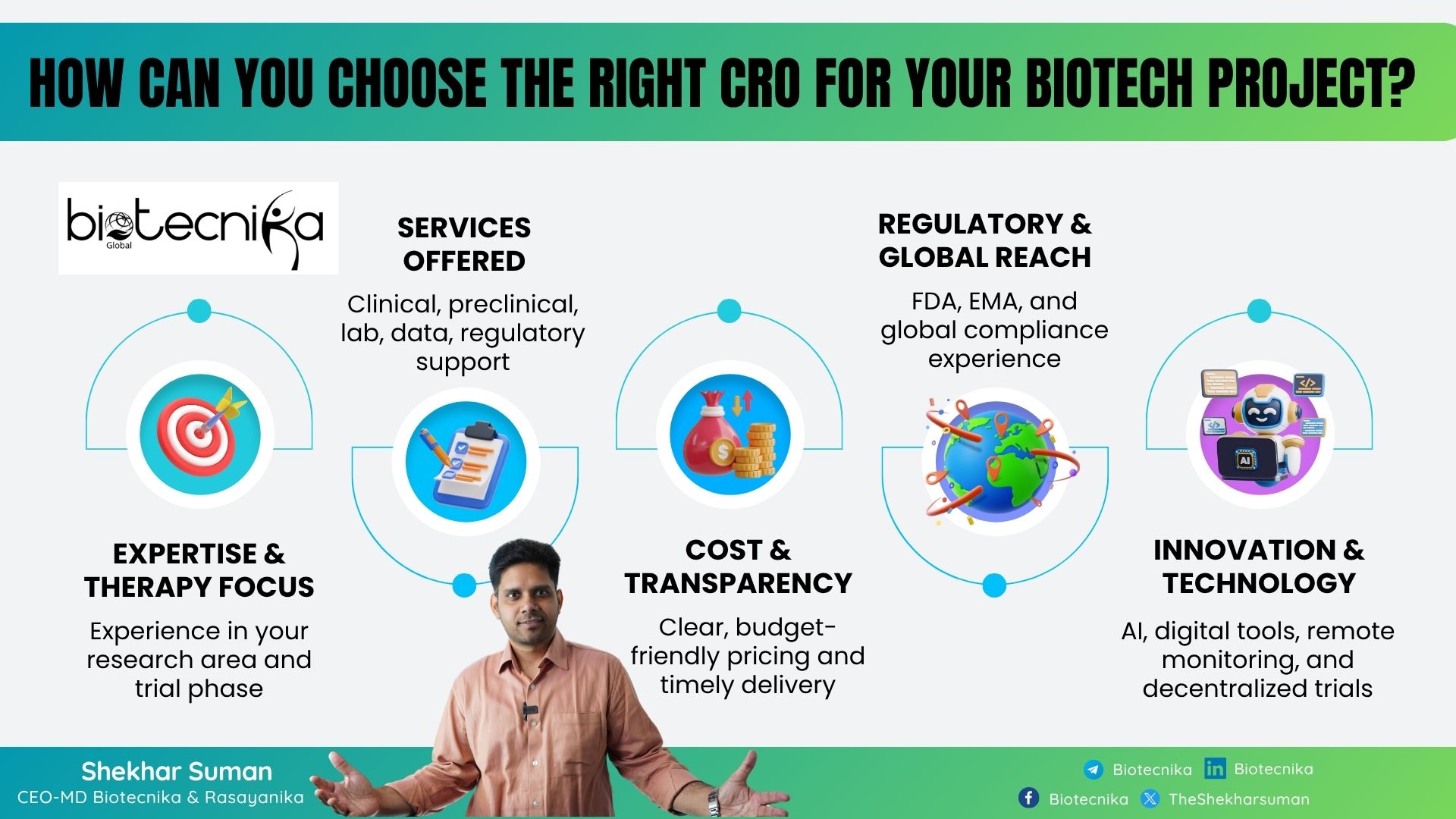
Your one decision can make or break your biotech project. To help you pick the right Contract Research Organisation, here is a simple guide:
-
Expertise & Therapy Focus:
While choosing the CRO, make sure they have the expertise in your research area and the trial phase.
-
Services They Offer:
Check if they offer everything you need, such as clinical trials, lab work, preclinical studies, data analysis, and regulatory support. It’s even better if they can grow with your project.
-
Cost & Transparency:
One of the most important things to keep in mind is clear pricing. Make sure the CRO you are selecting is budget-friendly and sticks to timelines.
-
Regulatory & Global Reach:
Look for CROs who have experience with regulatory bodies like the FDA, EMA, and others. If you want to go global, ensure your CRO handles global compliance.
-
Innovation & Technology:
The best CROs use modern technology. You can hire CROs who have expertise in AI, remote monitoring, digital trials platforms, and decentralized trials for faster and smarter research.
Choosing wisely means your biotech project runs smoothly, meets deadlines, and has a better chance of success.
What Does the Future Hold for CROs in Biotechnology?
You have seen how the CROs in Biotech are all set to grow and evolve into a strong build of the biotechnology industry. For young minds like you, this opens up new doors in both science and career development. Here are some key trends you must keep an eye out for in the future:
-
AI & Digitalisation:
With the advancing technology, there will be a lot of changes in trial design, patient recruitment, monitoring, and data analytics.
-
Advanced Therapy Modalities:
With the developments of therapies such as gene therapy, cell therapy, and RNA therapies, there is a demand for specialised CRO services.
-
Decentralised and Hybrid Trial Designs:
These will become common, driven by patient-centric models and global access.
-
Regulatory & Data complexity challenges:
With time, the challenges will increase, so CROs with strong data/regulatory chops will be in demand.
-
Opportunities and Challenges for Contract Research Organisation:
In the future, outsourcing demand will grow. Sponsors will demand more value, faster timelines, and lower cost. So, competition and consolidation in the CRO industry will continue.
Why Should Biotech Companies Partner with CROs?
Contract Research Organisations are more than just service providers. They are partners in innovations. They help biotech companies turn their ideas into reality, often faster and more efficiently than companies could on their own.
For young biotech graduates, Contract Research Organizations in USA are filled with exciting career opportunities in research, data analysis, regulatory affairs, and clinical operations. As the biotech industry grows, CROs will continue to play a key role in biotech innovations.
By learning about CROs now, you are not just understanding the industry. You are preparing to be part of its future. With dedication and curiosity, you can step into a career that will shape the next generation of medical breakthroughs.