


Building a Career in Space Biology in the United States
Maybe you have thought about what it would be like to live in space or how astronauts keep healthy during a long mission when you looked up at the stars at night? If the answer is YES, then you could be well-suited for a career in Space Biology. It is a branch of science (Biological Space) that deals with the study of how all living things can thrive in the environment of outer space. It includes the examination of living things above us, from very simple organisms, or microorganisms, up to humankind and how these living things would adapt to the many different types or extremes that would exist within an extraterrestrial environment.
As the United States is the worldwide leader in the exploration of outer space, many students and scientists can explore careers in Space Biology Research. The study of Space Biology is not limited to the health of astronauts but also aids in the development of our understanding of how life can exist in extreme environments. To summarise, Space Biology involves the study of life existing outside of Earth using the science of biology to assist with the development of solutions to questions concerning survival, adaptation and the potential for the existence of life elsewhere in the universe.
What Is Space Biology?
The study of living organisms in outer space, referred to as “Space Biology,” differs from Earth-based Biology in that the impact of microgravity, cosmic radiation, and limited resources on life is emphasized. Scientists conducting research in this area study how cells reproduce, how plants develop, how bacteria grow, and how the human body responds to living in outer space.
One example is that astronauts often lose muscle mass and have decreased bone density because of microgravity. The study of muscle loss and bone density reduction is done using Space Biology Research. In addition, when growing plants in outer space, the behaviour of the plants may differ from when they are grown on Earth. By studying these differences, scientists can prepare for future long-duration space missions and protect both humans and other organisms while aboard a spacecraft.
Why Choose a Career in Space Biology?
A career in Space Biology is exciting because it combines biology with space exploration. Unlike traditional biology careers, it allows you to work on real space missions or experiments that could impact the future of humanity.
The United States invests heavily in space research through NASA and other organizations. This means students have access to advanced labs, funding opportunities, and cutting-edge technology. Choosing this also opens doors to related fields like Astrobiology, Biological Space studies, and Biotechnology Research, giving you a wider career scope.
Educational Pathway to Space Biology
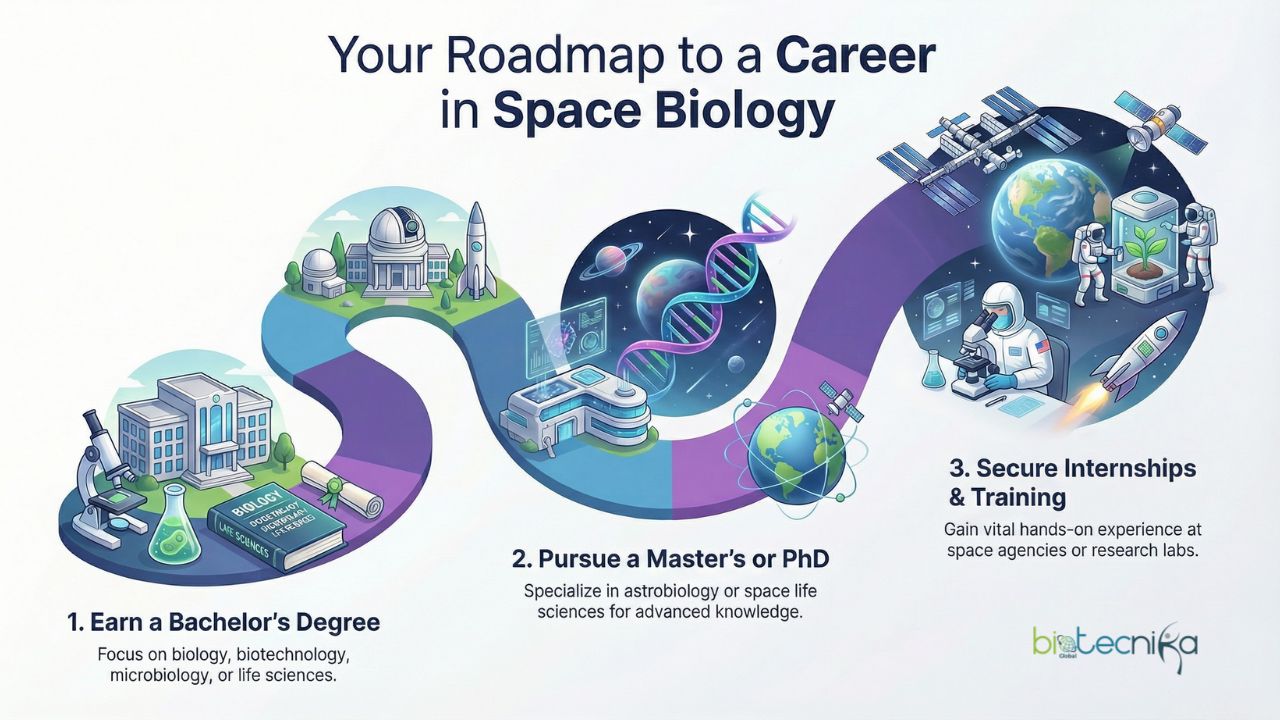
The journey to a career in Space Biology starts with education. Here’s a clear roadmap:
Bachelor’s Degree
Start with a bachelor’s degree in biology, biotechnology, microbiology, or life sciences. Focus on courses like genetics, molecular biology, physiology, and microbiology. These subjects provide a strong foundation for Space Biology Research.
Master’s Degree or PhD
After your bachelor’s, a master’s or a PhD is highly recommended. Advanced programs often specialize in Astrobiology, space life sciences, or molecular biology under space conditions. These programs offer hands-on experience in labs, internships, and even simulated space experiments.
Internships and Hands-On Training
Practical experience is vital. Look for internships in research labs, space agencies, or universities involved in Space Biology Research. This will help you learn lab techniques, experiment design, and how to work with space-related biological projects.
Skills Required for Space Biology Careers
To succeed in Space Biology, you need both technical and personal skills. Here are the key ones:
- Biology and Chemistry Knowledge: Understanding the basics of life sciences is crucial.
- Data Analysis: Learn to handle large datasets and analyze experimental results.
- Laboratory Skills: Work with cells, microbes, and plants in controlled conditions.
- Communication Skills: Be able to explain complex findings in simple terms.
- Teamwork: Most space missions require collaboration with engineers, doctors, and researchers.
- Curiosity and Patience: Experiments in space biology take time and sometimes fail, so persistence is key.
Knowing Biotechnology Research techniques is also important. This includes molecular biology, genetic engineering, and bioinformatics, which are increasingly used in Space Biology Research.
Research and Opportunities
Research is the heart of Space Biology. Students can get involved in:
- University Research Labs: Many universities in the U.S. have labs focused on Space Biology Research and Astrobiology.
- NASA Programs: NASA offers internships and fellowships for students interested in Biological Space studies.
- Biotechnology Research Projects: Some private companies conduct research on how biological systems behave in space conditions.
Through research, students learn how experiments are designed, monitored, and analyzed for space missions. Space Biology Research also teaches the importance of careful observation, critical thinking, and scientific reporting.
Career Options After Graduation
Graduates in Space Biology can explore multiple career paths:
- Research Scientist: Work in universities, government agencies, or private research organizations studying space life sciences.
- Laboratory Analyst: Focus on experiments related to Biological Space, analyzing data, and reporting findings.
- Space Agency Careers: Organizations like NASA hire scientists to design and monitor experiments for astronauts, space stations, and planetary missions.
- Astrobiology Specialist: Study the possibility of life on other planets and extreme environments.
- Biotechnology Researcher: Use space findings to improve biotechnology applications on Earth, like medicine, agriculture, and genetics.
- Science Educator or Communicator: Teach and inspire the next generation of Space Biology scientists through schools, universities, or public outreach programs.
Why the United States Is Ideal for Space Biology
The United States is considered the best place to pursue this field for several reasons:
- Advanced Research Centers: U.S. universities and labs offer state-of-the-art facilities for experiments in Biological Space.
- Funding Opportunities: NASA, NSF, and private organizations provide grants and scholarships for students.
- Collaborative Environment: Opportunities to work with international researchers on Space Biology Research projects.
- Access to Space Missions: Students may participate in actual space flight experiments or simulations.
- Growth Potential: With ongoing space exploration, career growth in this field is expected to rise.
The Future
Space biology has a bright future ahead! Scientists have been investigating how long-term space travel affects people’s health while they’re in microgravity, how we can create conditions that allow for life to exist on Mars and other planets, and much more.
As private companies like SpaceX and Blue Origin continue to expand their missions, there’s going to be a greater need for people to be trained in this field. This means that there will hopefully be more and more job opportunities in areas such as astrobiology, biotechnology, and space-based health research as we continue to venture further into space!
Tips for Students Interested
- Start Early: Take science and biology courses in school and college.
- Participate in Projects: Join science clubs or research projects related to Space Biology Research.
- Network: Attend conferences, webinars, and workshops. Connect with researchers in Biological Space studies.
- Stay Updated: Follow news about NASA, space missions, and Astrobiology research.
- Be Patient and Curious: Experiments take time, and the results may surprise you. The most successful scientists are persistent learners.
Conclusion
The field of “Space Biology” is extremely rewarding and exciting, and this career will allow you to study and search for life on other planets as well as do research related to space exploration and contribute to the success of future space missions. The United States has very good opportunities in this field, from education all the way through research to experiences in space.
If you are interested in the possibility of life beyond the Earth, like studying biology, and would like to make a positive impact on our planet and beyond, then pursuing a career in the field of “Space Biology” might be the right career path for you. Start studying, participate in research experiences, and prepare to take part in mankind’s exploration of the stars.