

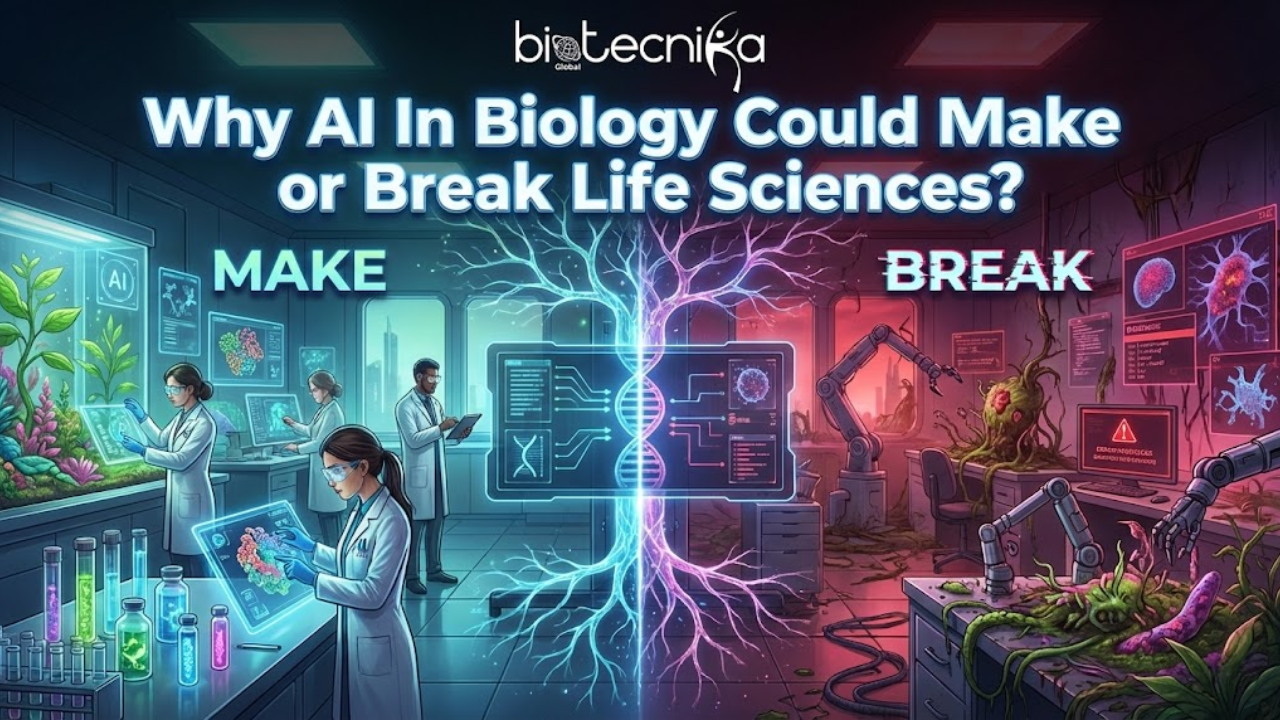
Why AI In Biology Could Make or Break Life Sciences?
Over the past few years, you must have seen the buzz created in the life science world by AI. Around the world, researchers and the public are discussing drug discovery, clinical trials, and automation. All these were possible due to the AI. In recent times, AI in Biology has become an important part of our lives. But do you know that in mid of all this AI hype, there is qa uestion in everyone’s mind. The question is, will AI really deliver in the future that we are waiting for?
In search of finding the answer to this question, the president of regulated industries at Salesforce, Mark Sullivan, recently spoke on The Top Line. In this podcast, he highlighted how AI hype is slowly fading away. He further explained this complex topic by mentioning how the industry is moving to a more practical stage. He said that the industry is divided into two major groups. Group one has done the hard work. They work on fixing data, building governance models, and setting up rules for AI usage. On the other hand, the second group is still testing pilots that look exciting but are struggling to grow.
This difference between the two groups is not because of the difference in ambition. This is due to the difference in the execution process of these companies.
Humans have a fear of AI agents replacing them. But in the talk, Mr. Sullivan explained that AI agents will not replace human beings. They are just the tools that are helping us to improve work and create a better future for the upcoming generation. Just like how laptops and smartphones have become basic skills, even AI will become a basic skill in the next few years.
He emphasised the importance of AI in research, manufacturing, and commercialization. He said that the teams working with the AI are faster. They are making smarter decisions and handling challenges very effectively.
Trust is critical. In life sciences, mistakes can cost lives. AI agents only work when they are built on good data and clear rules. This is challenging because about 80 percent of the industry’s data is unstructured. Trying to use AI often uncovers hidden problems in data and systems. Companies that fix these issues can save time, grow faster, and improve patient engagement.
The best results go beyond cutting costs. AI agents can help with patient engagement, clinical trial matching, and business processes. They can also help teams innovate faster and build stronger relationships with patients.
For life sciences leaders, the message is clear. Don’t chase flashy AI pilots that don’t scale. Focus on building strong foundations. Moving beyond AI hype means making AI work in the real world and turning it into a real advantage.