


AI Tools and Platforms Powering Cancer Genomics Worldwide
Imagine that there is a tiny map in your hands. It is not a normal map that has routes to places. It is composed of the building blocks of life – DNA. How fascinating it is that this complex block inside every cell of your body has the code for everything that makes you! Now, imagine something chaotic. Some routes are broken, symbols are unclear, and directions don’t make sense. That’s what the genetic landscape of cancer looks like.
Researchers and doctors are trying to identify how genetic alterations cause cancer cells to multiply and grow without control. It was like trying to find a needle in a haystack of genetic information. But now, a powerful tool is helping them. It is the Artificial intelligence. AI could be one of the most promising tools that transform cancer research and treatment.
Cancer genomics is the field that studies the complete set of genetic information in cancer cells. This would generate a huge amount of data. The genetic profile of each patient’s tumor is unique. Understanding the genetic differences among tumor cells is important for designing personalized treatments. However, analyzing and interpreting this complex information manually is not easy. This is where AI tools are used for cancer genomics. These are like super-powered detectives. They analyze mountains and heaps of genetic information, identify patterns, and find results that would take humans lifetimes to discover.
Computational Oncology Platforms and Genomic Analysis
To harness the power of AI in cancer research, scientists need more than just basic algorithms. Genomic sequencing of cancer cells will generate massive datasets. These comprehensive AI systems are required to manage, analyze, and interpret cancer cell genomes. This could be done using computational oncology platforms. They are the software that combine number of tools and algorithms. Researchers can analyze genomic data more deeply with this software.
Imagine that these computational oncology platforms are massive digital laboratories. These platforms enable researchers to store data, run complex experiments, and analyze results following genomic analysis of cancer cells. With the help of these platforms, Cancer genome analysis becomes faster and more accurate. Scientists can identify specific gene alterations associated with different types of cancer. These platforms help them to track how sudden changes in genes occur over time. Also, they can predict how a patient might respond to particular treatments by applying AI to genome analysis.
Bioinformatics Tools for Cancer Research
Bioinformatics Tools serve as the engine driving AI tools for cancer genomic research analysis. These tools clean up genomic data, identify mutations, and compare the genetic information across different types of cancer cells.
Imagine that these Bioinformatics tools for cancer research as a toolkit packed with powerful and specialized implements. Some tools are like high-resolution microscopes that allow researchers to magnify individual genes. Some organize huge amounts of data. Researchers can gain more knowledge into the molecular mechanisms that drive cancer by combining these tools.
AI Tools for Cancer Genomics and Their Functions
|
AI Tool Category |
Example Tools |
Functions |
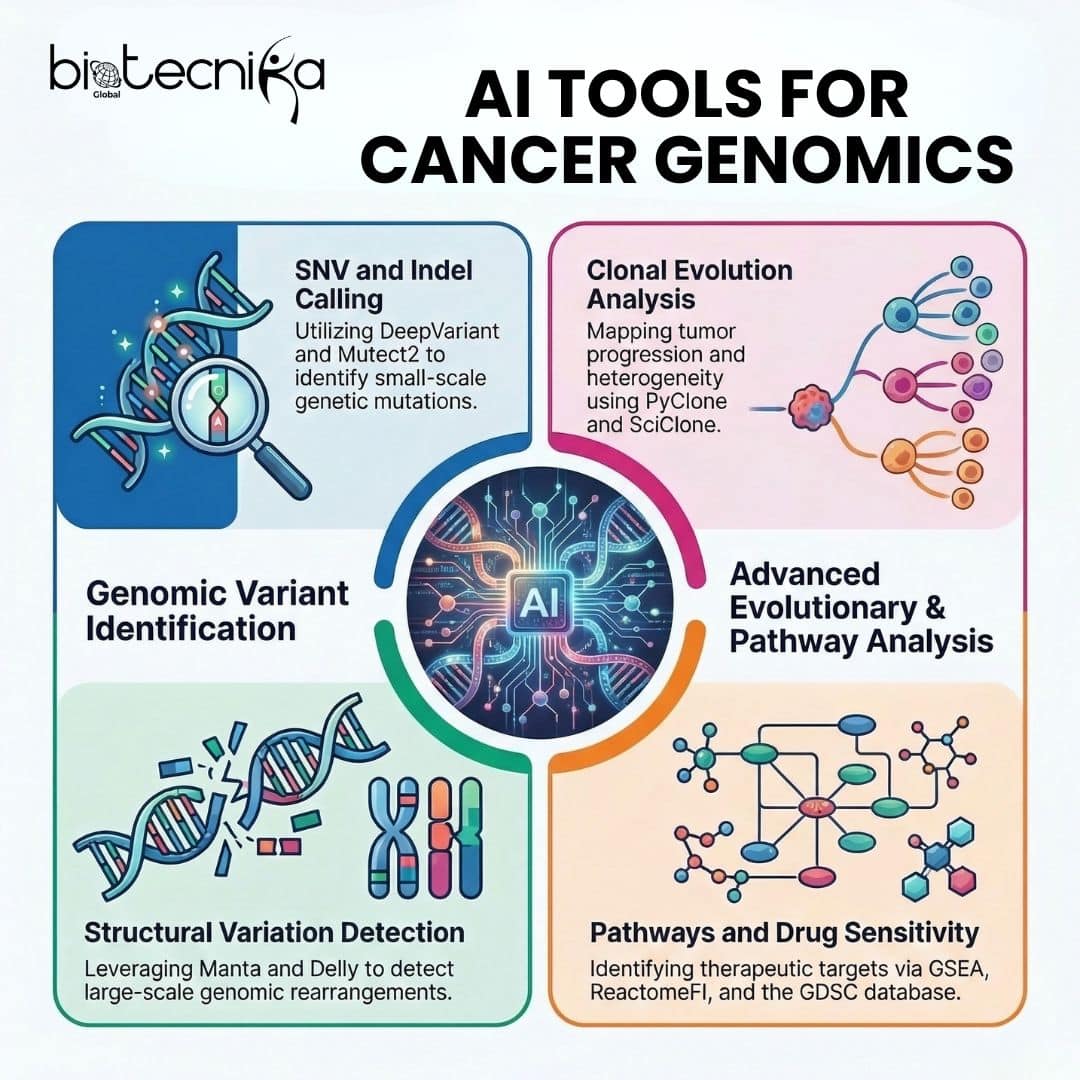
| Variant Calling | DeepVariant, Mutect2 | Identifying single-nucleotide variants and small insertions/deletions from sequencing data. |
| Structural Variant Detection | Manta, Delly | Detecting large-scale genomic rearrangements, such as deletions, duplications, inversions, and translocations. |
| Tumor Purity and Subclonality Estimation | PyClone, SciClone | Determining the proportion of cancer cells in a sample and identifying different sub-populations of cancer cells. |
| Pathway Analysis | GSEA, ReactomeFI | Identifying biological pathways and networks that are enriched for mutated genes in a cancer sample. |
| Drug Sensitivity Prediction | GDSC, CCLE | Using genomic and transcriptomic data to predict the response of cancer cells to specific drugs. |
Clinical Impact of AI
The ultimate goal of AI tools used in cancer genomics research is to improve patient outcomes. Analysis of a patient’s cancer genetic profile using AI helps doctors to make more informed decisions about diagnosis and treatment. This approach is known as Precision Oncology. This holds great promise for developing therapies according to each individual’s specific needs.
AI can help pathologists to identify earlier signs of cancer that might be missed by the naked eye. AI algorithms can analyze digital slides of tissue samples. This helps to identify the potential areas of concern and improve the accuracy of cancer diagnosis. Moreover, AI tools for cancer genomics can help identify biomarkers that indicate risk of disease progression or response to a particular therapy by analyzing patients’ genomic data.
A Global Endeavor: The Power of Collaboration
Cancer is one of the major global challenges. The fight against it requires a global response. AI tools are being developed and used for cancer genomic studies in many research institutions and hospitals around the world. International collaborations are more important for data sharing, resource collection, and advancing progress in cancer research.
Massive databases of cancer genomic data have been created by some projects, such as The Cancer Genome Atlas (TCGA) and the International Cancer Genome Consortium (ICGC). These are freely available to researchers worldwide. These are important for developing and validating AI models. And they also help in gaining a deeper understanding of genetic diversity in cancer across different populations.
Computational Oncology Platforms and Their Features
|
Platform |
Features |
Target Audience |
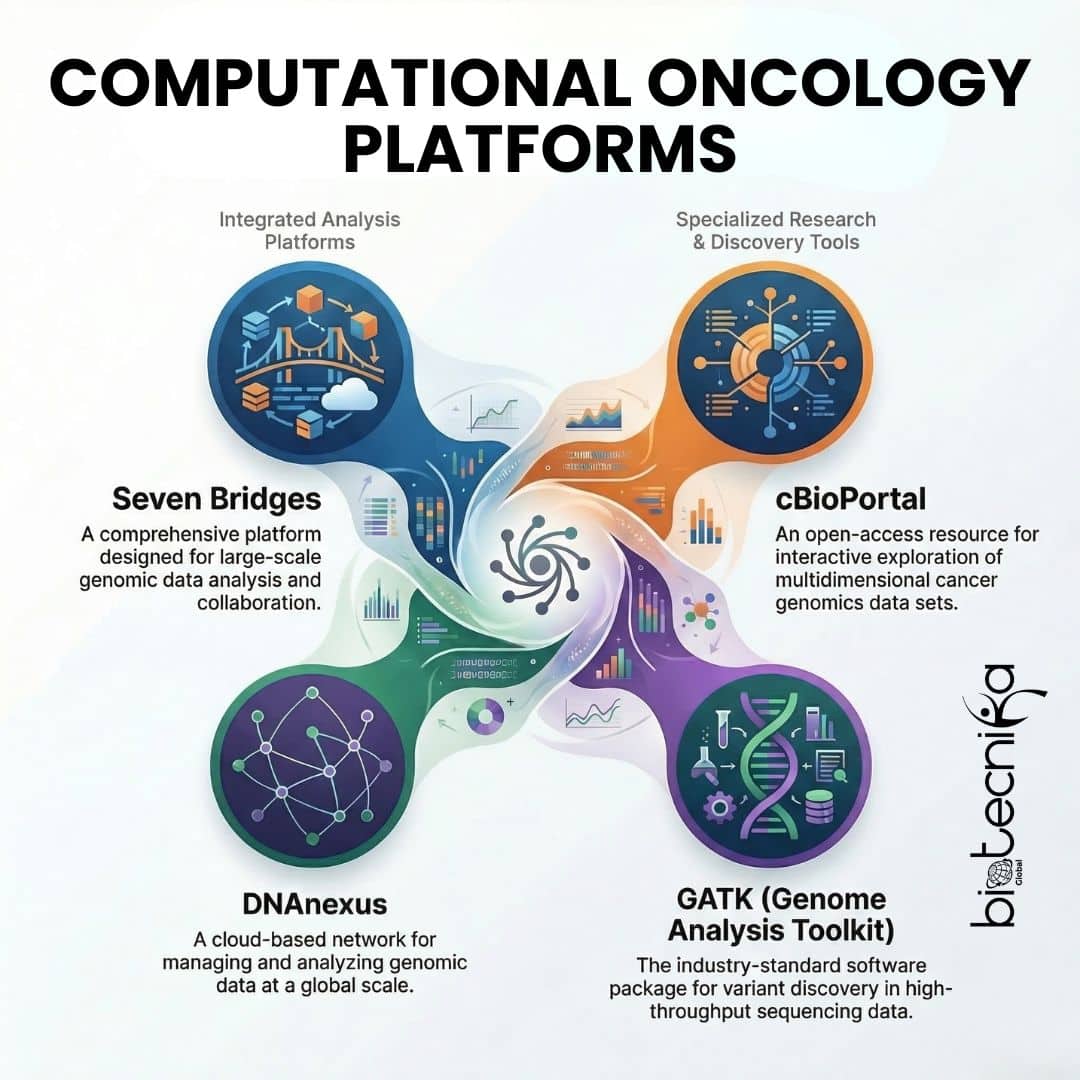
| Seven Bridges | Secure cloud-based platform, massive dataset accessibility, and workflow automation tools. | Researchers, pharmaceutical companies, and healthcare institutions. |
| DNAnexus | Secure cloud-based platform, compliant with regulatory standards, tools for data analysis and collaboration. | Biomedical researchers, diagnostic labs, and pharmaceutical companies. |
| cBioPortal | User-friendly web-based interface for exploring, visualizing, and analyzing cancer genomics data. | Cancer researchers, clinicians, and computational biologists. |
| GATK (Genome Analysis Toolkit) | Industry-standard suite of software tools for analyzing next-generation sequencing data. | Bioinformatics specialists and researchers. |
The Future of Cancer Genomics
The use of AI tools for cancer genomics and clinical research is still in its early stages. There will be more AI algorithms that can analyze biological data, from DNA Sequences to Protein Interactions. There will be Agentic AI developed to interpret the cancer genomes more accurately. We can also see more seamless integration between computational oncology platforms and clinical decision support systems. This will help the doctors to make personalized treatment recommendations.
However, some challenges will arise. Data Privacy and Security issues should be handled and managed carefully. The genomic data should be high-quality and standardized. The new generation of researchers and clinicians should also be trained in both biology and computer science.
Conclusion
Scientists and researchers are not the only people to use AI tools for cancer genomics research. They are the beacons of hope for cancer patients around the world. The diagnoses will be more accurate, more effective. There will be a future where cancer is no longer a life-threatening disease for sure. All of these would be possible by leveraging AI to decode the genetic language of cancer.
The journey has just begun, and the potential to unlock the secrets of cancer and transform the lives of millions is within our grasp!



I like this web site so much, saved to fav. “Nostalgia isn’t what it used to be.” by Peter De Vries.