


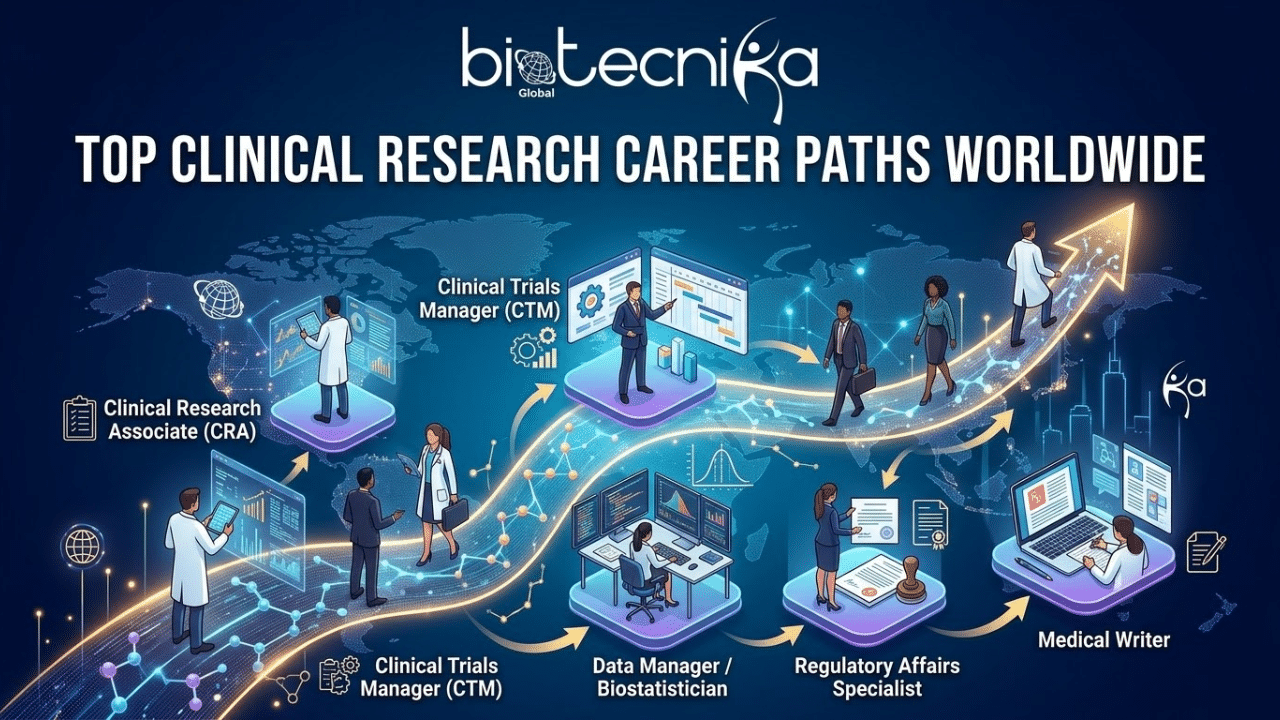
Top Clinical Research Career Paths Worldwide
Hey Young Minds! Did the job market overwhelm you? Even after so many career options around, you are still confused? Today, let’s talk about a career pathway that has gained significant attention in recent years. Clinical research has become the backbone of modern medicine. Every vaccine, cancer therapy, and medical test that reaches us goes through a structured process. With the rapidly growing healthcare sector, clinical research careers have become the most stable and rewarding career paths in the life science industry.
Today, this field is not limited to just a few countries. The trials are conducted around the world. Due to which you can find thousands of clinical research job opportunities.
To help you in building a promising career in clinical research, here we are with a deep and practical guide. You will gain insights about the trending clinical research jobs, salaries offered, and skills you need to excel in them. So, without any delay, let’s dive into this emerging field.
What Is Clinical Research and Why Is It So Important?
To build a successful career, we first need to strengthen our foundation. Let’s understand what clinical research really is. In simple words, it’s a scientific process of evaluating the safety, effectiveness, and efficiency of medical innovations. These can be drugs, vaccines, medical devices, or treatment procedures.
Here are some reasons that make clinical research important:
- With the laboratory results and animal testing, we can’t predict the human responses
- The regulatory agencies need human data for the approval of medical products
- Our safety depends on controlled and ethical testing
- With high-quality clinical data, medical relies improve
Every clinical research study follows clear and strict global standards. Some of them are ICH-GCP (International Council for Harmonisation – Good Clinical Practice). The international regulatory agencies, such as the FDA, EMA, MHRA, and WHO, oversee trials to ensure they are compliant with ethical conduct, data integrity, and patient protection. With this strong regulatory environment, clinical research jobs are the most in-demand career.
Top Clinical Research Career Paths Worldwide
Now, let’s look at some of the top clinical research career paths across the world that you can follow.
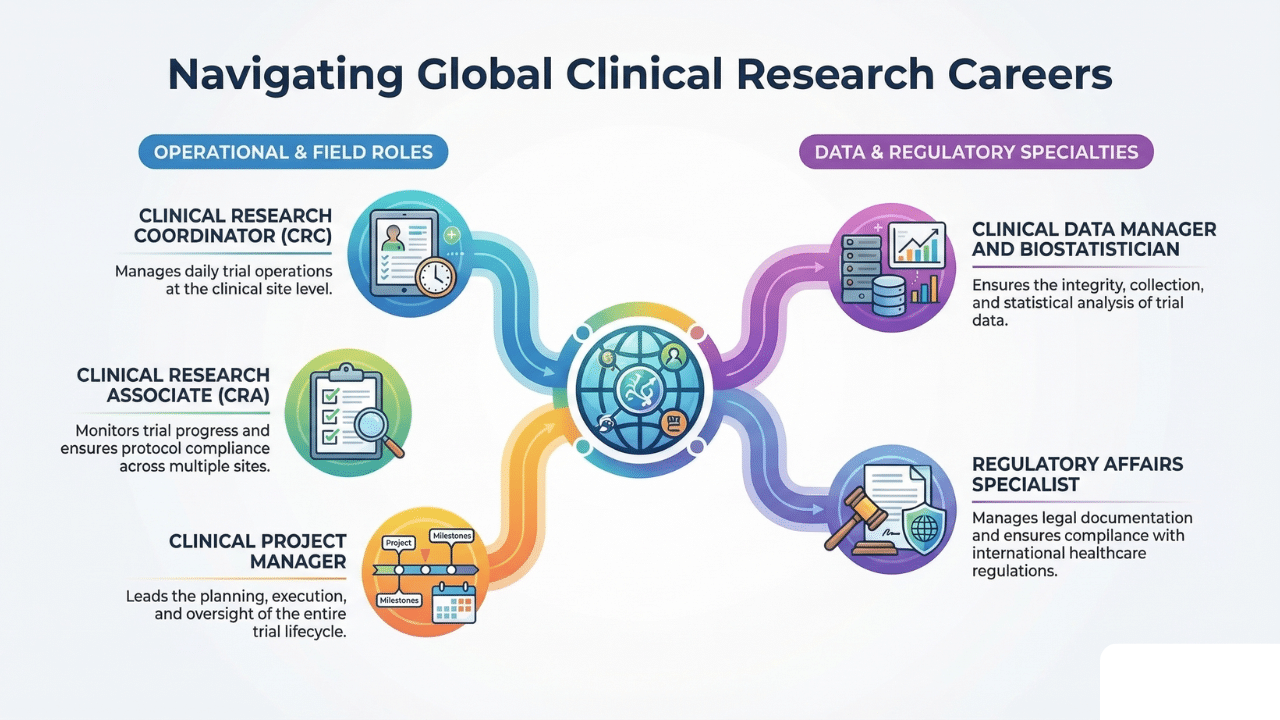
Clinical Research Coordinator (CRC)
In the clinical trial process, the first point of contact for patients participating is the Clinical Research Coordinator. In this role, you will have to work closely with people. You will be working in hospitals, clinics, or research centers.
What does a CRC actually do?
CRC is the one who manages everyday trial activities at the research site. They screen patients, coordinate study visits, and maintain regulatory documents. They make sure that the study follows the approved protocol.
Why does this role matter?
Without them, the clinical trials will not function well at the site level. They make sure patients are safe. They collect accurate data and become a bridge between investigators and sponsors.
What skills do you need?
- A good understanding of Good Clinical Practice
- You should communicate with the patient and also have ethical awareness
- You must have strong documentation and organizational skills
Clinical research salaries (approximate):
- United States: USD 55,000 to 75,000
- United Kingdom: GBP 30,000 to 45,000
- India: INR 4 to 7 LPA
- Australia: AUD 70,000 to 90,000
Clinical Research Associate (CRA)
The most famous and in-demand clinical research role is Clinical Research Associate across the world. You can find several CRA roles offered in the biotech and pharma companies. It is a fast career growth and international exposure.
What does a CRA do?
They monitor clinical trial sites on behalf of sponsors or CROs. As a CRA professional, you will ensure studies are conducted in accordance with protocols, regulations, and ethical standards. Along with it, you will have to review patient data, verify source documents, train site staff, and identify risks. They make sure no issues arise during audits or inspections.
Why CRAs are critical:
They are quality guardians. Regulatory agencies rely on CRA for trial data during product approval.
Essential clinical research skills:
- You need strong knowledge of ICH-GCP and regulations
- Learn risk-based monitoring techniques
- Have analytical thinking and problem-solving skills
- Build communication and relationship management
Clinical research salaries:
- United States: USD 75,000 to 120,000
- Europe: EUR 50,000 to 85,000
- Asia Pacific: Rapidly increasing with experience
Clinical Project Manager
Later in your career, you can be a Clinical Project Manager. They oversee entire clinical trials from planning to close-out. This role is suitable for experienced CRAs or clinical operations professionals.
What does a Clinical Project Manager do?
As a manager, you will have to manage timelines, budgets, cross-functional teams, and more. You have to make sure that milestones are met. Also, control risk throughout the project.
Why is this role strategic?
They connect science, operations, and business goals. Without them the project management can be poor due to which there can be a delay in drug approval for years.
Key clinical research skills needed:
- You must have Leadership and decision-making
- You should be good at Budgeting and forecasting
- Have stakeholder communication
- Be knowledgeable in regulatory and operational expertise
Clinical research salaries:
- United States: USD 100,000 to 150,000
- Europe: EUR 80,000 to 120,000
- Middle East: High expatriate demand
Clinical Data Manager and Biostatistician
As we know, a large amount of data is generated during clinical trials. Data managers and biostatisticians ensure that the data are accurate, complete, and reliable.
What do they do?
- They design and maintain clinical databases
- They perform data validation and cleaning
- They also analyze study outcomes
- Support regulatory submissions and publications
Why is this role important?
The decisions are taken based on the data. And a small error in data can lead to complete trial failure or rejection. Data managers make sure this does not happen.
Clinical research skills required:
- You should have Knowledge of EDC systems and CDISC standards
- Have a sharp statistical and analytical expertise
- Pay Attention to detail
Clinical research salaries:
- United States: USD 85,000 to 130,000
- Europe: EUR 60,000 to 100,000
- Asia: Strong growth and outsourcing demand
Regulatory Affairs Specialist
Another top clinical research career path is Regulatory Affairs, specialist. They make sure that clinical research complies with national and international regulations. Even successful trials can fail if regulatory requirements are not met.
What does this role involve?
- Preparing regulatory submissions
- Communicating with health authorities
- Interpreting evolving guidelines
- Supporting inspections and approvals
Clinical research skills required:
- You need regulatory knowledge and technical writing
- Pay attention to detail
- You must have strategic thinking
Clinical research salaries:
- United States: USD 90,000 to 140,000
- Europe: EUR 70,000 to 110,000
Key Clinical Research Skills Needed Across All Roles
Irrespective of the job role, to build a successful career, you need the right clinical research skill set. Let’s take a look at them.
Technical skills:
- Good Clinical Practice: Most of your work will be in clinical settings, so it is essential to have strong clinical skills.
- Regulatory compliance: You need a clear understanding of regulatory guidelines worldwide.
- Clinical trial systems and documentation: As a part of your job role, you should learn about clinical trials and how to document them.
- Risk management: In this field, the risk factor is high, and you should learn to manage it.
Soft skills:
- Clear communication: You should be able to clearly communicate your ideas and thoughts as you will be working with other teams.
- Ethical judgment: You must be able to distinguish between what is ethically right.
- Team collaboration: You should be able to collaborate with other team members and work as a team.
- Time and priority management
Certifications from ACRP, SOCRA, BIOTECNIKA, and DIA strengthen credibility and career prospects.
Clinical Research Salaries by Role and Region
|
Clinical Research Role |
North America (USD) |
Europe (EUR) |
Asia Pacific |
|
Clinical Research Coordinator |
49K-76K |
30K-48K |
Entry to mid-level |
|
Clinical Research Associate |
46K-115K |
45K-75K |
High demand |
|
Clinical Project Manager |
104K-131K |
45K-80K |
Growing |
|
Data Manager / Biostatistician |
59K-116K |
29K-96K |
Strong outsourcing |
| Regulatory Affairs Specialist |
42K-126K |
49K-53K |
Competitive |
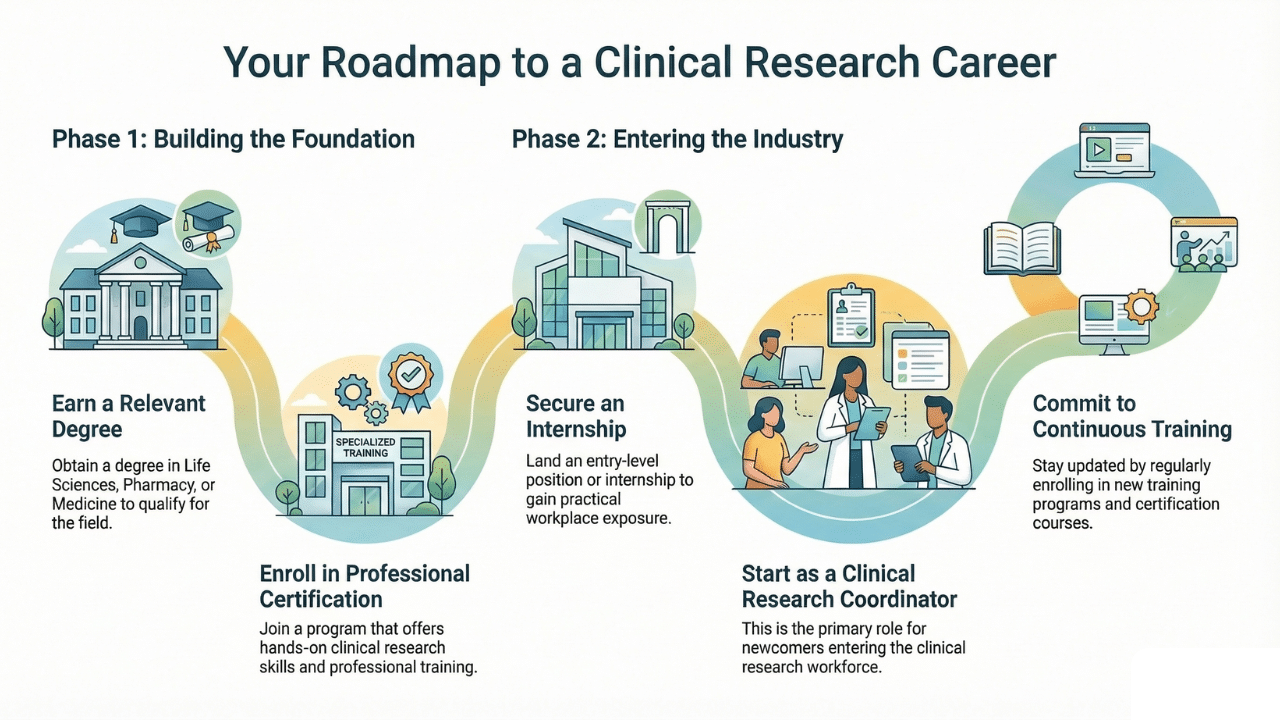
How to Start a Career in Clinical Research?
To build a career in this field, you can follow this roadmap:
- Earn yourself a life science degree. If you are a Pharmacy or medical student, you too have a chance.
- Enroll in a professional clinical research certification program. Learn the skills hands-on.
- Land an internship or entry-level position. If you are confused about where to find them, then don’t worry, just follow Biotecnika Global.
- Keep yourself updated with the training programs and certification courses.
As a fresher, you can start your career as a Clinical Research Coordinator.
Conclusion
Clinical research is one of the most promising and rewarding career paths today. It demands professionals who want to combine science, ethics, and global impact. With the impactful roles, competitive salaries, and continuous innovation, you can build the career that the world needs. So, what are you waiting for? Take your first today.