


Till now, the world has seen the industrial revolution powered by machines. But with the advancing technology, now the next revolution might be led by tiny microbes. Yes, you read it right. In today’s modern world, industrial biotechnology is changing the world with its innovations. Sustainable fuels now fuel the powerful engine.
Over the past few years, the world’s carbon footprint has increased. And biotech is emerging as the most reliable and promising sustainable solution to solve this problem. This field holds the power of redefining manufacturing. It can grow the economy and change the way we live.
But do you know how far we have come? What does the future hold for everyone? Let’s understand Industrial biotechnology. We will also look at the future of industrial biotechnology in the US. So, let’s begin our journey.
What Is Industrial Biotechnology?
Let’s start by understanding what industrial biotechnology really means. Well, in simple terms, it’s the use of living organisms or a biological tool to make industrial products. These can be microorganisms and enzymes. Today, companies are replacing oil and gas with renewable resources to ensure a better future.
The primary focus of industrial biotechnology is the manufacturing of products. Some of the common products are biofuels, bioplastics, industrial enzymes, and specialty chemicals. These products are often cleaner. They use less energy than the traditional chemical processes.
According to the US Department of Energy, the biobased production will help us in lowering greenhouse gas emissions. It will also reduce the environmental damage that we have caused. Due to these benefits, Industrial Biotechnology plays an important role in building a sustainable and low-carbon economy.
Current State of Industrial Biotechnology in the US
Do you know if the United States has a strong and growing industrial biotechnology sector? Every year, this sector offers thousands of job opportunities. Along with the exciting career opportunities, it adds billions of dollars to the US economy.
With the advancing technologies and innovations in biotechnology, the country has many biotech hubs. These innovative hubs include Boston, San Francisco, San Diego, and parts of the Midwest.
These are not just hubs for innovation but also have top-notch universities and research institutes. They are even ideal for biotech startups and large corporations. The biotech research teams in the US collaborate with each other to formulate and scale innovative biotech solutions for the global population. The US government organizations, such as the National Science Foundation (NSF) and the Department of Energy (DOE), assist and enhance the biotechnology industry.
Currently, the US is focusing on renewable chemicals, bio-based materials, industrial enzymes, and biofuels. The recent report from the Biotechnology Innovation Organization (BIO) states that investment is steadily increasing, especially in synthetic biology and biomanufacturing. With such a strong ecosystem, the US leads the global biotechnology market.
Key Drivers Shaping Industrial Biotechnology
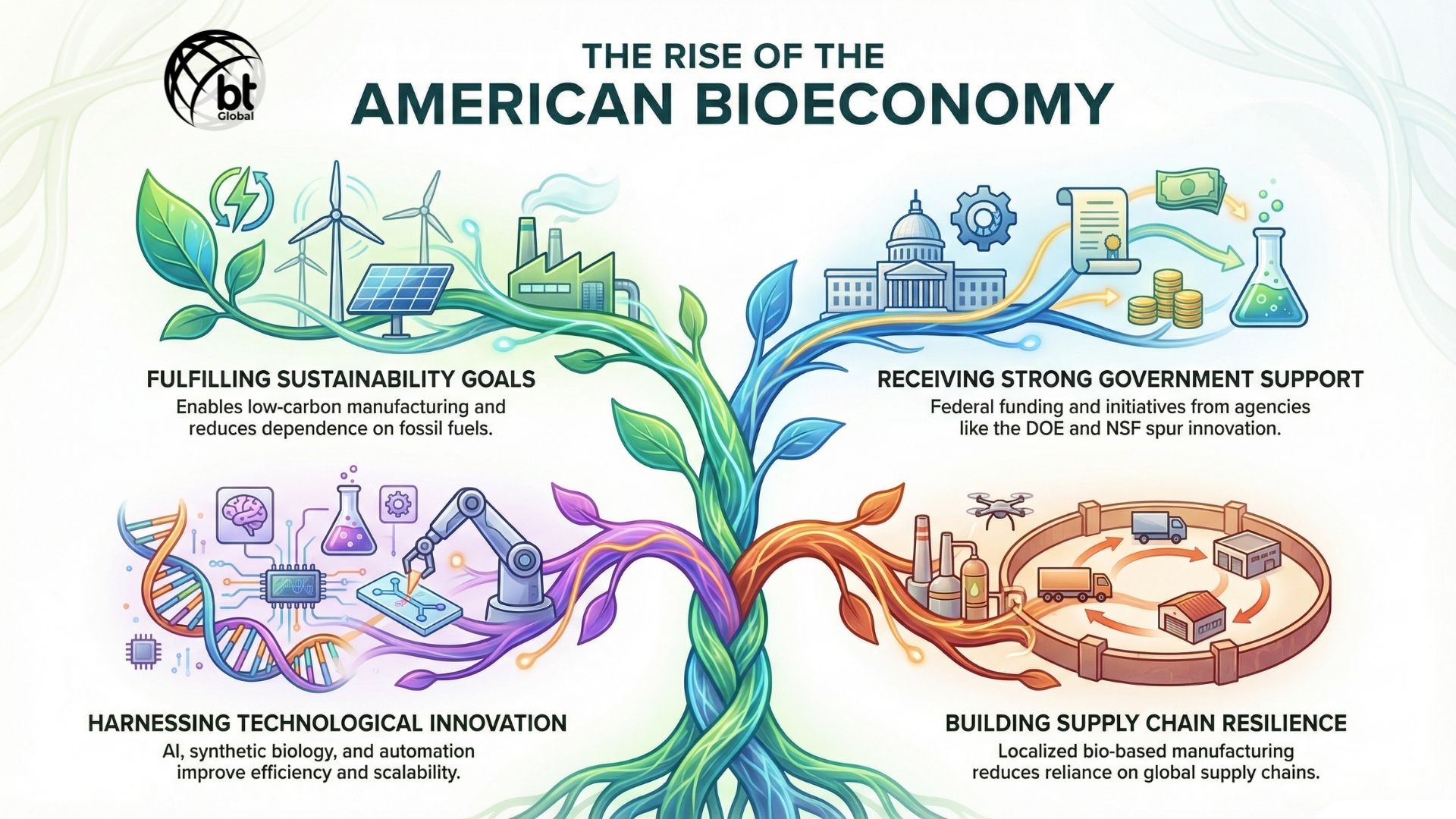
If you look at the driving force behind this booming industry, there are many. For your ease of understanding, we have listed a few of these factors below. Take a look:
| Factor | Summary | Impact on Industrial Biotechnology |
| Sustainability Goals | Industrial biotechnology supports low-carbon, renewable manufacturing. | Reduces emissions and fossil-fuel dependence. |
| Government Support | US policies and funding (DOE, NSF, Bioeconomy initiatives) accelerate innovation. | Strengthens domestic biomanufacturing and commercialization. |
| Technological Innovation | AI, synthetic biology, and automation improve efficiency and scalability. | Expands Industrial Biotechnology scope and lowers production costs. |
| Supply Chain Resilience | Bio-based manufacturing enables localized production. | Improves supply security and industrial independence. |
Industrial Biotechnology Scope
With the substantial investments and strategic planning, the US is leading in the biotech race. The Industrial Biotechnology scope is now expanding into many new areas like never before. You can take a look at these new and exciting areas of Industrial Biotechnology. They include:
- Sustainable Aviation Fuel (SAF):
Do you know that air travel produces a lot of carbon emissions? To solve this problem, we can use SAF as a cleaner alternative. Along with it, bio-based fuels are one of the best ways to reduce these emissions. With this innovative technology, the US Department of Energy is working with its airlines and fuel producers to support SAF development
2. Carbon Capture and Utilization (CCU):
Inside the labs, our scientists are designing microbes that can convert carbon dioxide and other industrial pollutants into useful products. With this method, we can now reduce pollution. Not only can we create economic value from what would otherwise be waste.
3. Bioplastics and Bio-based Polymers:
Our traditional plastics rely on petroleum. But not anymore. With bio-based alternatives, the world is changing. These materials are biodegradable. This will help us cut down on plastic and reduce the pollution caused by it. Across the US, many niotech companies are now investing heavily in these sustainable options for everyday products.
4. Food Industry Innovations:
Not only the Aviation and environment, but this industry is also changing our way of producing food. It is producing alternatives to proteins, enzymes, and functional ingredients. These innovations are promoting a circular economy. Yes, now we can reuse waste wisely. With that, we can use our resources more efficiently.
Role of Synthetic Biology
Synthetic biology is a powerful tool within Industrial Biotechnology. It allows scientists to design and control biological systems more precisely. With synthetic biology, microbes can be programmed to produce specific chemicals, fuels, or materials.
Advanced biomanufacturing methods are also improving production. Continuous fermentation, automated systems, and digital tools help lower costs and improve quality. These advances make it easier to scale production from the lab to the factory.
Public-private partnerships are quite important in this domain. National laboratories, research institutions, start-ups, and corporations usually have joint ventures. Training of the workforce is also essential. There should be people with expertise in biology, engineering, data, and manufacturing. NSF and DOE support initiatives have contributed to training the workforce for the future.
Challenges in Industrial Biotechnology
| Challenge | Description | Impact on Industrial Biotechnology |
| High Capital Costs & Scale-Up Risks | Commercial-scale biomanufacturing facilities require large investments and long development timelines. | Slows commercialization, especially for startups moving beyond pilot scale. |
| Regulatory Complexity | Multiple U.S. agencies oversee bio-based products, creating lengthy approval processes. | Delays innovation and market entry for novel technologies. |
| Competition from Petrochemicals | Low-cost, fossil-based alternatives remain economically competitive when oil prices are low. | Puts pressure on pricing and profit margins of bio-based products. |
| Infrastructure Limitations | Limited access to feedstocks, bioprocessing facilities, and logistics infrastructure. | Constrains scaling and geographic expansion. |
| Public Perception & Awareness | Limited understanding of biotechnology and sustainability benefits. | Affects market adoption and policy support; requires transparent communication (OECD). |
Global Industrial Biotechnology Landscape
Across the world, industrial biotechnology is booming. In Europe, the bio-based products are supported by strong policies. In Asia, we see a rapid increase in production capacity.
At the same time, the US is leading this race with its research, innovation, and startups. Additionally, the advanced technologies and expertise have a strong role in making the US a global leader. To stay ahead of others, the US is investing in science, infrastructure, and talent.
But we have to remember that to get the best out of this field, we have to work together. The international collaboration plays an important role. The countries have to come together to build a better global future.
Future Outlook
The future of Industrial Biotechnology in the United States looks promising. Over the next few years, we can expect it to become an important part of the US economy. With biotechnology, AI, and other advancing technologies, there will be many more opportunities.
As industries focus more on sustainability, bio-based manufacturing will become more common. With continued government support, private investment, and scientific progress, we will help reduce emissions and strengthen the economy. We will have global sustainability.
For the global life science community, Industrial Biotechnology is not just a trend. It is a long-term solution for building a cleaner, more resilient industrial future.