


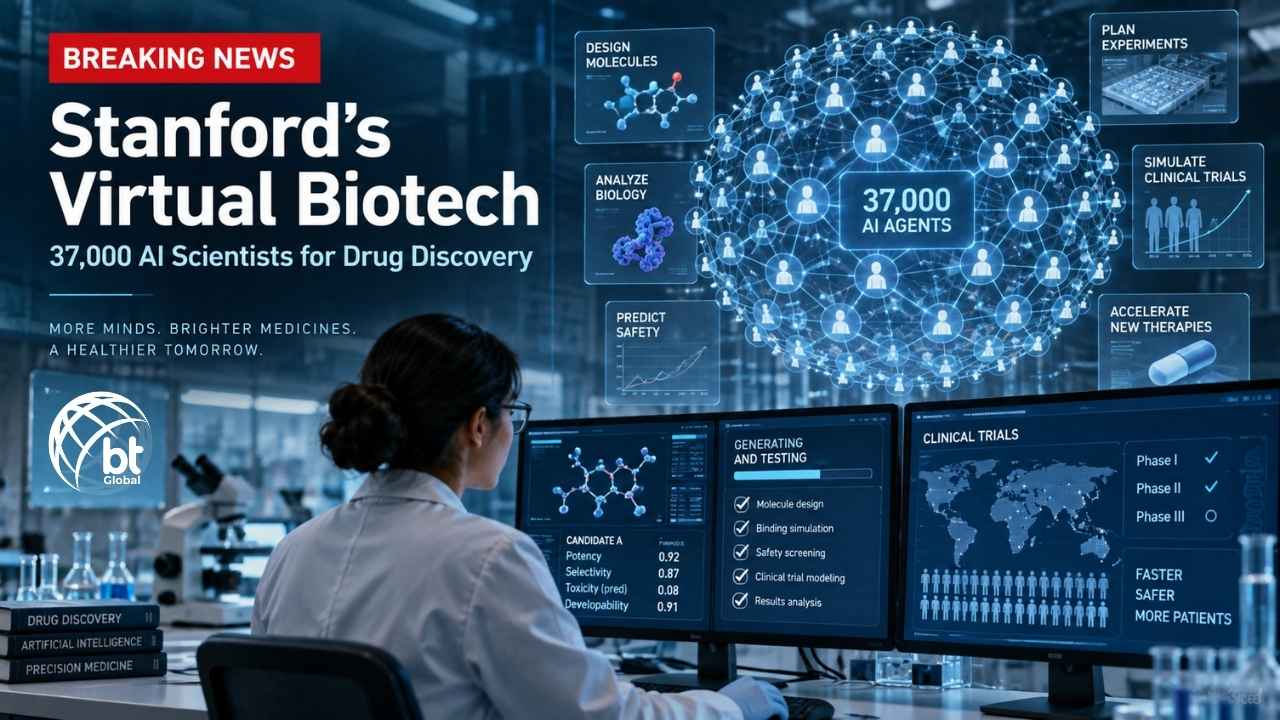
What if a biotech company could have hired more than 37,000 scientists overnight and not a single one of them was human? That is almost what researchers at Stanford have built. They have created something that sounds almost like science fiction. They have created a system called Virtual Biotech. Stanford Virtual Biotech is made up of thousands of artificial intelligence agents that can work together on different parts of drug discovery, from analysing clinical trials to identifying possible treatment strategies.
This work was led by Stanford researcher James Zhu and a graduate student, Harrison Zhang, along with their colleagues. This study was published on September 17, 2026, in the journal Science.
How Does Stanford Virtual Biotech Work?
The system, virtual biotech, is designed to work like a biotechnology research organization where different AI agents are assigned different scientific tasks instead of relying on a single AI model to handle everything.
There is a central AI agent described as a virtual chief scientific officer, which breaks a research problem into smaller questions and directs specialized agents to work on them.
More Than 37,000 AI Agents Analyse 55,984 Clinical Trials
This is one of the largest demonstrations that involved an analysis of 55,984 clinical trials with more than 37,000 AI agents working across the dataset. The researchers said that the system was able to process this large amount of information in less than a week.
The analysis produced several findings related to how drug targets may affect clinical success.
According to this study, drugs targeting genes that are more specific to certain cell types were 40% more likely to move from Phase 1 to Phase 2 trials. These drugs were also 48% more likely to eventually reach the market and were linked to 32% fewer adverse events compared with drugs acting on genes that are active across a wide range of cells.
Stanford Virtual Biotech’s AI Identifies a Possible Lung Cancer Treatment Strategy
The researchers also tested whether the system could move beyond analyzing existing trial data and generate possible drug development ideas.
And for this, Stanford Virtual Biotech examined B7-H3, also known as CD276, a protein being studied as a target in lung cancer. After analyzing biological and clinical information, the system proposed targeting B7-H3 with an antibody drug conjugate (ADC).
ADC is combined with a cancer-killing drug, allowing the treatment to target certain cancer cells more directly.
The researchers used information from January 2025 for this analysis. Several months later, in August 2025, a pharmaceutical company independently advanced a similar B7-H3 ADC approach. Zou said “This was really exciting as an independent, third-party validation that’s consistent with the effects and the design proposed by the virtual biotech”.
The treatment later received FDA breakthrough therapy designation after showing promising results in the clinical study.
Stanford Virtual Biotech Also Studies a Failed Clinical Trial
The team also applied Wozul biotech to a field ulcerative colitis trial. The system reviewed the trial and identified possible reasons why the treatment may not have worked, while also suggesting that biomarkers could help select patients more effectively in future studies.
AI Still Needs Real-World Testing
The Stanford Virtual Biotech’s performance depends heavily on the amount and quality of available scientific data. Diseases and targets with limited research may therefore be more difficult for the system to analyze.
Any treatment idea proposed by the AI would also still need laboratory experiments, clinical testing, and review by human researchers.
The Stanford Virtual Biotech has also not yet been fully validated through prospective rule-based drug discovery.
Zou isn’t chasing the B7-H3 target any further, as it’s already being shepherded into clinics by another company. But he says the virtual biotech has surfaced other candidate targets designed in a similar way. Humans, physical experimentation and validation will always be the conduit through which AI makes an impact, Zou said.
“Our next step is to bring the new findings from the virtual biotech into real labs and test how many hold up in the real world.”