


You should have studied a lot of mechanisms, principles, pathways, techniques like PCR, cell culture, microbial identification, bioinformatics, etc, in your textbooks of bachelor’s or master’s – but at some point of tim, you would have asked the same question: “How do I actually get real experience?” That is where Biotechnology Internships in USA can come into the picture and make a very huge difference.
In fact, not only internships in USA but in general internships around the world would make a lot of difference.
An internship can make you realise what it is to go from classroom theory to actual research labs, research teams, projects, biotech companies, etc,.
Whether you are searching for biotech summer internships, biotechnology internships for undergraduates, paid biotech internships, or life science internships in USA, this article brings the important information together in one place. From companies and research institutes to eligibility, stipends, application steps, documents, interview questions, and common mistakes, you will find everything you need to start your internship search with more clarity and confidence.
What are Biotechnology Internships?
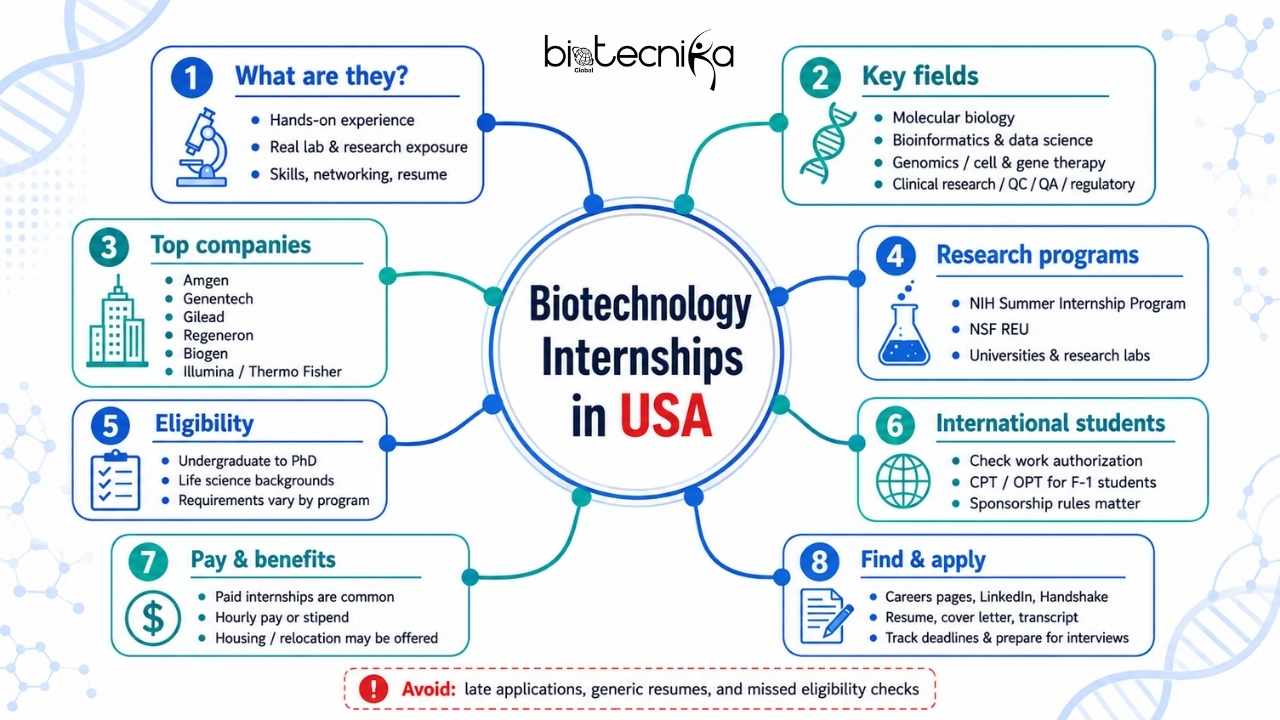
Biotechnology Internships are actually hands-on programs in different fields that help the students get real-time experience of laboratory work. These internships help in gaining practical experience, building a professional network, enhancing your resume, and also in exploring different career paths.
These internships are not limited to laboratory work. They can be available in areas such as:
- Wet-lab research
- Bioinformatics and computational biology
- Data science
- Genomics
- Regulatory affairs
- Clinical research
- Quality control and quality assurance
- Manufacturing and bioprocessing
- Other biotechnology and life-science fields
Internships not only teach you lab techniques but also teach you how results are recorded, how experiments are planned, and also teaches you how people from different departments work together.
Does USA have biotechnology internships
The answer to this question is YES. USA does have many internships in different fields like biotechnology, pharmaceuticals, Research and Development, biomedical research, and many other life sciences fields.
Students can find internships in:
- Biotechnology companies
- Research institutes and universities
- Government labs
- Genomics companies
- Pharmaceutical companies
- Healthcare and diagnostic companies
- Life science technology companies
Types of Biotechnology Internships in USA
There are so many internship opportunities for biotech students in USA. Biotech internships are not of single type, in fact, there are various fields in biotech in which students can choose their interest of subject and make a career in it.
| Internship Field | Typical Work | Useful Skills |
| Molecular Biology | PCR, DNA/RNA work, cloning and cell-based experiments | PCR, pipetting, gel electrophoresis, basic molecular biology |
| Bioinformatics | Analysing biological data, sequences and genomic datasets | Python, R, databases, genomics |
| Computational Biology / Data Science | Working with large biological datasets, modelling and data analysis | Python, R, statistics, data visualisation |
| Bioprocessing | Supporting the production and processing of biological products | Cell culture, fermentation, aseptic techniques, basic bioprocess knowledge |
| Process Development | Improving manufacturing processes for biologics and other biotech products | Experimental design, data analysis, bioprocess knowledge |
| Pharmaceutical Research | Supporting drug discovery, development and laboratory testing | Laboratory techniques, data analysis, documentation |
| Genomics | DNA sequencing, sample preparation and genomic data analysis | Sequencing basics, molecular biology, bioinformatics |
| Cell & Gene Therapy | Working with cells, genetic material and advanced therapeutic technologies | Cell culture, molecular biology, aseptic techniques |
| Clinical Research | Supporting clinical studies, documentation and research data | Data management, communication, clinical research basics |
| Quality Control (QC) | Testing samples and checking the quality of products and materials | Analytical techniques, documentation, attention to detail |
| Quality Assurance (QA) & Regulatory Affairs | Supporting quality systems, documentation and regulatory requirements | GMP basics, documentation, communication, attention to detail |
| Biostatistics & Translational Research | Analysing research or clinical data and helping connect laboratory findings with medical applications | Statistics, R or SAS, data interpretation, research skills |
| Type of Internship | What You Might Work On |
| Molecular Biology Internship | PCR, DNA/RNA work, cloning, cell-based experiments |
| Bioinformatics Internship | Biological data, Python, R, genomics |
| Bioprocess Internship | Production and processing of biological products |
| Pharmaceutical Internship | Drug discovery, development, testing |
| Genomics Internship | DNA sequencing and genomic data |
| Clinical Research Internship | Clinical study support and research data |
| Quality Control Internship | Testing samples and checking product quality |
Top Companies that offer Biotechnology Internships in USA
Several well-known biotechnology and life science companies have internship or early-career programs.
| Company | Internship Opportunities |
| Amgen | Internships, co-ops and student programmes |
| Genentech | Internships, co-ops and early-career opportunities |
| Gilead Sciences | Student internships and early-career programmes |
| Regeneron | Paid internships across different teams |
| Biogen | Summer internships and longer co-op programs |
| Illumina | Internships for undergraduates, master’s, MBA and PhD students |
| Thermo Fisher Scientific | Internships and early-career opportunities across scientific, technical roles, etc |
| Johnson & Johnson | Student internships and early-career programmes across healthcare and life-science areas |
Internship vs Co-op: What Is the Difference?
A summer internship is usually a shorter work experience that takes place during the summer break.
A co-op, or cooperative education programme, may last longer and can sometimes be connected to an academic term or university programme.
The exact structure depends on the employer and university, so always check the programme details before applying.
Important: These companies have offered student, internship, co-op or early-career opportunities, but this does not mean that every programme is open at all times. Check the official careers page for current openings, eligibility, pay, location and U.S. work-authorisation requirements.
University & Research Institute Biotechnology Internships in USA
Not only big international companies are the only option, but you can get internship opportunities in many top-class institutes, government organisations and research labs. These places also provide valuable Biotechnology Internships in USA.
- NIH Summer Internship Program (SIP)
The National Institutes of Health (NIH) Summer Internship Program (SIP) offers full-time research experiences in areas such as biomedical science, bioinformatics, pharmaceutical sciences and other health-related fields.
For Summer 2027, applicants must be U.S. citizens or permanent residents and must meet the programme’s education and enrolment requirements. Permanent residents must also be attending or accepted into an educational institution in the USA.
So, international students should not assume that having a U.S. student visa or work authorisation automatically makes them eligible for NIH SIP.
- NSF Research Experiences for Undergraduates (REU)
The National Science Foundation Research Experiences for Undergraduates (NSF REU) programme gives undergraduate students an opportunity to take part in research projects supported by NSF.
Under current NSF rules, undergraduate participants supported through REU Sites or REU Supplements must be U.S. citizens, U.S. nationals or permanent residents. Individual REU sites may also have additional eligibility requirements.
Therefore, international students should check the eligibility rules of each research programme instead of assuming that every university-based opportunity accepts international applicants.
What is the eligibility?
There are different eligibility criteria for different internships, and there is no one rule or single rule for all the Biotechnology Internships in USA.
Every company, every institute, every organization usually mentions the eligibility criteria clearly in the notification given on their respective website for the internships.
You may find internships for students studying:
- Biotechnology
- Biochemistry
- Bioengineering
- Computational Biology
- Microbiology
- Molecular Biology
- Genetics
- Biology
- Biomedical Sciences
- Bioinformatics
- Or related life sciences subjects
Can International Students Apply for Biotechnology Internships in USA?
Yes, international students may be able to apply for biotechnology internships in the USA. However, the requirements are different depending on where you are studying and your current work-authorisation status.
- U.S. Citizens and Permanent Residents
U.S. citizens and permanent residents can generally apply for internships without needing employer visa sponsorship. They still need to meet the company’s education, skills and other eligibility requirements.
- International Students Studying in the USA
International students who are already studying in the USA may be eligible for internships depending on their visa status, academic programme and work authorisation.
For example, eligible students in F-1 status may be able to work through Curricular Practical Training (CPT) or Optional Practical Training (OPT). CPT is generally connected to the student’s academic programme, while OPT employment must be related to the student’s field of study.
Before accepting an internship, students should speak with their Designated School Official (DSO) and confirm that they have the correct authorisation to work.
- Students Studying Outside the USA
Students who are currently studying in any other country can also search for internships in the USA, but the process can be more difficult.
Before applying, check whether the internship:
- accepts applicants who are studying outside the USA;
- requires applicants to already have U.S. work authorisation; and
- provides any visa or immigration support for international interns.
Do not assume that a company will arrange a visa simply because the internship says “international students may apply.” Always read the eligibility and work-authorisation requirements carefully.
Pre-Application Checklist for International Students
Before applying for a biotechnology internship in the USA, check:
- Citizenship or residency requirement: Is the internship limited to U.S. citizens or permanent residents?
- Student status: Do you need to be currently enrolled in a bachelor’s, master’s or PhD programme?
- Work authorisation: Are you legally allowed to work in the USA during the internship?
- Visa or sponsorship policy: Does the employer offer sponsorship or require existing work authorisation?
- Location: Is the internship on-site, hybrid or remote, and can you work from that location?
- Pay and housing: Is the internship paid? Does the company provide housing or relocation support?
- Application deadline: When is the last date to apply?
Important: Being eligible to apply as an international student does not automatically mean that the company will provide visa sponsorship. F-1 students should confirm their CPT or OPT eligibility with their DSO and check the employer’s requirements before accepting an internship.
U.S. immigration and student-employment rules can change, so always check current official guidance and your university’s international student office before making a decision.
Are Biotechnology Internships in the USA Paid?
Many biotechnology internships in the USA are paid, but the type and amount of payment can vary.
Depending on the company or programme, interns may receive:
- Hourly pay for the hours they work.
- A fixed stipend for the full internship programme.
- Housing support or company-arranged accommodation.
- Travel or relocation assistance for interns moving to another city.
The compensation can depend on the employer, internship programme, academic level, location and the type of work involved.
Not every internship offers the same benefits, so always check the official internship description for information about pay, travel support and other benefits before applying.
When Should You Apply for Biotechnology Internships in the USA?
There is no single application month for all biotechnology internships in the USA.
Many companies and research programmes begin recruiting for summer internships several months before the internship starts. However, application dates and deadlines can vary widely between employers and programmes.
It is a good idea to start researching opportunities early and keeping track of:
- Company or programme name
- Internship position
- Application opening date
- Documents required
- Eligibility requirements
- Application status
- Deadline
Where to Find Biotechnology Internships in the USA
You can find biotechnology internships through several reliable sources. Start by checking:
- Official company careers pages for biotech and pharmaceutical companies.
- University and research laboratory websites for research internships.
- NIH internship and training programme pages for biomedical research opportunities.
- NSF Research Experiences for Undergraduates (REU) listings for eligible undergraduate research programmes.
- University career centres and Handshake if your university provides access.
- LinkedIn for company and research internship listings.
You can also use specific search terms instead of searching only for “biotechnology internship.”
For example:
- “biotech summer intern Boston”
- “computational biology internship USA”
- “genomics intern undergraduate”
- “molecular biology summer internship”
Biotech Summer Internships: When Should You Apply?
Do not wait until summer to start searching for a summer internship.
Many large companies recruit several months before the internship begins. Some programs start accepting applications during the previous fall or winter. One simple plan can be like this:
| Period | What You Should Do |
| August-October | Update your resume and identify companies |
| October-December | Start checking major company programs |
| January-March | Apply widely to companies and research programs |
| March-May | Continue checking smaller companies, labs and new openings |
| May-August | Many summer internships take place |
This is only a general timeline. Every company has its own schedule, so start checking early.
How and Where to Find Biotechnology Internships in USA
You can search for opportunities through:
- Official company career pages
- University career portals
- Handshake
- Research institute websites
- Government research websites
- University professors and laboratories
- Life science and biotechnology job portals
Try different search terms instead of searching only “biotech internship”.
Procedure to apply for the internship
The application process is usually simple.
Step 1: Choose your area. Decide whether you are interested in wet-lab research, bioinformatics, genomics, pharmaceuticals, clinical research, or another field.
Step 2: Find suitable opportunities. Check the eligibility before applying.
Step 3: Update your resume. Highlight your education, projects, technical skills, laboratory experience, and achievements.
Step 4: Prepare a cover letter if required. Explain why you are interested in that particular internship.
Step 5: Apply through the official website. Avoid unknown websites asking for payment in exchange for a job or internship.
Step 6: Track your applications. Keep a simple spreadsheet with the company, position, deadline, application date, and status.
Step 7: Prepare for interviews. Read about the company and revise the basic concepts related to your field.
Documents Required for Biotechnology Internship Applications
The documents depend on the program, but you may be asked for:
- Resume or CV
- Cover letter
- Academic transcript
- Statement of purpose
- Recommendation letter
- Research or project details
- Portfolio or GitHub profile for computational roles
- Work authorization information when required
Biotechnology Internship Interview Questions
Biotechnology interviews can include technical as well as general questions.
Some common questions are:
- Tell us about yourself.
- What laboratory techniques do you know?
- Why do you want this internship?
- What are your career goals?
- Why are you interested in our company?
- What is PCR and how does it work?
- Explain your college or research project.
- How would you handle an experiment that did not work?
- Tell us about a problem you faced during a project.
- What do you hope to learn from this internship?
Common Mistakes That Can Get Your Internship Application Rejected
A few simple mistakes can reduce your chances of getting selected. They can be:
- Sending the same resume to every company
- Applying without checking eligibility
- Applying very late
- Writing unclear project descriptions
- Adding skills you do not actually know
- Not following the application instructions
- Applying only to well-known companies
- Ignoring spelling mistakes in your resume
- Not preparing for the interview
- Forgetting to check work authorization requirements
When you are applying, apply to different types of companies, organisations, etc.
Tip: A smaller biotech company or university laboratory can sometimes give you more hands-on experience than a very large company.
FAQs
- Are there biotechnology internships for undergraduates in the USA?
Yes. Many companies, universities, and research programs provide opportunities for undergraduate students. Eligibility depends on the individual program.
- Are biotech internships in the USA paid?
Many industry internships are paid, but payment varies. Some academic research programs provide stipends instead of an hourly salary.
- Can international students apply for biotech internships?
Some can, depending on their immigration status, work authorization, university rules, and the employer’s requirements. F-1 students should speak with their DSO before starting off-campus practical training.
- When should I apply for biotech summer internships?
Start looking several months before summer. Fall and winter are good times to begin checking opportunities for the following summer.
- Can I get a biotechnology internship without previous experience?
Yes. Focus on your college projects, laboratory coursework, technical skills, research experience, and willingness to learn.
- Where should I search for life science internships in USA?
Start with company career pages, university portals, LinkedIn, Handshake, research institute websites, government research programs, and university laboratories.
- What skills are useful for biotechnology internships?
Useful skills depend on the role. They may include PCR, cell culture, DNA/RNA techniques, microscopy, data analysis, Python, R, bioinformatics, scientific writing, and communication.
Conclusion
Biotechnology internships in USA can help you gain practical experience, build useful skills, and understand different career paths in the life sciences industry.
Start your research early, check the eligibility and requirements carefully, and apply for opportunities that match your skills and interests. A good internship can give you valuable experience and help you plan your next career step.