

Base Editing vs Prime Editing: Which Gene Editing Technology Is More Precise?
Have you ever wondered what would happen if we could replace a few nucleotide bases and do a bit of tinkering with the original DNA sequence? Would that change something? If yes, then what can we achieve by doing so? And this thought of tinkering with the bases of nucleotide is exactly what happens when we talk about base editing and prime editing, from drug development to genetically modifying crops so they can thrive through the harsh weather conditions and much more, creating billions of opportunities and the never-ending spark of innovations.
How it all started…
Recall when CRISPR-Cas9 was initially celebrated as a breakthrough in molecular biology? It felt like we had finally found a way to use DNA scissors, cut a gene, correct it, and that’s it. However, the situation was more complex than that. CRISPR operates by severing both strands of DNA, and the cell’s repair mechanisms could occasionally lead to mistakes, deletions, or rearrangements. Effective for knocking out genes, but not ideal for precise modifications.
Introducing the next generation: Base Editing and Prime Editing.
Both are advancements from CRISPR, but rather than cutting DNA, they alter it letter by letter with remarkable precision. It’s as though the previous scissors have been swapped for a fine-tipped pen.
But here’s the question that everyone in the genetics field seems to be asking lately: Which one is more precise, Base Editing or Prime Editing?
What Is Base Editing?
Base editing enables precise changes to individual nucleotides within the genome without creating double-strand breaks, for example, switching a C-G pair into a T-A pair or an A-T pair into a G-C pair. Unlike CRISPR-Cas9 technologies, which rely on inducing breaks in the DNA strands that are then repaired by the cell’s own repair machinery, base editing directly converts one DNA base to another at a specific target site.
Mechanism of action…
It uses a modified Cas9 nickase (which nicks only one DNA strand) fused to a deaminase enzyme that chemically changes the target base. Think of it as using a pencil eraser to gently replace one letter without disturbing the rest of the word.
Base editing has showcased its precision in correcting point mutations that are responsible for diseases like sickle cell anaemia, progeria, and Duchenne muscular dystrophy, all in preclinical or experimental stages.
Base editors are fast, precise, efficient, and quite elegant when it comes to editing typos in the DNA.
What Is Prime Editing?
Prime editing is also referred to as ‘search-and-replace’ editing. Prime editing is a gene editing technique that allows precise modifications to the DNA sequence, including insertions, deletions, and substitutions, without the need for double-strand breaks.
This technique uses a Cas9 nickase fused to a reverse transcriptase enzyme and a specially designed prime editing guide RNA (pegRNA). The pegRNA not only directs the Cas9 nickase but also carries the template sequence that specifies the desired edit, as well as a primer-binding site for the reverse transcriptase enzyme.
That sums up to the probable chances of curing almost 90% of all genetic mutations, quite a remarkable rise in potential. Briefly, prime editors can alter bases in the genetic code in addition to fixing the mutations.
Which technique is more precise….
Let’s examine both techniques and determine which one is more precise.
Comparison Between Base Editing and Prime Editing
| Feature | Base Editing | Prime Editing |
| Type of Change | Single-base swap (C→T or A→G) | Any small insertion, deletion, or base substitution |
| DNA Damage | No double-strand break | No double-strand break |
| Off-Target Effects | Possible due to bystander edits | Fewer off-target edits because of precise pegRNA design |
| Flexibility | Limited to specific base transitions (C↔T, A↔G) | Can perform all 12 possible base conversions |
| Efficiency | Generally higher for simple edits | Slightly lower but improving rapidly with optimization |
| Key Advantage | High efficiency and simplicity | High precision and broader editing capability |
| Best Use Case | Single-letter gene corrections | Complex edits (insertions, deletions, multi-base changes) |
Prime editing takes the lead in precision and versatility, but base editing still wins in simplicity and efficiency, especially for straightforward single-letter corrections.
A real-life example….
An exciting real-life application of this tech was brought to light in 2023, which highlighted that prime editing was able to efficiently correct the mutation that leads to sickle cell anemia, a severe blood disorder common among people of African descent. The condition is caused by a single Adenine to Thymine mutation in the haemoglobin-beta gene.
The prior study implies that base editing was not able to restore the original sequence; instead, it could only replace a safe variant to replace the defective base. However, approximately 40 percent of patient-derived stem cells achieved complete repair after prime editing, and further research in mice revealed a high potential for long-term therapeutic advantages.

The Challenges No One Should Ignore
No technology is flawless; every technique has its own restraints.
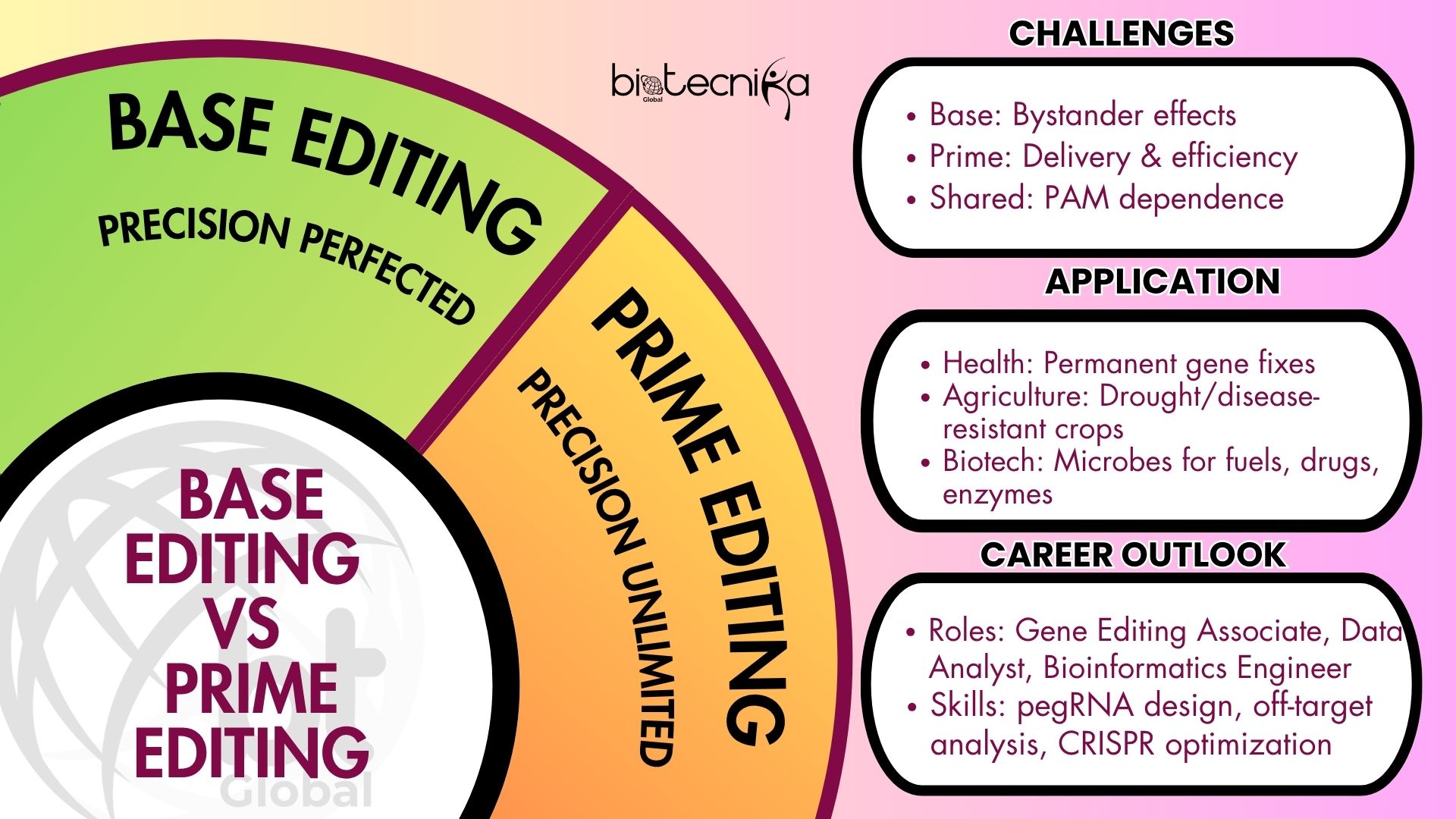
Base editing struggles with bystander effects, in which neighbouring bases in the target region are altered unintentionally. Prime editing often has lower initial efficiency and is harder to deliver into cells due to its larger protein-RNA complex.
Both rely on Cas9, which is limited by PAM sequence, the short DNA motifs necessary for Cas binding. However, scientists are now developing PAM-free or PAM-relaxed Cas variants to expand target options.
The real hurdle in gene therapy is to get these editors into the right cells safely and remain.
Career Outlook: A Revolution in the Making
Here’s where it’s getting personal for all the young researchers and students in biotech. The rise of precision genome editing isn’t just transforming research; it’s creating entirely new career opportunities.
This is your best opportunity if you’re studying genetics, biotechnology, or bioinformatics. Jobs requiring base and prime editing technologies are in high demand in fields such as genetic engineering, cell therapy, bioinformatics, and computational biology.

Even in academic institutions, labs are looking for researchers who are capable of constructing pegRNAs, analyzing off-target profiles, and maximizing editing efficiency. You can begin developing these talents right now.
Base and prime editing provide an innovative environment for entrepreneurs and businesses. Consider genetic diagnostics, precision medical technologies, agricultural biotech, and even ethical genome design frameworks.
Conclusion….
Gene editing has moved from imagination to impact, from cutting DNA to rewriting it with purpose.
Base editing gives us accuracy and speed, prime editing brings limitless precision, and together they’re reshaping how we fight disease, grow food, and design life itself.
For students, researchers, and dreamers, this isn’t just another chapter in genetics; it’s the way they picture their future. The more we understand these tools, the closer we move towards building a more sustainable world, curing genetic diseases, improving global health, and with AI, ethical oversight, and global collaboration guiding the way, the future of biotechnology isn’t just about discovery, it’s about responsibility.
Maybe our generation won’t just read the book of life; we’ll rewrite it with purpose.