


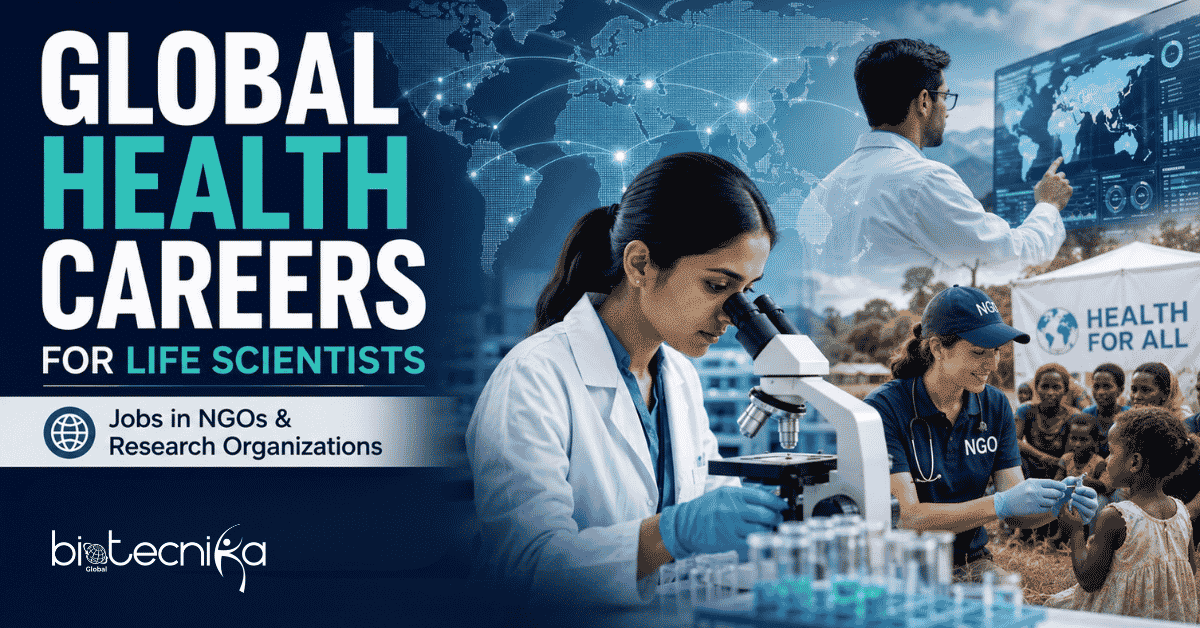
Global Health Careers for Life Scientists: Jobs in NGOs & Research Organizations
With a vaccine campaign, it is possible to save thousands of lives worldwide. With some effective disease surveillance strategies, it becomes easy to handle and manage an outbreak in time before it spreads into other nations. A researcher with a computer at their disposal can help ensure that Healthcare services improve for millions of people worldwide. This is precisely what the impact and responsibility of modern-day Global Health Careers entail.
Healthcare has become a very broad sector, not limited to laboratories, clinics, or Hospitals. Currently, scientists & Researchers from different parts of the world are handling vaccination drives in Africa, nutrition programs in underdeveloped nations, Research activities related to Healthcare in North America & Europe, or disease surveillance strategies in Asia. Life science graduates have begun to realize that they can achieve so much outside the conventional laboratory through a career in global health.
It is clear that the use of Biotechnology, Microbiology, Pharmacy, Genetics, Bioinformatics, and Public Health to improve lives in different parts of the world is far more rewarding & satisfying for Life Science graduates and students than conventional jobs. The rapid emergence of career prospects in organizations such as Healthcare companies, NGOs, as well as Research Institutes, offers an opportunity to explore the real-world Healthcare as well as Science & Technology challenges.
An increased demand for skilled professionals creates great opportunities for Global Health careers for professionals in the Life Sciences seeking global experience, relevant work, and direct impact on communities worldwide.
What Are Global Health Careers?
Global Health refers to efforts aimed at improving Healthcare delivery, preventing illnesses, and ensuring access to Healthcare services for people worldwide. Global Health workers differ from conventional Healthcare professionals because while the latter concentrate on providing Healthcare within their country or community, the former tackle international issues such as disease, malnutrition, maternal health, climate change, and inequities in Healthcare delivery.
This is why Global Health career opportunities are becoming popular among Life Science graduates. Organizations today need professionals who can support Research, analyze health data, manage Healthcare projects, and contribute to international Public Health programs.
Graduates from Biotechnology, Microbiology, Biochemistry, Bioinformatics, Pharmacy, Genetics, and related fields are increasingly applying for Global Health Research Jobs in NGOs, Healthcare startups, Universities, and international organizations.
Why Is This Field Growing So Fast?
There has been an increasing demand and need for Healthcare professionals in recent years across the globe. The WHO reported that the world might experience a deficit of about 11 million health practitioners by the year 2030, particularly in the low- and middle-income nations. One of the major factors contributing to the growth of global careers in Public Health is the increasing workforce shortage.
The horrific Pandemic caused by the Coronavirus disease in 2020 also brought significant changes to perspectives on Healthcare systems worldwide. Institutions as well as Governments are thereby investing more in Disease surveillance, vaccine research, preparedness for future pandemics, and Healthcare Technologies. As a consequence, there is a growing need for specialists in areas such as Policy, Public Health management, as well as Research coordination who have a background in Science & Healthcare. The modern drivers for global health roles are Climate-induced vector shifts, AI-driven real-time Digital Epidemiology, AMR (Antimicrobial Resistance), and the One Health approach (linking environmental, animal, and human health).
There are many reasons for the expansion of these careers, due to an increase in global disease conditions. The Healthcare sector is becoming more connected across nations, making international collaboration more important than ever.
Popular Career Options in Global Health
There are many career paths available within Healthcare and Life Sciences. Some jobs involve laboratory Research, while others focus on fieldwork, Healthcare policy, or data analysis.
Popular roles include:
- Public Health Analyst
- Clinical Research Associate
- Global Health Program Coordinator
- Biostatistician
- Health Data Analyst
- Epidemiology Research Assistant
- Vaccine Research Scientist
- NGO Project Officer
- Healthcare Policy Associate
- Infectious Disease Researcher
Many professionals also work on projects related to Malaria, Tuberculosis, HIV, nutrition, disease prevention, as well as maternal Health programs in underserved communities and nations.
Some NGO giants where Life Science professionals aspire to contribute are the Bill & Melinda Gates Foundation, Wellcome Trust, the Clinton Health Access Initiative (CHAI), or MSF (Doctors Without Borders). In recent years, leading Healthcare employers have also started seeking for candidates who have a knowledge of Bioinformatics, digital Healthcare tools, as well as data Science. Having skills in Scientific Writing, Healthcare Communication, as well as Statistics Software can make candidates more competitive in Global Health Research Jobs.
Best Countries for Global Health Careers
Several countries have become major hubs for global Healthcare Research and Public Health innovation, such as.
- United Kingdom: It is well known for Public Health Research and Genomics. Universities and Healthcare organizations actively work on infectious disease studies, Vaccine Research, and Healthcare innovation. The UK is leading in Genomic Surveillance & Digital Epidemiology, and the prime hubs include the London School of Hygiene & Tropical Medicine (LSHTM) and Wellcome Trust.
- Switzerland: Here, Geneva, is known as a global health center because it hosts organizations like the World Health Organization and many United Nations agencies. Professionals working here often contribute to international Healthcare policy and disease prevention programs. It is the epicenter of Global Health policy & home to the Global Fund, WHO, as well as Gavi (The Vaccine Alliance).
- United States: It continues to lead in Biomedical and global health Research. Organizations such as the CDC (Centers for Disease Control and Prevention) and the NIH (National Institutes of Health) offers career opportunities in Healthcare analytics, infectious disease Research, as well as Epidemiology. The USA is the hub for international development and some prime employers are the CDC, massive health consultancies or foundations (like The Bill & Melinda Gates Foundation), as well as NIH.
- Germany: It has grown into a major destination for Biotechnology and Pharmaceutical Research. Research Institutes and hospitals collaborate on global Healthcare projects, especially in infectious diseases and Healthcare Technology.
- Canada: It is becoming increasingly attractive to Healthcare Researchers and Public Health professionals. The country supports Healthcare Research, community health programs, and immigration pathways for skilled Healthcare workers.
According to WHO data, women now make up nearly 67% of the global health workforce, showing how diverse and inclusive the Healthcare sector has become internationally.

Skills That Can Help You Succeed
Students interested in Global Health Careers should build both Technical and Communication skills. Organizations usually prefer candidates who can work in multicultural environments and adapt to international Healthcare challenges.
A professional with a Bachelor’s in Biotechnology or Life Sciences should possess an MPH (Master of Public Health), a diploma in epidemiology, or field volunteer experience to secure a position in Global Health NGOs.
Some important skills include:
- Data Analysis and Statistics
- Research Methodology
- Public Health knowledge
- Project Management
- Scientific Writing
- Communication and teamwork
- Bioinformatics and Digital Health Tools
- Clinical Data Management
Internships, online certifications, volunteer work, and Research experience can also significantly improve career opportunities.
How to Break In a Global Health Career – Roadmap
- Academic Start: Consider adding a Clinical Research, MPH, or Health Informatics certification to your core Life Science education.
- Gain Field Experience: Volunteer with local health NGOs, health camps, or data-collection drives to demonstrate your understanding of community and Global health.
- Master the Tools: Learn Python or R for Biostatistics, and get familiar with GIS (Geographic Information Systems) mapping software for tracking outbreaks.
Future Scope & Real-Life Impact
With time and advancements, the fields of Healthcare and Life Science are becoming increasingly global. Industry experts believe that there will be a surge in careers in the fields of Disease Surveillance, Genomics, Vaccine development, Artificial Intelligence-driven Healthcare, as well as Epidemiology in the coming years.
Nevertheless, beyond incredible salary growth and expanding job opportunities, their importance far exceeds expectations. As global health professionals, they provide communities with vaccines, a healthy Healthcare system, disease awareness campaigns, and even cures. For example, during the pandemic, Researchers were actively involved in vaccine development and disease tracking and helped with awareness campaigns worldwide.
Many Healthcare workers and Researchers in different regions are working on fighting deadly diseases such as Tuberculosis, Malaria, Dengue, as well as HIV, among others. They provide aid to millions of people every year across the globe.
Therefore, for those Life Science students who wish to have a career that involves all of those, Global Health career opportunities are a great choice.