

Neurobiology Major in the U.S.: How Hard Is It? A Complete Student Guide
Are you fascinated by the mysteries of the human brain? Have you ever wondered about the intricate dance of neurons, or how our thoughts and behaviors come from bundles of cells and chemicals? If questions like these keep you curious, a Neurobiology major might be exactly the path that pulls you in.
Studying neurobiology is not just memorizing the names of brain regions or cramming diagrams before exams. It’s a mix of detective work and science, pulling together pieces from biology, psychology, chemistry, and a fast-moving world of research.
Every class gives you a new angle on how the nervous system shapes what we feel, think, and do.
But let’s be honest. We all know this branch of biology is not as easy as it sounds. But how hard is it really? Neurobiology has a reputation for being demanding. Some of the lab work is meticulous, and the concepts can get pretty deep. Still, the challenge becomes manageable once you know what’s coming and how to approach the coursework.
This guide breaks down the essentials, from neurobiology basics and the classes you will take to the strategies that actually help students succeed.
Whether you are just dipping your toes into neuroscience for beginners or you are a life science student from anywhere in the world trying to understand what this major really involves, you’ll find a clear roadmap here. Think of it as your starting point for deciding whether this exciting (and yes, occasionally tough) major fits where you want to go.
What is Neurobiology?
The definition of Neurobiology in simple terms is a scientific study of the nervous system, where you will learn about the structure, function, development, genetics, biochemistry, physiology, and pathology of neurons.
This branch of biology focuses on unfolding the complex neural network that drives our thoughts and behavior. Just think of it as the biological foundation of neuroscience.
As a Neurobiology student, you will explore topics like:
- How neurons communicate
- How the brain develops
- What happens during diseases like Alzheimer’s
- How genetics influences brain function
Neurobiology sits at the crossroads of several disciplines. For example:
- Psychology overlaps by examining how brain activity shapes behavior.
- Biology provides the molecular and cellular groundwork.
- Medicine uses neurobiological research to diagnose and treat neurological disorders.
To begin your journey, you can take an introductory course such as Intro to Neurobiology. These foundational courses will give early exposure to the basics of neurobiology. They will build your confidence as you progress through the advanced topics.
Course Structure and Curriculum
Are you someone who is looking for Neurobiology majors in the US? Well, every university structures its program slightly differently, but most of them follow a similar path. They offer a perfect balance of core courses with electives and hands-on research experiences.
Core Classes You Will Likely Take
- Cellular and Molecular Biology
- Genetics and Genomics
- Neurophysiology
- Systems Neuroscience
- Neuroanatomy
- Biochemistry and Molecular Neuroscience
These courses build the foundation for understanding the nervous system from multiple angles: chemical, electrical, anatomical, and behavioral.
Electives You Can Explore:
- Behavioral Neuroscience
- Cognitive Neuroscience
- Computational Neuroscience
- Laboratory Techniques in Neuroscience
If you are someone who is just beginning the journey in neurobiology, these programs will help build a future-ready career in research and medicine. With lab research, internships, and fieldwork, you will master your practical skills.
A Neurobiology study guide or structured study plan can be extremely helpful, especially when juggling dense lecture notes with lab reports. Here is a sample Neurobiology study guide that you can use in your day-to-day life:
| Topic | Key Points | Study Tips |
| Neuron Structure | Neuron parts: glial cells | Draw diagrams; flashcards |
| Resting Potential | Ion gradients: Na⁺/K⁺ pump | Explain RMP in 2–3 sentences |
| Action Potential | Depolarization → Repolarization → Hyperpolarization | Sketch the AP curve |
| Synaptic Transmission | Neurotransmitter release: EPSPs vs. IPSPs | Make a synapse flowchart |
| Neurotransmitters | Glutamate, GABA, dopamine, serotonin, ACh | Memorize functions |
| Basic Neuroanatomy | Lobes, cerebellum, brainstem, limbic system | Label brain diagrams |
| Sensory Systems | Vision, hearing, touch, smell, taste | Watch short animations |
| Motor Systems | UMN vs LMN; basal ganglia; cerebellum | Compare pathways visually |
| Neurodevelopment | Neurogenesis, migration, synaptogenesis | Create timeline charts |
| Neuro Diseases | Alzheimer’s, Parkinson’s, ALS, MS, epilepsy | Focus on mechanisms |
| Research Skills | Imaging, electrophysiology, and molecular tools | 1–2 sentence summaries |
How hard is a Neurobiology major?
One of the most common questions is one that every aspiring student has. The answer depends on your aptitude and study habits. Here’s where students get the most anxious, and reasonably so. Neurobiology is known for being one of the more demanding life science majors. But why? Becuase
1. It’s Highly Interdisciplinary
You are not just learning one subject. Instead, you are constantly pulling from:
- molecular biology
- chemistry
- physics (yes, for membrane potentials!)
- psychology
- computational modeling
That’s a lot of mental shifting.
2. The Course Material of Neurobiology Major Is Dense
Understanding how neurons work requires learning mechanisms at the molecular level and then scaling those concepts up to understand whole brain systems. Many students find the jump from details to big-picture concepts challenging.
3. Labs Can Be Intense
Neuroscience labs often involve imaging techniques, electrophysiology, or molecular assays, none of which are “light” activities.
Compared to Other Life Science Majors
Most students say neurobiology is more difficult than general biology or ecology, but comparable to majors like:
- biochemistry
- biomedical engineering
- molecular biology
If you are someone who enjoys solving puzzles and understanding how things work from the inside out, the difficulty becomes part of the fun.
Skills and Knowledge Gained
By the time you finish your degree, and you will walk away with far more than just memorized facts about the brain.
Scientific & Technical Skills
- Lab techniques such as microscopy, PCR, and electrophysiology
- Data analysis, statistics, and experimental design
- Reading and interpreting scientific papers
Cognitive and Professional Skills
- Critical thinking and analytical reasoning
- Scientific communication
- Teamwork in lab settings
- Problem-solving and research literacy
These skills transfer well into countless life science careers, from research to biotech to clinical roles.
Success Strategies for Students
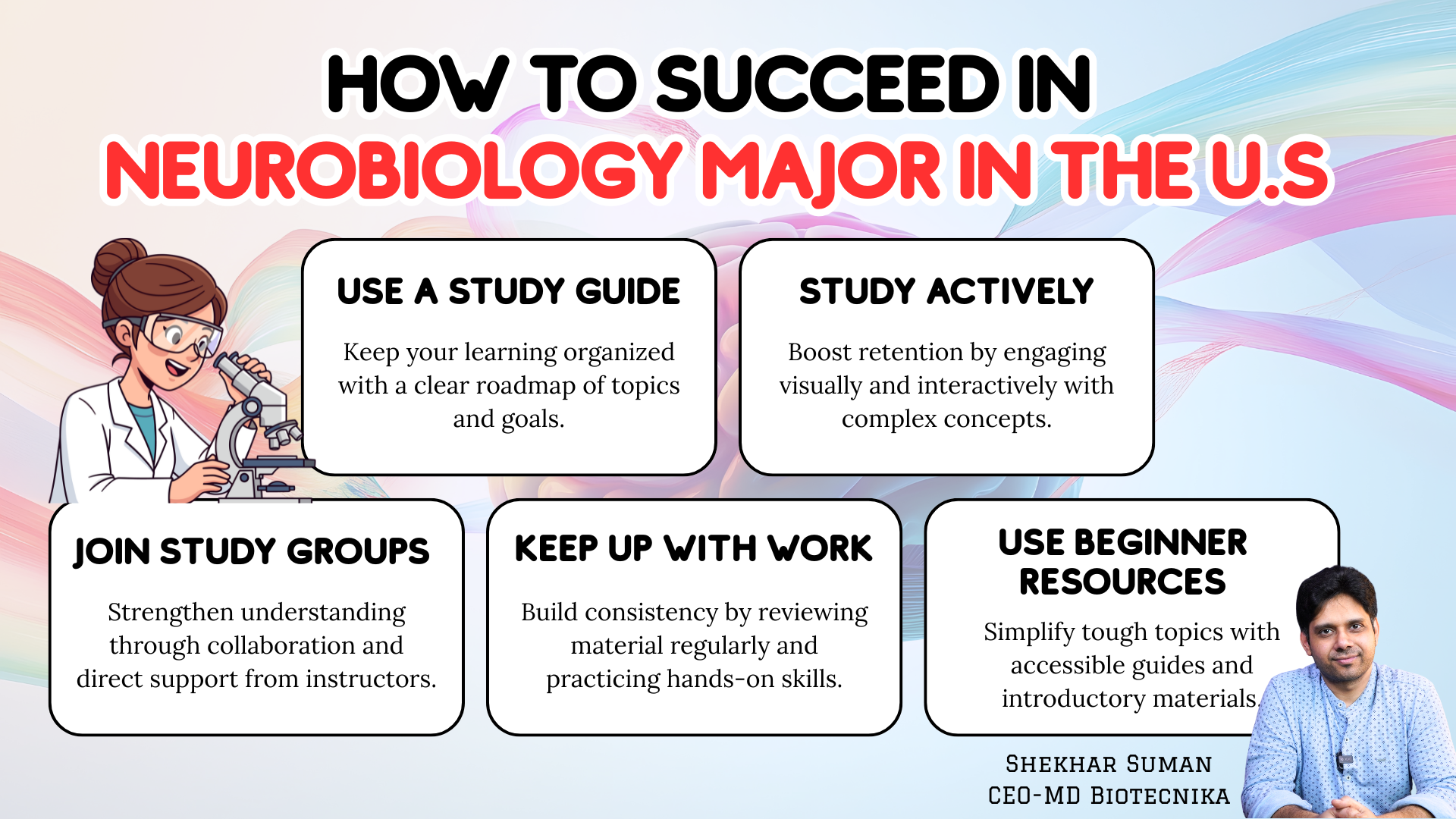
If the major sounds intimidating, don’t worry. Every year, thousands of students succeed in this complex branch of biology. You can too with these smart strategies, so here are some:
| Strategy | Description |
| Break Material Into Manageable Pieces | Use diagrams, color-coding, and flow charts to simplify complex pathways. |
| Practice Spaced Repetition | Apps like Anki help with long-term memorization of neuroanatomy and molecular concepts. |
| Join Study Groups | Discussing material with peers improves understanding and reduces study stress. |
| Go to Office Hours | Professors are often research-driven and eager to help — take advantage of their expertise. |
| Use Beginner-Friendly Resources | “Neuroscience for beginners” books, videos, and structured neurobiology study guides help when lectures move quickly. |
| Stay Organized | Plan ahead to manage labs, readings, problem sets, and exams effectively. |
By applying these strategies, you can navigate the rigor of neurobiology while building a strong academic foundation.
The Role of Research in Neurobiology
A Neurobiology major opens more doors than many students expect. While some go on to medical school or graduate school, others find fulfilling careers right after earning their bachelor’s degree.
Possible Career Paths
- Research assistant or lab technician
- Neuroscientist (with further education)
- Clinical research coordinator
- Science writer or educator
- Pharmaceutical or biotech analyst
- Neuropsychology (with graduate training)
- Medical doctor, neurologist, or psychiatrist
The job market is strong in areas involving biotechnology, drug development, artificial intelligence, and brain–machine interface research.
Career Opportunities and Pathways in the Neurobiology Major
Graduating with a Neurobiology major opens diverse career paths. Potential options include:
| Career Category | Potential Career Options |
| Research and Academia |
|
| Healthcare and Medicine |
|
| Industry and Technology |
|
The job market for neurobiology graduates is competitive but promising, too, especially for those with strong research experience or advanced degrees. Your resume should highlight your technical skills as well as soft skills, along with research experience and a strong academic background.
Conclusion
Remember, a major in neurobiology is not an easy path, but it’s the most fascinating and promising career one can have. If you are passionate about exploring the nervous system, this branch of biology is one of the most intellectually stimulating and satisfying. You will learn how the human brain works at different levels and gain valuable research experience. Neurobiology will open doors to a wide range of scientific careers.
If you are just beginning your journey, then focusing on neurobiology basics, taking a solid intro to Neurobiology course, and using a structured Neurobiology study guide can help you transition smoothly.
With curiosity, patience, and a willingness to push through challenges, the neurobiology major becomes not just another branch of biology but a genuinely exciting one that will help you build a strong research career.