


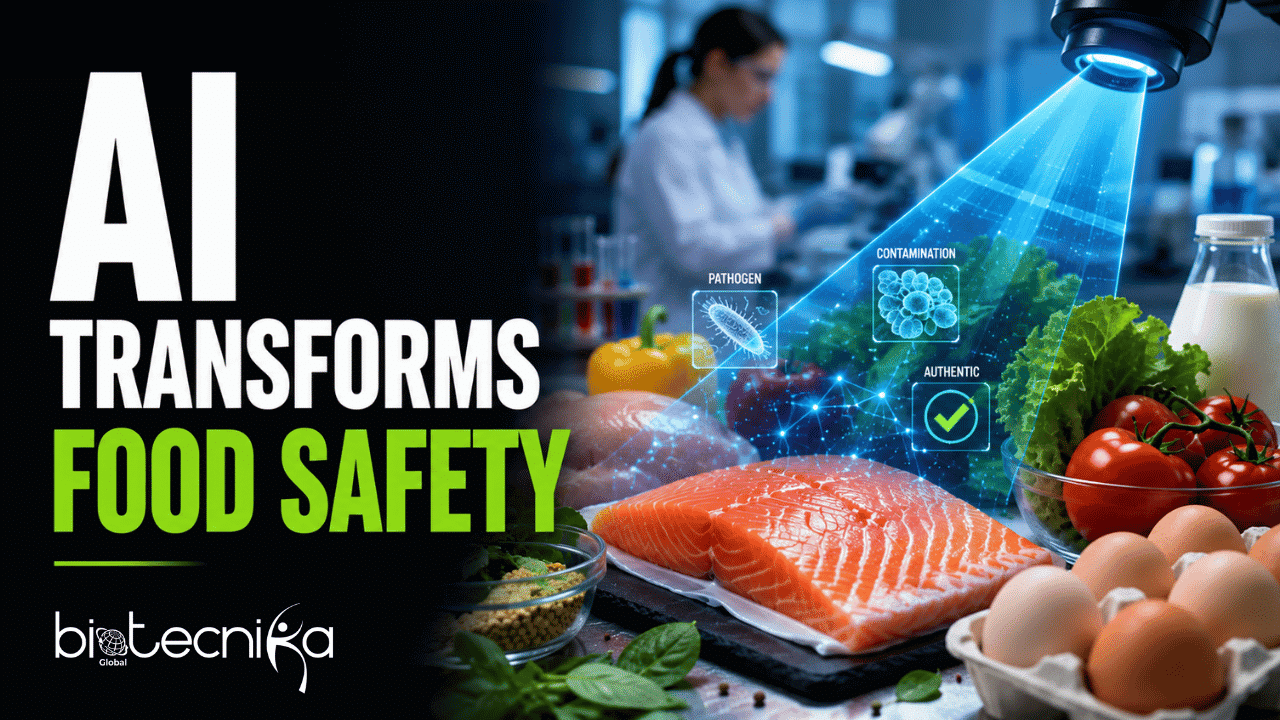
New Research Shows How AI Could Transform Food Safety
When it comes to Food Safety, one tends to worry only during an outbreak. Harmful microorganisms, Chemicals in foods such as pesticides, or food fraud can be among the factors threatening consumers’ health. Rapid identification of Food Safety risks, therefore, remains the greatest challenge facing the global food industry.
According to Researchers, AI (Artificial Intelligence) might be the key to solving this problem. As a new review shows, AI-based methods are becoming more and more common for the rapid detection of Food Safety risks.
AI is turning out to be a revolutionary tool in ensuring Food Safety, as evidenced by the growing number of papers exploring the benefits that AI holds for detecting pathogens, speeding up outbreak investigations, chemical contaminations, as well as food fraud.
Recently, a Review was published in “npj Science of Food” based on 161 peer-reviewed scientific publications and conference proceedings that examined how AI is being applied in Food Safety research. The results have revealed the rapid growth of AI, ML (Machine Learning), and DL (Deep Learning) Technologies, showcasing their significant role in building sustainable Food Safety systems across the globe.
Growing Need for Smarter Food Safety Systems
Maintaining Food Safety continues to be one of the largest problems facing the world today, with severe implications for economic stability, public health, as well as food security. Typically, Food Safety measures have been approached reactively, such as inspecting products after manufacture or investigating food contamination only after people fall ill.
This has proved challenging, as modern food production networks generate large volumes of data that cannot be easily processed using the usual inspection and monitoring techniques. According to Researchers, the advent of Artificial Intelligence enables the efficient processing of large datasets to detect potential risks.
Statistical modeling has historically been employed to monitor food risks, but the use of Artificial Intelligence offers improved strategies. For instance, machine learning uses data to make predictions, while deep learning enables the automatic interpretation of large datasets with minimal manual input.
The rapid growth of research in this field reflects increasing interest in these Technologies. According to the review, only one study explored AI applications in Food Safety in 2012. By 2023, that number had grown to 46 published studies.
How the Review Was Conducted
To map the expanding research landscape, the authors initially identified 783 publications from the Scopus database.
To help manage the screening process, the Researchers used an AI-powered active learning tool called ASReview. The software ranks studies by predicted relevance and continuously improves its recommendations in response to researcher feedback.
Using ASReview, the team screened 434 records at the title and abstract stage before conducting full-text evaluations. After this process, 161 studies published up to April 2024 were selected for detailed analysis.
The selected publications were categorized according to research domains, implementation settings, data collection methods, and the types of AI Technologies used.
AI’s Biggest Role: Detecting Microbiological Hazards
The review found that microbiological hazards accounted for 35% of all studies, making them the largest area of AI application in Food Safety research.
Within this category, nearly 59% of studies focused on enhancing conventional laboratory testing methods.
One example highlighted in the review combined an electronic nose sensor with AI classification algorithms to detect Salmonella, achieving reported accuracy rates ranging from 85% to 100%. Another study used a random forest model to predict disease outcomes from untagged Salmonella genetic sequences, achieving 87% accuracy.
These findings suggest AI could help laboratories detect harmful pathogens more quickly and efficiently.
Detecting Chemical Contaminants and Food Fraud
Chemical contamination represented the second-largest research area, accounting for 25% of the reviewed studies.
Researchers frequently use AI to identify contaminants such as heavy metals and pesticide residues, often through non-destructive testing methods that allow products to be analyzed without being damaged.
Food authenticity and fraud accounted for 17% of the studies. In these applications, AI was used to identify suspicious activities within supply chains. One example involved analyzing electronic invoices to flag potentially suspicious oil manufacturers, demonstrating how AI can support transparency and traceability in food production networks.
Improving Foodborne Disease Surveillance
The review also highlighted AI’s growing role in tracking foodborne disease outbreaks.
In one example, Researchers used anonymized smartphone search and location data to identify contaminated venues. According to the study cited in the review, this AI-driven approach was more than three times as effective as traditional outbreak investigations.
Such applications suggest AI could strengthen public health responses by helping authorities identify contamination sources more rapidly.
Deep Learning Is Becoming More Common
The review found a notable shift toward more advanced deep learning techniques in recent years.
The proportion of studies using deep learning models increased from 22% in 2019 to 43% in 2023, reflecting the growing capability of these systems to analyze increasingly complex Food Safety datasets.
Food Safety Challenges That Still Need to Be Addressed
Despite the promising results, the authors emphasize that several important challenges remain.
One of the biggest obstacles is class imbalance. Most Food Safety datasets contain examples of safe food products and low-contamination environments, while actual contamination events are relatively rare. This can make it difficult for AI systems to accurately identify uncommon but high-risk situations.
Data privacy concerns and proprietary restrictions also limit the sharing of information needed to develop and validate more robust models.
The Researchers further noted that comparing the performance of different AI models across studies remains challenging because many datasets contain only a small number of positive contamination cases and a limited set of predictor combinations.
The review also acknowledged its own limitations. Because it focused only on Scopus-indexed literature, it may not fully capture commercial or industrial applications of AI used in food manufacturing environments but not reported in peer-reviewed publications.
Moving Toward Predictive Food Safety
Looking ahead, the authors highlight emerging Technologies such as explainable AI and federated learning as potential solutions to current challenges.
Explainable AI can help users understand how algorithms arrive at decisions, improving transparency and trust. Federated learning allows organizations to collaborate on AI model development without directly sharing sensitive data.
Overall, the review suggested that AI has the potential to transform Food Safety from a largely reactive system into a more data-driven, predictive, and transparent approach. As these Technologies continue to evolve, they could play an increasingly important role in protecting consumers and strengthening the resilience of global agrifood systems.