


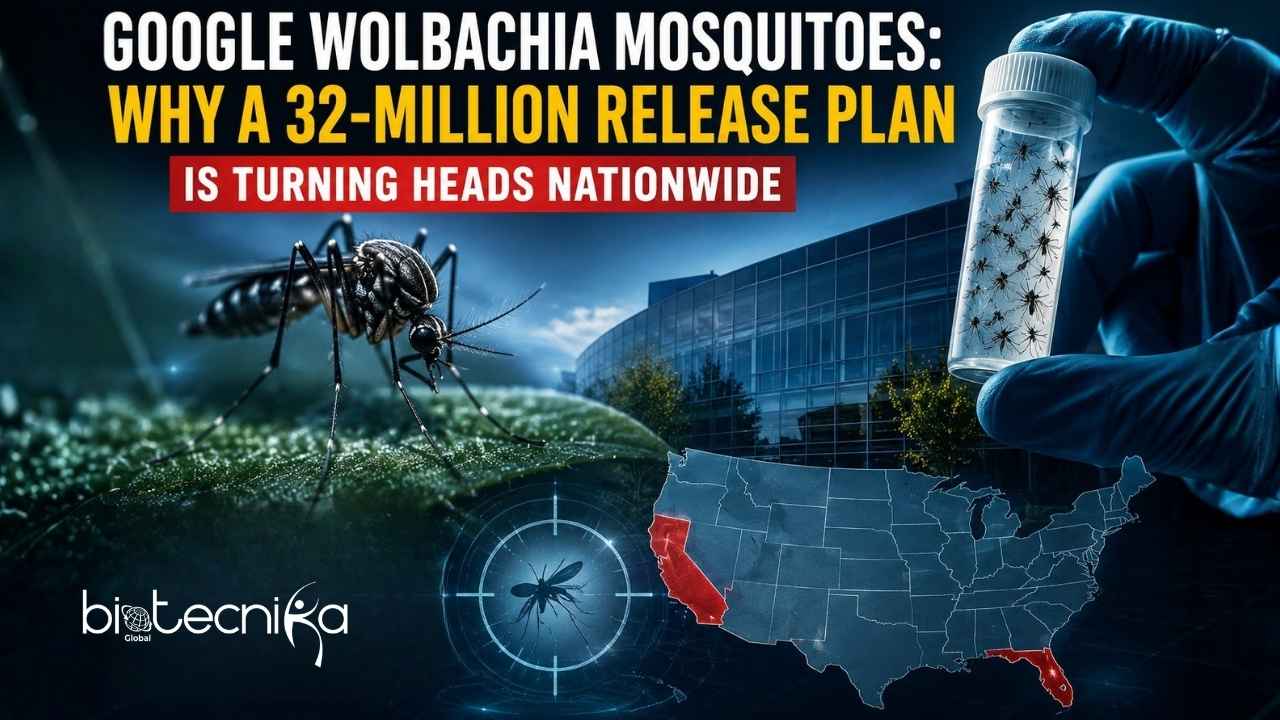
Google Wolbachia Mosquitoes: Why a 32-Million Release Plan Is Turning Heads Nationwide
Google Wolbachia mosquitoes may soon take center stage in an unusual effort that is already attracting nationwide attention.
Don’t you think that mosquitoes are more than just a nuisance; they can spread diseases that pose a serious public health concern for all?
At the moment, Google Wolbachia mosquitoes project of Alphabet Inc. (Google’s parent company) is seeking ways to deal with the issue in a highly unconventional manner. This initiative seeks to use Biological methods to eliminate mosquitoes that carry various diseases, rather than traditional chemical methods. Alphabet Inc. is seeking EPA (Environmental Protection Agency) approval to release 32 million specially-treated mosquitoes in California and Florida within the next two years.
This initiative would help naturally reduce mosquito populations. It would be an interesting and scientifically backed method for controlling mosquito-borne diseases. The initiative would involve utilizing the bacterium Wolbachia, which has previously been successfully used on a small scale.
This falls under the “Debug initiative” project. It is a mosquito-elimination project launched in 2016 by Verily Life Sciences, the Life Sciences division of Alphabet Inc. At the moment, the proposal is under review by the EPA as an experimental use permit. The locations have not been disclosed and are currently undergoing public comment period till early June.
How Does The Strategy And Google Wolbachia Mosquitoes Work?
At the heart of the Google Wolbachia mosquitoes initiative is a naturally occurring intracellular bacterium known as ‘Wolbachia,’ which is already found in many insect species. Scientists involved in the program breed male mosquitoes that carry this bacterium and then release them into the environment.
When these Wolbachia-infected male mosquitoes mate with wild females that don’t carry the same strain of the Wolbachia bacterium, the eggs produced from that mating don’t hatch. Over time, this reduces the local mosquito population.
Only male mosquitoes will be released, which means residents are not expected to experience additional mosquito bites. Because, male mosquitoes do not bite humans or animals.
Targeting Disease-Carrying Mosquitoes
The mosquitoes targeted in this proposed trial belong to the Culex quinquefasciatus (commonly known as the Southern house mosquito), utilizing the Wolbachia pipientis (wAlbB strain). These mosquitoes are recognized as the primary carriers of deadly diseases such as St. Louis Encephalitis and West Nile Virus.
Both of these diseases already exist in California. According to the U.S. CDC (Centers for Disease Control and Prevention), West Nile virus remains the most common mosquito-borne disease in the United States. A positive mosquito sample linked to the virus was recently confirmed in Riverside County, California.
By reducing the number of Culex mosquitoes, researchers hope the Google Wolbachia mosquitoes program can help lower the risk of disease transmission in affected areas.
Technology Behind the Large-Scale Effort
While Wolbachia-based mosquito control has been tested before, carrying out a program on the scale proposed by Alphabet presents significant operational challenges.
Previous projects, including trials conducted by the Florida Keys Mosquito Control District, have shown meaningful reductions in mosquito populations. However, releasing millions of mosquitoes requires advanced systems for breeding, sorting, and distribution.
To address this issue and scale the Google Wolbachia mosquitoes project, Debug uses a combination of automation Technologies, AI (Artificial Intelligence), as well as Robotics. The project employs AI-powered systems to separate male mosquitoes from females, automated rearing technologies to raise large numbers of insects, and vehicle-based platforms to release them efficiently into the environment.
These technologies are designed to help Researchers breed, sort, and release mosquitoes on a much larger scale
What Happens Next for Google Wolbachia Mosquitoes?
If the EPA approves the program, the program would be carried out over two years. The proposed plan allows the release of up to 16 million Wolbachia-infected male mosquitoes per state in the first year, followed by another 16 million per state in the second year.
For now, the Google Wolbachia mosquitoes proposal remains under Regulatory review as the EPA evaluates its potential effectiveness as well as impact. If approved, it could become one of the largest mosquito-control programs of its kind in the United States, using biological methods rather than chemical pesticides to help combat mosquito-borne diseases.
As Health authorities continue to look for effective ways to control disease-carrying mosquitoes, the outcome of Alphabet’s proposal will be closely watched by scientists, regulators, and local communities alike.