

EU and India Move Closer Through Technology and Research Partnership
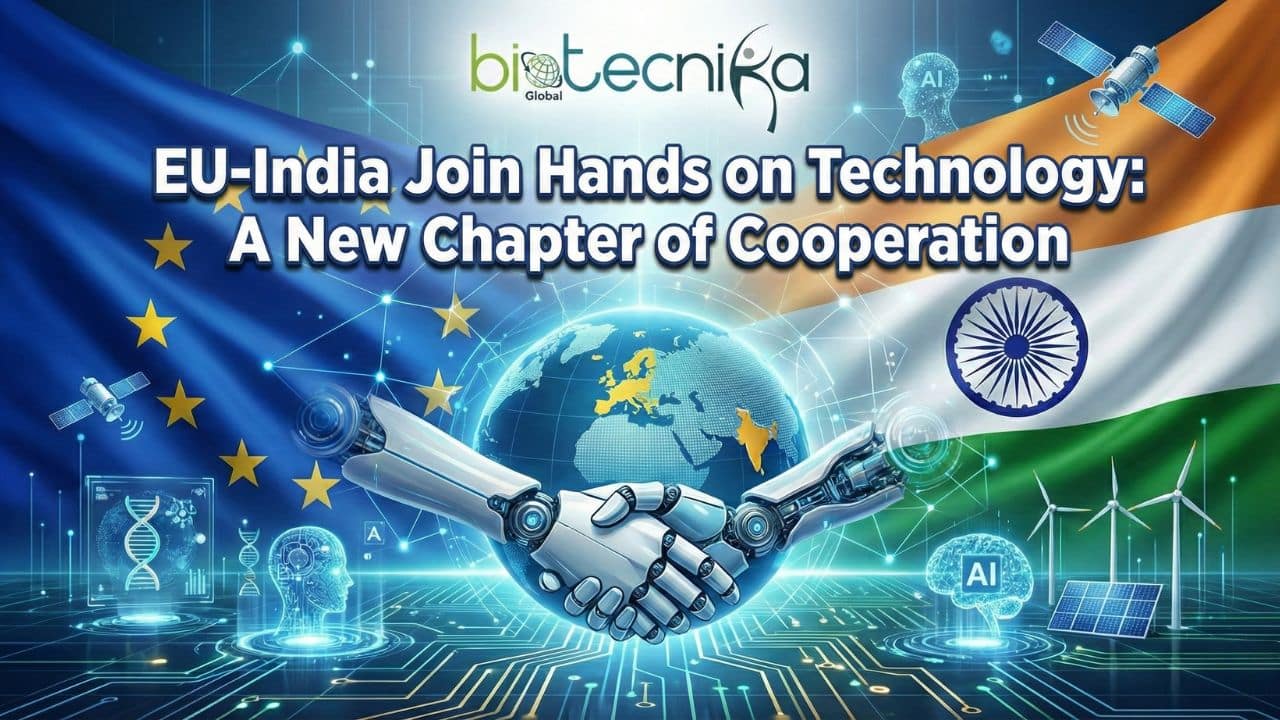
Through its recent agreement with India for numerous new Science & Technology Collaboration Agreements (STCA), the EU has moved significantly closer to India as of January 27, 2026, following a high-level meeting between EU leadership and Indian Government officials. Both the EU and India will increasingly align their respective technology policy objectives as well as build on how to collaborate on future research and development. Some experts have suggested that this agreement will serve as a platform for global collaboration and joint research in the areas of green energy (which often uses digital platforms), digital platforms that will also often be used for developing green energy, and other types of collaborative R&D activity.
Both the EU and India have concerns regarding excessive reliance on China. And to a certain degree, American technology platforms. In this instance, both entities are looking to leverage their collective strength through collaboration rather than relying solely on the power of other states. Because of this, the aforementioned STCA is viewed as an important indication of the growing confidence and desire to work cooperatively between both regions over the longer term.
President Ursula von der Leyen of the European Commission outlined this vision explicitly. According to her statement, the agreement unites India’s abilities to provide services with its huge workforce and Europe’s technological, financial, and innovative capabilities. In other words, it appears as if both parties are working to jointly produce and develop their respective strengths.
One of the most notable plans coming out of this announcement was the creation of an EU-India Start-Up Partnership. This partnership, which will involve Start-Up India, European Innovation Council (EIC) and EU member countries, has yet to provide detailed plans but has begun discussions. Officials estimate the partnership will include joint information sessions, exchange visits, and exchanging ideas between the two sides of startups. This could open many new opportunities for young entrepreneurs.
In addition to Start-Ups, the EU and India have also agreed to establish multiple Innovation Hubs. These Innovation Hubs will facilitate conversations, share ideas and develop joint projects in major and developing technologies. Although specific details about the Innovation Hubs have not yet been finalized, the intention is to create environments which will allow researchers, innovators and companies to collaborate more closely.
India’s potential participation in Horizon Europe, the European Union’s €93.5 billion research and innovation scheme, is among the major advantages of this agreement. Horizon Europe promotes international research cooperation and allows scientists to collaborate on research projects across international borders.
Countries that already have access to EU funding through Horizon Europe include Canada, Japan, South Korea, and New Zealand. If India were to join Horizon Europe, Indian researchers would receive direct funding from the European Union and have the ability to collaborate with European scientists as partners. This collaboration would dramatically enhance research collaboration between the European Union and India.
In addition to research initiatives, the agreement also includes commitments to collaborate in many key areas, such as semiconductor supply chains, artificial intelligence, nuclear power, electric vehicle charging standards, digital public infrastructure, and even access to supercomputers. Each of these fields is crucial for both future economic growth and national security.
Experts believe that both the EU and India are following the idea of ‘strategic autonomy’ as their guiding principle. Strategic autonomy refers to the ability to exercise independent decision-making while not being unduly reliant on other states for one’s strategic needs. According to policy experts, this line of reasoning has gained traction since there has been increasing tension worldwide over the past few years. The EU has made a concerted effort to build a stronger relationship with India since the start of the Russia-Ukraine conflict in 2022, including reducing India’s reliance on Russian military hardware. In time, this strategy has produced positive results for both parties.
Both sides appear to share a strong common interest in developing green technologies as a solution to climate issues. With some nations continuing to forsake their commitments to greening the planet, the EU will be looking for partners it can rely on for clean technologies. One such country is India. As India has increasingly moved towards using renewable forms of energy, it could position itself to also be a strong source for the EU to partner with in the development of green hydrogen. The EU and India should also work together to create climate-friendly solutions that each will be able to utilize to reach their climate goals.
Digital public infrastructure is another area where technology partnerships between the EU and India will be expanding. India’s infrastructure is built on proven systems such as Aadhaar for digital identity and the Unified Payments Interface (UPI), a mobile payment system, both of which are being recognized and lauded by many around the world. The EU is also in the process of developing its own digital euro. While a digital euro won’t be developed and implemented to the exclusion of global card networks, there is general consensus by experts that there may be good opportunities to link EU and Indian systems together through the use of developed e-technology and achieving standards which will create a virtual alternative to using global card network systems. Thus, India’s technological advancements may play an important role in supporting the EU’s technological goals.
Joint manufacturing is another promising idea. For example, India has strong biomanufacturing facilities, while Europe has advanced precision medicine companies. Together, they could work on projects like manufacturing mRNA vaccines. Open-source software is also an area where joint efforts could reduce dependence on big US or Chinese companies.
Currently, much of the r&d cooperation between the EU and India happens through Global Capability Centres. These are India-based centres run by European and US companies. Earlier, these centres focused mainly on cost-saving, but now they are deeply involved in core innovation and advanced research. India has also become a major source of artificial intelligence talent for Europe. Many Indian experts work abroad and later return home, creating a healthy flow of skills between regions.
However, experts also point out some challenges. Publicly funded joint research projects between EU and Indian universities are still limited. Joint laboratories and long-term shared research facilities are rare. India’s participation in EU research programmes has traditionally been low and even declined under Horizon Europe, which started in 2021.
By joining Horizon Europe, India can improve its standing in relation to global scientific co-operation. The Indian government has provided funding in the past for international scientific research, and institutions such as the Council of Scientific and Industrial Research have received funding to support this type of collaboration through EU-funded mechanisms. However, India has expressed reservations regarding its financial exposure to and the degree to which it will be able to determine the research priorities of other countries. Indian policymakers would prefer to participate actively in defining the research agenda, rather than accepting the ones created by other nations.
The EU-India agreement is evidence of a desire for greater scientific co-operation. The implementation of this type of co-operation will continue to require further development of detailed terms of co-operation, but it demonstrates that both institutions are choosing collaboration, co-creation of new technologies, and long-term partnerships in an environment that is highly uncertain.