

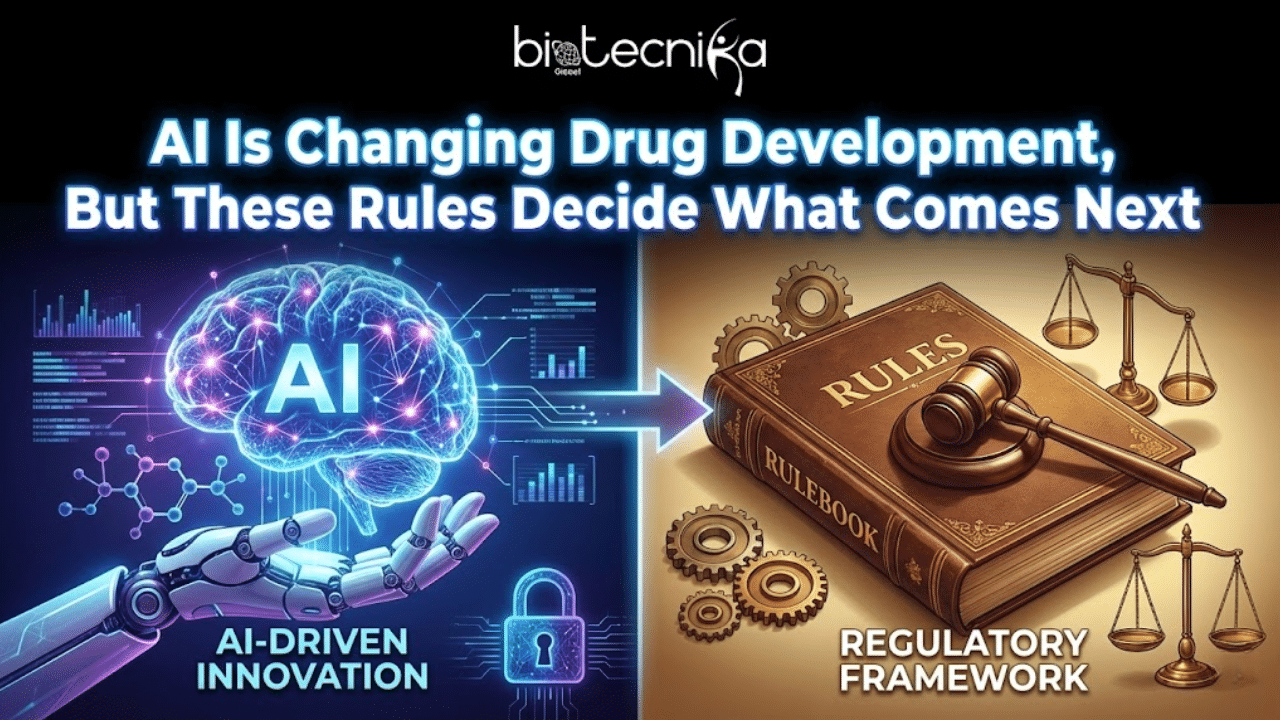
AI Is Drug Development
The world is changing, and so is the biotech industry. Today, advanced technologies such as AI are not just side experiments in labs. It become an integral part of everyday research. From early discovery to post-market safety monitoring, AI in Drug Development changed the way the industry works. With its advancements, it has become one of the most talked-about topics in global life sciences.
In January 2026, regulators and international partners took a bold step that decided what comes next, bringing better clarity to this fast-moving space. The regulators and partners have released Guiding Principles of Good AI Practice in Drug Development.
This is not just another document. This document does not introduce new laws or approval pathways. Instead, it answers the questions that many companies, regulators, and researchers have been asking. Even you might be wondering how we use AI in drug development in a way that is reliable, ethical, and safe for everyone?
But Why These Principles Matter Now?
AI tools have become a part of our everyday lives and research. The scientists are using AI tools in the full drug product life cycle. With these tools, we can speed up the development process. Additionally, we can reduce costs, improve safety monitoring, and lower the need for animal testing. These tools also have stronger predictive power for human toxicity and effectiveness.
But remember, the world of AI is complex. It depends on the data quality, model design, and ongoing monitoring. A single mistake can impact the entire process. To have better control over this, the European Medicines Agency (EMA) and the Food and Drug Administration (FDA) have set some ground rules. They welcome innovations, but for them, patient safety comes first.
Let’s look at these new guiding principles to ensure AI supports that goal rather than weakening it.
The 10 Guiding Principles for AI in Drug Development
The regulators are not treating AI like a black box. Instead, they have come up with guidelines that will shape how AI should be used in drug development. Let’s understand them one by one below:
-
Building a Human First Design
The guidelines begin with the most basic and important rule: human-centric design. All the AI tools should be designed based on human values and real-world decision-making. These tools should support our scientists, doctors, and regulators and not replace them.
-
Risk-based approach
The level of validation and oversight should match the AI system’s risk and intended use.
-
Follow existing rules, not side-step them
With the AI in the picture, we are not going move away from the existing rules. AI should meet the same legal, ethical, quailty and regulatory requirements that the traditional work as accepted.
-
Be clear about why the AI is being used
Every AI tool used should have a well-defined role in the research. People working with these tools should be aware of the systems and their limitations.
-
Bring different experts to the table
AI development should involve experts from both technical and scientific fields. They should be working together throughout the life cycle.
-
Data governance and documentation
The sources of data, processing, and decisions made based on the data should be clearly recorded. The sensitive data should be protected at every stage.
-
Build models that can be trusted
AI models should be built using best practices, fit-for-use data, and sound engineering principles. These models should perform consistently and behave as expected in real use.
-
Test performance in real-world conditions
During the evaluation, the AI should reflect how it actually works. This should include how people are going to interact with it, too. The metrics and testing methods should fit the purpose.
-
Manage AI over time, not just at launch
The advancing technology needs a contant monitoring even after launching. The performance of these AI models should be reviewed regularly. This will help in getting hold of issues like data drift or unexpected behavior.
-
Explain the essentials in plain language
The last and most important one is having transparency. The users and patients should get clear, understandable information about the role of AI and its limitations. Along with it, they should have a clear understanding of updates.
A starting point, not a final rulebook
The January 2026 document is not a checklist or a regulation. It is a foundation. As AI continues to evolve, so will good practice. The guiding principles are meant to grow alongside the technology.
For the industry, the message is encouraging but firm. Innovation is welcome, but it must be responsible. For regulators such as the EMA and FDA, the principles provide a shared language for future guidance. For patients, they signal that safety and transparency remain the top priorities.
AI is now part of the process by which medicines reach the market. With these guiding principles, the life sciences community has a clearer path forward for using it wisely, consistently, and with trust at the center.