


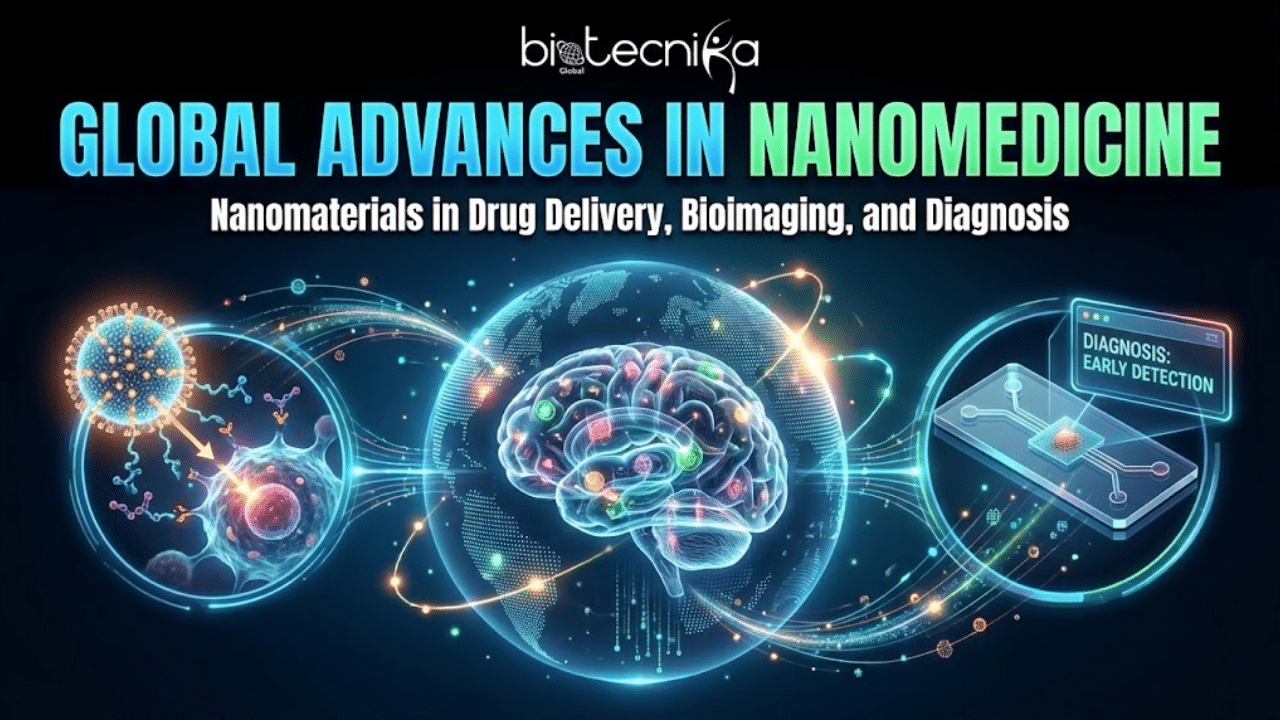
Global Advances in Nanomedicine: Nanomaterials in Drug Delivery, Bioimaging, and Diagnosis
Hello, Dear Future Scientist, Have you ever wondered what if a tiny medicine could cure the deadliest disease in the world? What if a medicine can travel through your bloodstream, find a diseased cell, and treat it? All of this without harming your other healthy cells. Or what if doctors are able to see the early signs of disease even before the symptoms appear? These are not some crazy thoughts or wishful thinking. This is what nanomedicine is already doing.
The world is shifting towards nanomedicine to solve some of the biggest challenges in healthcare. With the innovations at the nanoscale, our researchers are now able to work on smarter drug delivery systems, clearer bioimaging tools, and faster diagnostic methods. These new tools are making a difference not just in the hospitals but also in the small towns and remote areas around the world.
For a life science student, nanomedicine is more than just a topic in a textbook. It’s a field with hope, creativity, and real impact. In this article, we will decode the world of nanomedicine. So, let’s dive deeper into this world of innovations.
What Is Nanomedicine?
Before we dive deeper into this world of science, let’s understand what nanomedicine is. This is a branch of medicine that uses nanotechnology to improve healthcare. It operates at the nanoscale, between 1 and 100 nanometers. At this size, materials behave in special ways. They can move easily inside the body and interact with cells.
For understanding, remember that bacteria are about 1,000 nanometers wide. While viruses are typically around 100 nanometers. With this size, the nanomaterials can directly interact with viruses, proteins, and cells.
Across the world, Nanomedicine is used in cancer treatment, vaccines, imaging, and diagnostic tests.
Why the Nanoscale Is Important in Global Healthcare?
The nanoscale is important because it matches the size of many biological molecules. At the nanoscale, medical tools work more precisely and efficiently. These benefits are more helpful in regions where access to healthcare resources is limited.
With the power of nanomedicine, we can:
- Reducing drug doses and side effects
- Improving treatment effectiveness
- Allowing earlier diagnosis
- Supporting portable and low-cost diagnostic tools
Nanomaterials Used in Nanomedicine
These tiny materials are designed to work safely inside the human body. Different nanomaterials are used depending on the medical purpose.
Common Nanomaterials and Their Uses
| Nanomaterial Type | Examples | Global Medical Applications |
| Lipid-based | Liposomes | Drug delivery, vaccines |
| Polymeric | PLGA nanoparticles | Controlled drug release |
| Metallic | Gold nanoparticles | Diagnostics, imaging |
| Magnetic | Iron oxide nanoparticles | MRI imaging |
| Semiconductor | Quantum dots | Bioimaging |
Do you know that many of these nanomaterials are already approved for medical use? Currently, countries such as Asia, Africa, Europe, and America are using these tiny materials in their healthcare sector.
Nanomedicine in Drug Delivery
In many parts of the world, medicines fail because they break down too fast or cause side effects that can be deadly sometimes. Some medicines do not reach the target tissue. To solve these problems, nanomedicine comes as a saviour. Drug delivery has become one of the most important applications of nanomedicine. Let’s understand how.
How Nanomaterials Improve Drug Delivery?
Nanomaterials carry drugs safely through the body and release them in a controlled way. This improves treatment outcomes and reduces waste. These tiny molecules protect the drug until it reaches the target area.
Key advantages of nanomaterials in drug delivery are:
- Better drug stability in every condition
- Lower toxicity
- Fewer side effects
- Improved patient response
These benefits are especially useful in regions where regular hospital visits are difficult.
Targeted Drug Delivery Explained Simply
| Targeting Method | Description | Global Use Case |
| Passive targeting | Drugs collect in diseased tissue naturally | Cancer therapy |
| Active targeting | Nanoparticles bind specific cell markers | Precision medicine |
Examples of Approved Nanomedicine Drugs
| Drug | Nanocarrier | Used Worldwide For |
| Doxil | Liposome | Cancer treatment |
| Abraxane | Protein nanoparticle | Breast and lung cancer |
| Onpattro | Lipid nanoparticle | Genetic disorders |
These drugs are approved by global regulatory agencies and used in many countries.
Role of Nanomedicine in Bioimaging
With bioimaging, doctors can see inside the human body without surgery. Nanomedicine has improved bioimaging by making images clearer and more accurate.
Why Nanomaterials Improve Bioimaging?
These materials remain in the body longer. Additionally, they produce stronger signals than traditional imaging agents. They help with early disease detection. They also present clearer images and better monitoring of treatment progress.
Nanomaterials in Common Imaging Techniques
| Imaging Method | Nanomaterial | Benefit |
| MRI | Iron oxide nanoparticles | Higher contrast |
| CT scan | Gold nanoparticles | Clear images |
| Optical imaging | Quantum dots | Bright signals |
| PET | Radiolabeled nanoparticles | Early diagnosis |
These technologies are being adapted globally. They are included in teaching hospitals and research centers in developing regions.
Nanomedicine in Diagnosis and Early Detection
With these materials, we can detect diseases before symptoms appear. They help doctors detect diseases more accurately and quickly with limited options.
Nanoscale Biosensors
Using nanoscale biosensors, researchers can detect very small amounts of disease markers. These biosensors are used in cancer screening. In recent times, they have also used
Nanoscale biosensors can detect very small amounts of disease markers. They are used for cancer screening, infectious diseases, and blood and genetic testing. Because all they need is a small sample. They are used worldwide for their rapid results.
Point-of-Care Diagnostic Tools
With these latest innovations, we no longer need to rely on expensive diagnostic devices. Nanomedicine has made diagnostic devices portable and easy to use. These tools are low-cost and need minimal training. They are primarily used in rural and remote areas to help people who cannot afford expensive healthcare. These tools support global health efforts and disease control programs.
Global Research Trends in Nanomedicine
Nanomedicine research is growing across continents. Countries in Asia, Europe, Africa, and the Americas are contributing through universities, public health institutes, and startups.
Major Global Research Focus Areas
- Vaccine nanotechnology
- Personalized nanomedicine
- Smart drug delivery systems
- AI-assisted nanoparticle design
Challenges Around the World
| Challenge | Global Impact |
| Safety testing | Needs international standards |
| Manufacturing | High cost in some regions |
| Regulation | Different rules across countries |
Global collaboration is helping address these challenges.
Ethics and Regulation in a Global Context
Nanomedicine must follow ethical and safety guidelines. Global organizations such as the WHO, FDA, and EMA work to ensure patient safety.
Key concerns include:
- Fair access to nanomedicine
- Long-term safety
- Environmental impact
- Ethical clinical trials
For students worldwide, learning these principles is essential.
The Future of Nanomedicine Worldwide
Nanomedicine is expected to play a major role in global healthcare. Future developments may include:
- Smarter vaccines
- Personalized treatments
- Early disease prediction
- Affordable diagnostics for all regions
As technology becomes more accessible, nanomedicine can help reduce healthcare inequality.

Conclusion
Nanomedicine reminds us that even the smallest tools can create the biggest changes. By using nanomaterials at the nanoscale, scientists are improving drug delivery, strengthening bioimaging, and enabling early disease diagnosis around the world. These innovations are not limited to advanced laboratories. They are reaching classrooms, clinics, and communities across continents.
For students in the global life science community, nanomedicine offers a powerful message of possibility. It proves that science can be precise, compassionate, and inclusive at the same time. As research continues and global collaboration grows, nanomedicine has the potential to make healthcare more effective, more affordable, and more accessible for everyone.
The future of medicine is being built one nanoparticle at a time, and the next breakthroughs may come from students who are learning about nanomedicine today.