


Systematic Analysis of PPI
Have you ever observed a busy metropolitan city like New York by standing on the observation deck of a skyscraper? You can see millions of people. But you will not understand how the city works just by looking at the people. You need to know who is communicating with whom. The city not only functions because people exist there. But also because of the connections they have. Even our cells operate in the same way. Proteins are the citizens of our cellular cities. And PPI networks are the connections between them.
For many years, Biology has been mainly focused on studying each and every cell. But the reality is revealed by a single protein isolated in a test tube! We must examine the proteins and the processes by which they communicate with each other to understand health and disease. We need to study Protein-Protein Interactions (PPIs)
Mapping protein interactions can help create a PPI Network. A systematic analysis of these protein networks is crucial for understanding modern biology. It changes the focus from the individual parts to the entire functioning machine.
What is Meant by Protein-Protein Interactions?
A protein is a worker molecule at its core. They build structures, carry signals, and speed up the chemical reactions. Most proteins don’t work alone. A Protein-Protein Interaction (PPI) is the physical connection between two or more proteins. It is known as the biochemical handshake.
This is not just a random jump into the crowded cytoplasm of a cell. There is a specific, intentional interaction between the proteins. This is driven by forces such as electrostatic interactions and hydrophobic effects.
This is like a lock and key concept. One protein might have a specific site that serves as a groove, and another protein has a protruding structure that fits perfectly into the groove. Something gets changed when they connect. They can activate a complex machine, such as a ribosome, or mark one of the partners for destruction. Protein interaction is fundamental to almost every biological process.
Key Concepts of PPI
- Nodes & Edges: Imagine this like a map of friends. The nodes are the people (proteins), and the edges are the relationships connecting them.
- Interactome: This is known as the Master Map. It represents every single connection within the organism at once.
- Hubs: These are considered to be the social butterflies. They are the proteins connected to tons of other proteins. They hold everything together. If one of the proteins fails, it can lead to disease.
- Modules/Communities: They are groups of proteins that stay together and work on the same specific function.
- Centrality Measures: This is just a way to keep score and see who is most important. It answers questions like: “Who knows the most people?” or “Who is the bridge between two different groups?”
Important Aspects of PPIs
Not all interactions are created equal. Researchers categorize these interactions based on their lifetimes and binding capacities during protein analysis. Some interactions are stable, and some are not. The stable interactions are long-term relationships. The proteins form a permanent complex to perform a task that requires constant effort. One of the best examples is making up the structural skeleton of a cell.
The weak and unstable interactions are quick and temporary. They are transient and often used for signaling processes.
The cell malfunctions if the transient signal becomes permanent, or a stable complex falls apart.
The Nature of Protein Interactions
| Feature | Stable Interaction | Transient Interaction |
| Duration | Long-lasting, permanent. | Short-lived, temporary. |
| Function | Structural support, permanent machine complexes. | Signaling, regulation, transport. |
| Binding Strength | Usually very strong. | Often weaker, easily reversible. |
| Example | Hemoglobin subunits transport oxygen. | The kinase enzyme briefly binds to pass a signal. |
Why PPIs Matter?
Broken networks cause disease. Many types of cancer and neurodegenerative disorders like Alzheimer’s are not just about a bad protein but often about a bad interaction. A protein might lose its ability to bind to the right protein, or might start binding to the wrong things.
It is easy to identify where communication breaks down by studying the PPI Networks. This opens the door for the production of new drugs. Modern medicine seeks to design drugs that either block a harmful PPI or restore a lost beneficial protein, rather than simply destroying a harmful protein.
From Protein Identification to the Network Map
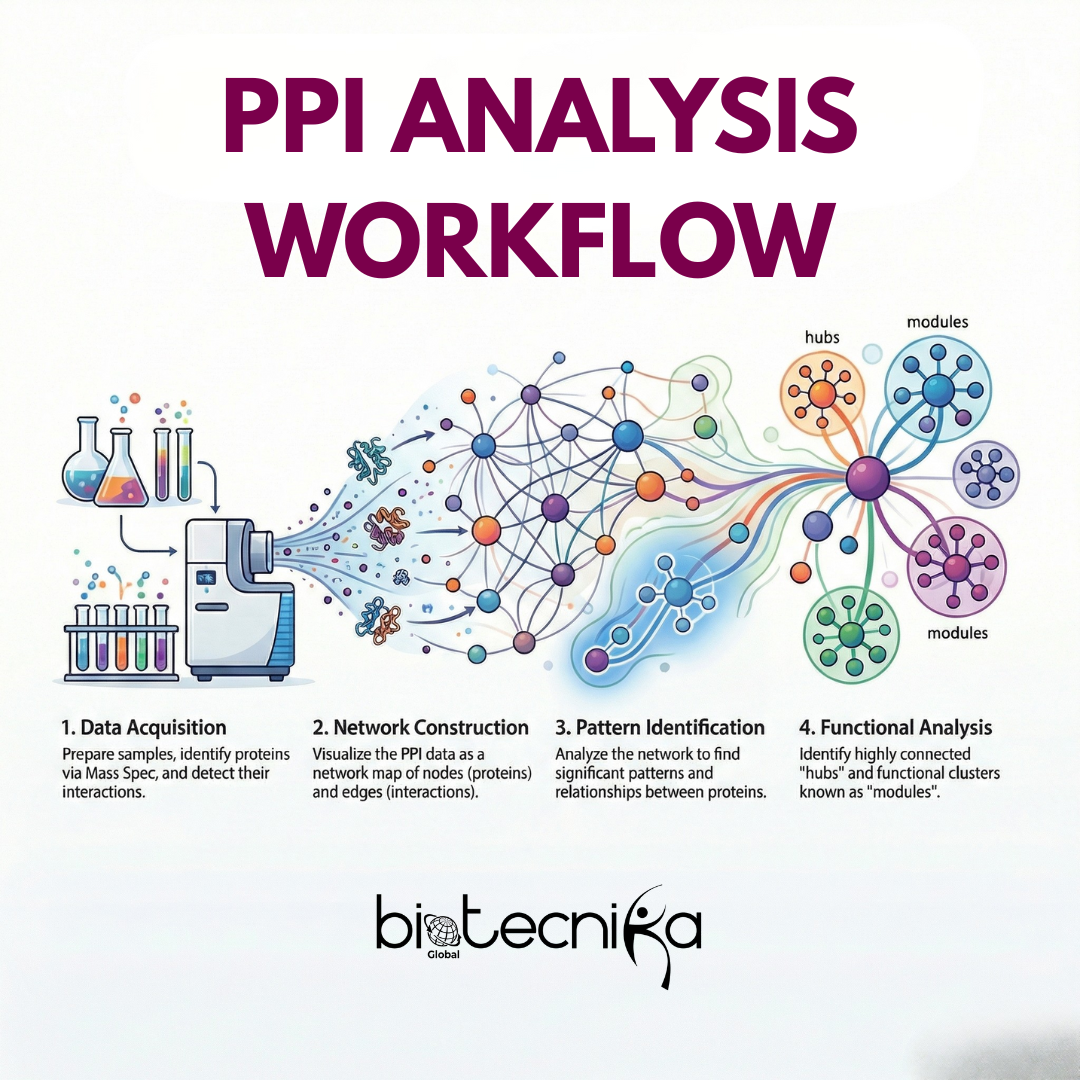
Before we can analyze the network, we have to build it. This starts with protein identification. You cannot know who is interacting if you don’t know who is present in the sample.
Modern mass spectrometry is often used for high-throughput protein identification. Once scientists have the “guest list” of proteins in a cell type, they use various experimental methods to see who is hanging out with whom.
This data is collected and fed into computers to generate a PPI network. Visually, this looks like a giant hairball. The proteins are dots (nodes), and their interactions are lines connecting them (edges).
A raw PPI network is highly complex and appears chaotic. This is why “systematic analysis” is very important. We need to use statistical and computational tools to untangle the hairball and find the meaningful patterns hidden within the protein interaction data.
Moving from Parts to Whole
| Step | Action | Goal | Keywords Involved |
| 1 | Protein Identification | Cataloging which proteins are present in the cell. | Protein identification, protein analysis |
| 2 | Interaction Screening | Detecting physical binding between identified proteins. | PPI, Protein Interaction |
| 3 | Network Construction | Mapping connections to visualize the “hairball.” | PPI network |
| 4 | Systematic Analysis | Using algorithms to find hubs, modules, and pathways within the map. | Systematic analysis, protein analysis |
Systematic Analysis of the PPI Network
Systematic analysis moves beyond just looking at the connections. It primarily focuses on understanding the shape and structure of the network. Some proteins have an unusually high number of connections. They are the critical influencers. If a peripheral protein is removed, the network is likely to survive. The entire protein network might collapse if the hub is knocked out through a genetic mutation. This can lead to cell death or severe disease.
We also look for modules or clusters. These are the groups of proteins that interact to perform a specific function. The functions of unknown proteins can be predicted using this systematic protein analysis on a network level.
Common Tools & Databases used in Systematic Analysis of PPI
- STRING: It gives a huge list of interactions. Both the ones we know for a fact and the ones based on predictions.
- IntAct & MINT: These are the reliable storage lockers. They are public archives where the scientists upload their raw data. This hard evidence can be accessed by anyone else.
- Cytoscape: This is the main piece of software everyone uses to “draw” the map. The data is fed, and it creates the actual visual network, so we will be able to see the patterns.
- PINA: It is a platform that allows data collection, network building, and analysis. This happens in one place, without jumping between websites.
Analysis Steps
- Collection of Data: A list of proteins and interactions relevant to the study from databases like STRING.
- Build the Map: The collected data is converted into a network graph. This is where the filters are applied to extract the specific data for the study.
- Find the Patterns: Now you run the stats. You look for the “hubs” and “modules” to see which functions are appearing most frequently.
- Make it Visible: A visual representation is created by loading the collected data into a tool like Cytoscape. This converts all the big data into a map that is easy for the researchers to understand.
- The “So What?”: Finally, the visual representation helps to connect the new clusters or hubs that were found back to real-world biology to form a new hypothesis to test in the laboratory.
Conclusion
We observe a drastic change in biology when moving from studying isolated proteins to analyzing the PPI network systematically. It determines that life is complex and interconnected. It is the study of protein interaction that reveals the instruction manual of life, though protein identification gives us the parts list.
By continuing to refine our maps of cellular communication, we come closer to understanding the basic mechanics of life and finding new ways to fix it when it breaks!