


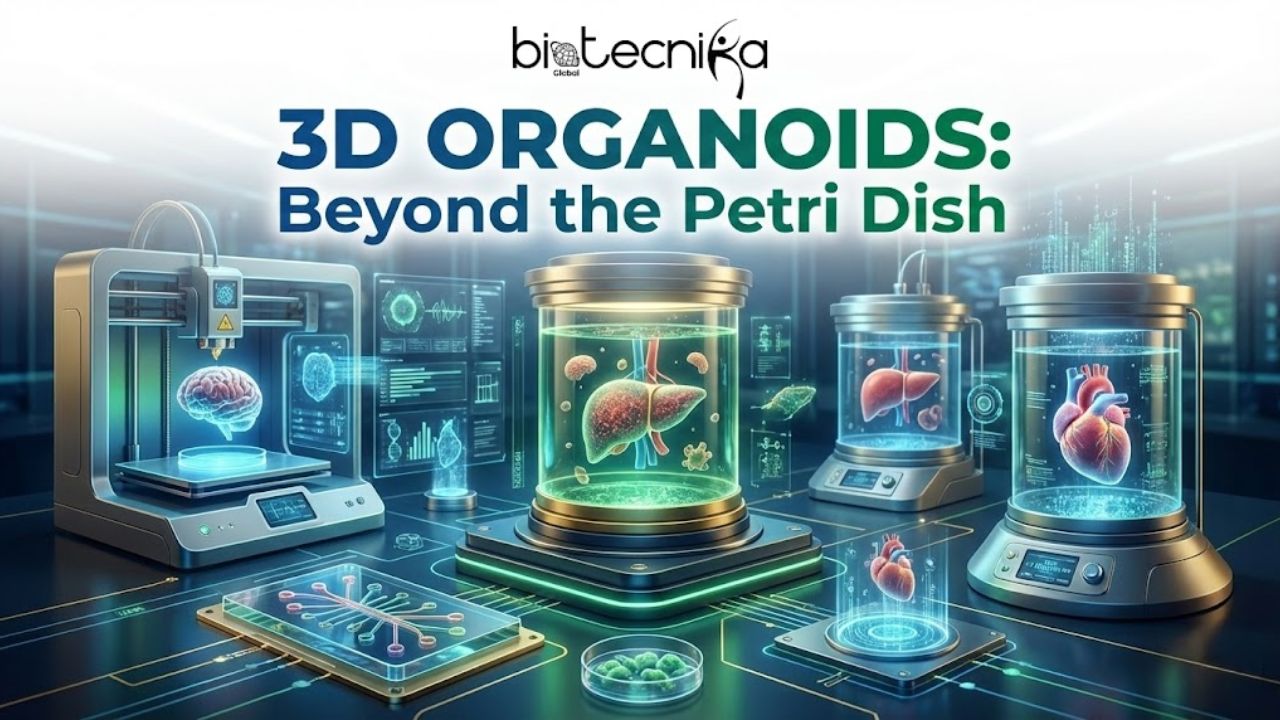
3D Organoids
Imagine that you are trying to know about the complexity of a busy city like Manchester using a flat, two-dimensional paper map. You will only see the street grid. But you will miss seeing many things, such as skyscrapers, subway systems, and the chaotic interactions among millions of people.
For many years, biologists have been studying human cells grown flat on the bottom of petri dishes. The actual three-dimensional complexity of a real human organ cannot be seen or analyzed in flat structures. Biology is getting bigger. We are moving from flat layers to the era of 3D Organoids. This shift is the revolution in Biology. We can understand diseases, develop drugs, and even approach personalized medicine.
What Are Organoids?
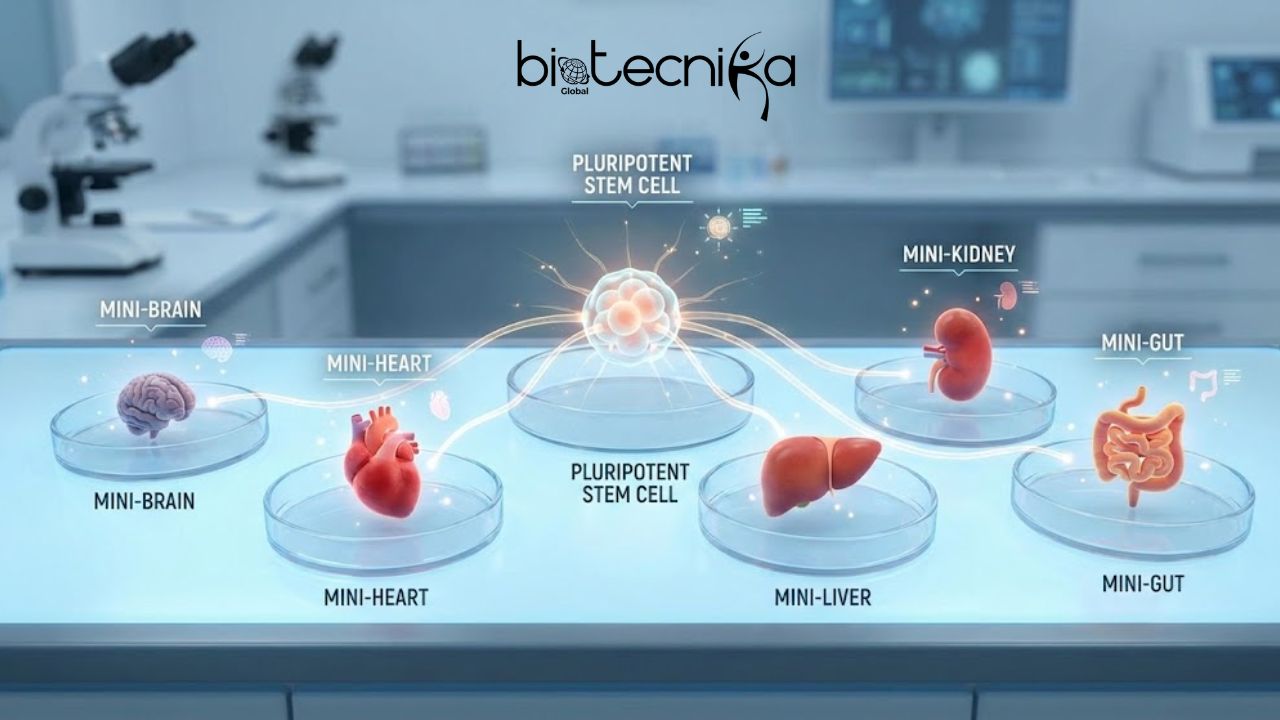
Organoids are miniature, three-dimensional versions of human organs. They are grown in the laboratory petri dishes. They are not full-sized, and functioning organs present inside the human body. They are microscopic structures. They range from the width of a hair to five millimeters. They resemble the structure and function of real organs. Some laboratory-developed organoids are mini-brain, mini-gut, mini-kidney, and mini-liver.
Because stem cells can develop and differentiate into many types of cells, they give rise to these 3D Organoids.
What is the problem with the 2D Organoids?
For more than seventy years, traditional cell culture has been the workhorse of biology. Researchers take cells and grow them in a single layer on a flat plastic surface. This method is cheap and easy. But human cells do not live on a flat surface. They live in a complex 3D environment surrounded by other cells.
In a real organ, cells stack on top of each other, squeeze against their neighbors, and communicate in all directions.
When cells grow flat in 2D, they behave differently. They stop communicating with each other properly. A drug that demolishes cancer cells in a flat petri dish often fails when being tested in a real human or animal because of this. So, there is a need for a better model.
3D Cell Culture for developing Organoids
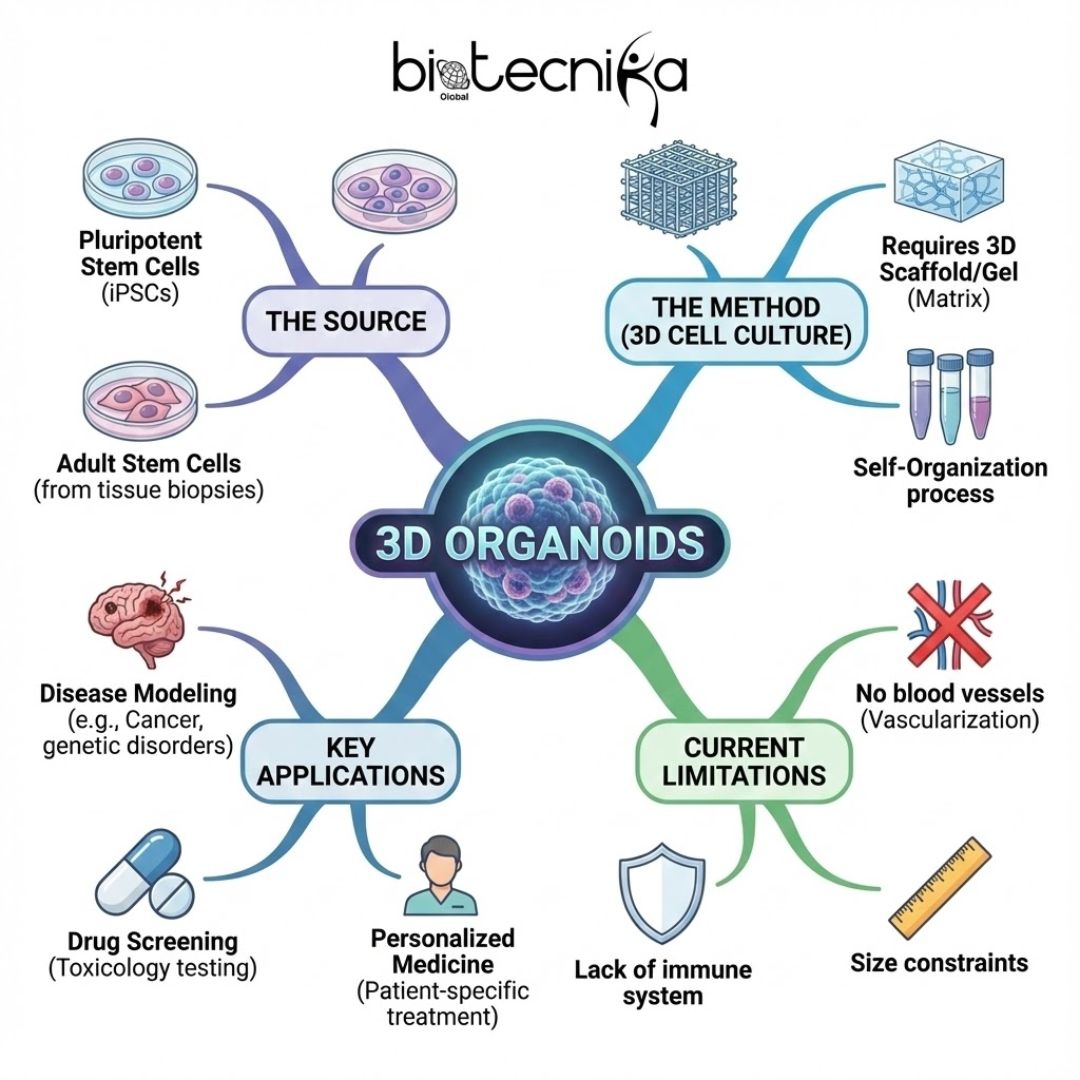
The solution lies in 3D Cell culture. Scientists place stem cells into a special 3D gel or scaffold rather than onto a flat surface. This gel acts like the supportive material that surrounds the cells.
Something incredible happens when the stem cells are surrounded by this 3D environment and given the right chemical signals. The stem cells start to self-organize, divide, and differentiate into specialized cell types. Just like developing organs in an embryo, these stem cells organize themselves into complex structures. This process is known as 3D Organoid Culture.
3D Organoid Culture enables the growth of miniature organ models that resemble real organs. A heart organoid can actually beat, and a kidney organoid can filter urine.
Comparing 2D Cell Culture vs. 3D Organoid Culture
| Feature | Traditional 2D Cell Culture (The “Flat Map”) | 3D Organoid Culture (The “Mini-Model”) |
| Cell Shape | Flat and stretched out unnaturally. | Natural, complex 3D shapes. |
| Cell Interactions | Limited interaction; mostly touches the neighbor on the sides. | Complex interactions in all directions (top, bottom, sides). |
| Mimics Real Organs? | Poorly. Loses tissue architecture. | Excellent. Mimics actual organ structures. |
| Cost & Complexity | Low cost, easy to maintain. | Higher cost, technically challenging. |
| Drug Response Prediction | Often, predictions of human response are inaccurate. | Much better predictor of human response. |
Why are they changing the Game?
The ability to grow these mini-organs is opening doors that were previously welded shut.
- Modeling Diseases in a Dish
It is not possible to study the development of Alzheimer’s in a living human brain without hurting the patient. But it is now possible to grow a mini-brain organoid from a patient suffering from Alzheimer’s to study them. Scientists can observe how plaques form and neurons die in 3D space. This makes them understand how the disease develops in a real-time lab.
- Smarter Drug Testing
It takes over a decade and costs billions to develop new drugs. Most of the drugs being developed fail because the animal models, like mice, are not similar enough to humans at times. 3D Organoids provide an excellent “middle ground” between petri dishes and animal testing. The number of potential drugs can be tested on human organoids and checked for their toxicity and side effects before giving them to a human.
- Personalized Medicine
Imagine that a person is having a specific type of cancer. A doctor could take specific healthy cells, grow countless mini-versions of the particular tumor in the laboratory. They could test different drug combinations in these organoids to see which one works best for that person. Personalized medicine is a better option than chemotherapy.
Challenges and the Future
While 3D Organoids are amazing, they are not yet perfect. Most of the organoids lack a blood supply. Without blood vessels, the required nutrients cannot reach the organoids. They also lack the immune system essential for assessing the organoids’ immunity against real diseases. The future of this field is incredibly bright. There are several courses, such as the 3D Organoids Certification, offered for Life Science Students to understand and learn about it. Researchers are currently working on linking different organoids together on microchips. Imagine that a heart organoid is connected to a liver organoid through small fluid channels. Using this, they can see how the liver metabolizes a drug and how it affects the heart. This concept is known as “Human-on-a-Chip.” We have shifted far from the flat map and are now exploring the complex three-dimensional world of human biology.