


Synthetic Genes in Biofuel Production
“I’d put my money on the sun and solar energy. What a source of power! I hope we don’t have to wait until oil and coal run out before we tackle that,” said Thomas Alva Edison. Over a century ago, Edison recognized that relying on fossil fuels alone was not enough and that we would need sustainable alternatives.
Imagine you are trying to complete a full marathon while eating only celery. You would not be able to go very far. Your body is not designed to convert low-energy foods into high-performance output. This is similar to the case of conventional Biofuels. Mother Nature has given us many beneficial microorganisms, such as bacteria and yeasts, that can produce energy. But they lack high-speed fuel factories to produce them.
For many years. Researchers have been trying to influence these microorganisms to work harder. But now they have started to completely rewrite their operating mechanisms instead of influencing them. This is where the exciting world of synthetic genes enters the picture. Synthetic genes are the supercharging innovation in biofuel production.
The Problem with Regular Biofuels
Let us understand the baseline before getting into the high-tech solutions. Conventional Biofuels, like ethanol, are made from corn. They are a step in the right direction, but they have baggage. They increase grocery prices because they are mainly derived from food sources. Moreover, the process of converting a corn stalk into a fuel is not always very efficient. The microorganisms used in the process may be affected by the fuel produced during fermentation. So, there is a need for the researchers to make these invisible workers mightier, tougher, faster, and hungrier for the waste products rather than food crops.
Enter the Designer DNA
This is where biology meets engineering. Scientists use rDNA Technology to build a better biofuel factory. They can cut and paste DNA Sequences from one organism to another using this Recombinant DNA Technology.
Imagine that a piece of DNA from a bacterium is a huge instruction manual. Recombinant DNA Technology is like having a pair of biological scissors and glue to edit the genes. Researchers can cut and paste DNA Sequences from one organism to another. This has been useful for many years. But nature does not have to be the exact paragraph you need to paste in. You will need to write a new one from scratch.
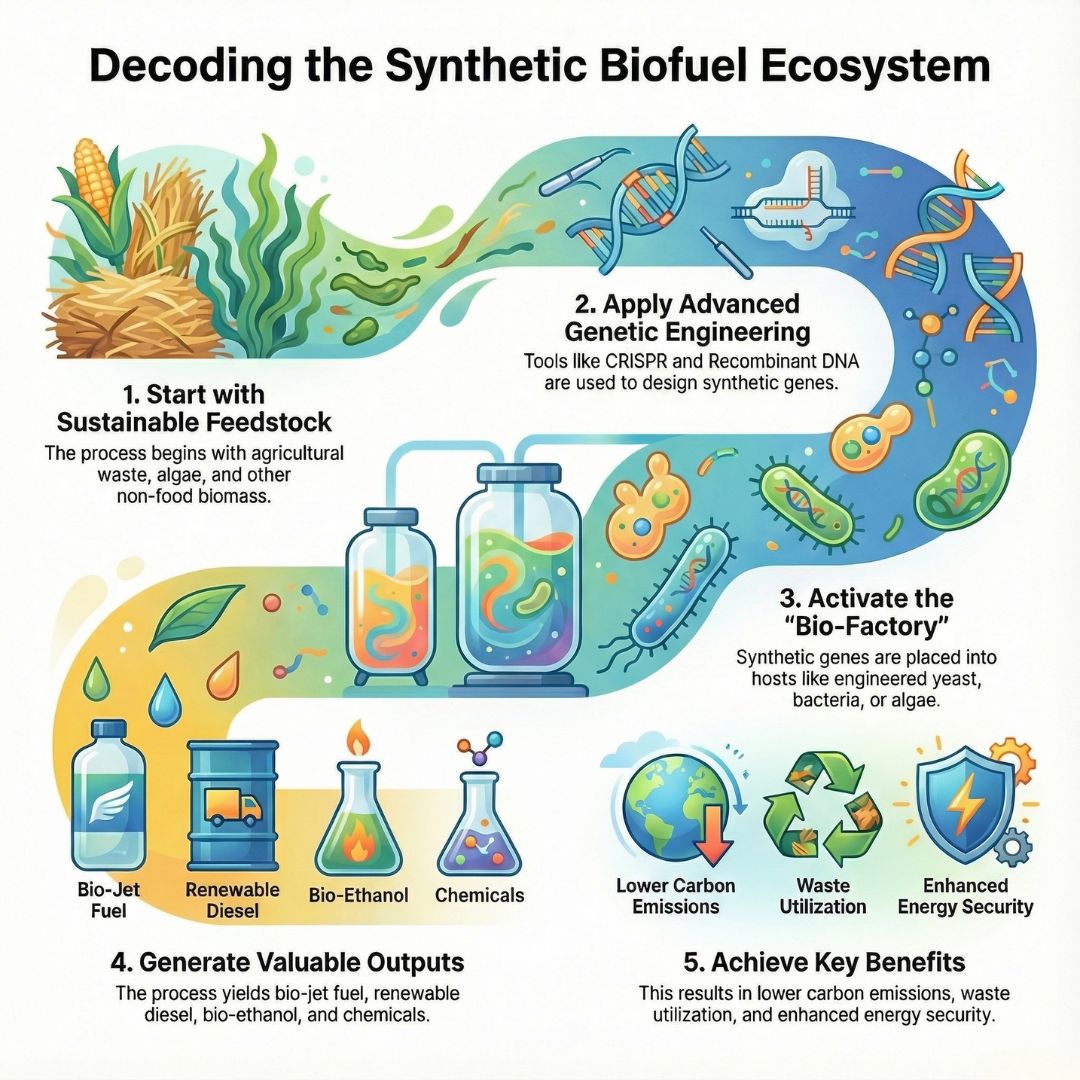
This is what means synthetic genes. They are custom-written DNA sequences that are designed on a computer or constructed in a research laboratory. They do not exist anywhere else in nature. New capabilities are tweaked in an organism by inserting these synthetic genes into it.
How Synthetic Genes Supercharge Production?
The primary goal in life is reprogrammed when synthetic genes are introduced into a host organism, such as bacteria, yeast, or algae.
- Eating Trash: Synthetic genes that allow microorganisms to digest hard agricultural waste, wood chips, or even garbage can be designed. This reduces the need for and cost of sugar or corn. This helps to solve the “food vs. fuel” debate.
- Working Harder: In nature, when a microbe makes enough alcohol (ethanol), it stops working because the alcohol becomes toxic to it. Synthetic genes can strengthen the cell walls of microorganisms, allowing them to survive in higher concentrations of fuel and produce higher yields.
- Designer Fuels: Ethanol is made by the fermentation of Saccharomyces cerevisiae. But the jets and heavy trucks need diesel or jet fuel. Researchers are designing synthetic pathways that enable microorganisms to produce long-chain hydrocarbons that perfectly mimic gasoline and diesel.
Microorganisms and their Biofuel Pathways
| Microorganism | Biofuel Produced | Production Method/Mechanism |
| Saccharomyces cerevisiae (Common Yeast) | Bioethanol | Fermentation: Scientists use synthetic genes to modify this yeast so it can digest tough plant waste (xylose/cellulose) rather than just simple sugars, converting them into alcohol. |
| Escherichia coli (E. coli) | Biodiesel & Jet Fuel | Fatty Acid Synthesis: While naturally found in the gut, these bacteria are genetically rewired to overproduce fatty acids. These fatty acids are then enzymatically converted into long-chain hydrocarbons that function exactly like diesel. |
| Clostridium acetobutylicum | Biobutanol | ABE Fermentation: This bacterium uses the Acetone-Butanol-Ethanol pathway. Synthetic biology is used to boost the production of butanol specifically, which is more energy-dense and less corrosive than ethanol. |
| Botryococcus braunii (Algae) | Renewable Diesel | Lipid Accumulation: This algae naturally produces huge amounts of hydrocarbons. Scientists engineer genes to improve its growth rate and force it to “secrete” the oil, making extraction easier without killing the algae. |
| Zymomonas mobilis | Bioethanol | Entner-Doudoroff Pathway: This bacterium naturally produces ethanol faster than yeast. Recombinant DNA technology is used to expand its diet, allowing it to eat agricultural residues that it couldn’t digest naturally. |
| Synechocystis (Cyanobacteria) | Bio-hydrogen | Photosynthetic Splitting: These “blue-green algae” use sunlight to create energy. Scientists insert synthetic instructions to divert that energy into splitting water molecules, releasing pure hydrogen gas as fuel. |
A Snapshot of Innovation
The transition from old methods to new synthetic methods is stark. Here is a simple comparison of how these technologies differ in biofuel production.
| Feature | Traditional Biofuel (e.g., Corn Ethanol) | Synthetic Gene-Enhanced Biofuel |
| The “Worker” | Natural Yeast or Bacteria | Genetically Reprogrammed Microbes |
| The Feedstock (Food) | Mostly food crops (Sugarcane, Corn) | Agricultural waste, algae, non-food biomass |
| Efficiency | Moderate. Limited by natural tolerance. | High. Microbes engineered for maximum output. |
| End Product | mostly Ethanol (requires engine modification) | Ethanol, Diesel, Jet Fuel drop-ins. |
Challenges and the Future
This all sounds amazing. Why aren’t we filling our cars with synthetic diesel today?
The biggest hurdle is the scale and cost of any upcoming new technology. It’s one thing to get high numbers of engineered bacteria to fill a conical flask in a laboratory, and it’s another thing to fill giant industrial bioreactors. On a massive scale, it is challenging and expensive to manage these “super-microbes” in a healthier and productive way.
There are also regulatory hurdles to be cleared. This ensures that genetically modified microorganisms are used safely and do not escape into the wild.
Conclusion
We are no longer just searching for energy; instead, we are designing it. Synthetic genes are rewriting the future of energy by combining the precision of engineering with the power of biotechnology.
It is not an overnight fix. It will definitely take lots of time, investment, and intelligence to scale up this technology. Also, it is too valuable to ignore the potential to create clean and renewable energy without threatening our food supply.
We are finally taking the advice of Thomas Alva Edison and tackling the energy challenge before the oil runs out.