


AI and Machine Learning in Cancer Genomics: Global Research, Tools, and Career Opportunities
Do you know that every year, nearly 10 million people lose their lives to one deadly disease? Yes, the one we cancer. In the recent reports from the World Health Organization, these numbers have shown the need for a treatment to fight deadly cancer. Today, the world needs advanced technology like AI and Machine Learning in Cancer Genomics to detect, understand, and treat this disease.
With this push, cancer research is changing faster than ever before. Just a few years ago, our researchers worked long hours in the lab studying cancer. It was filled with slow data analysis and many unanswered questions. Today, things are different. With the rise of AI and Machine learning in cancer genomics, scientists can now explore cancer at a completely different and new level.
In this article, we are going to explore how AI and machine learning have changed cancer research. We will look at some of the most important cancer research tools you should know. And what are the career paths for the life science student as you can have in this life-changing field?
What is AI and Machine Learning in Cancer Genomics?
The concepts like AI and ML in cancer genomics may look overwhelming. Especially if you are a fresh graduate or a student. So, to put you at ease, let’s break it down simply.
We will start with the basics: What is cancer geneomics? It is the study of DNA changes in cancer cells.
Then comes, how artificial intelligence (AI) in cancer research is playing an important role? Well, this advanced technology helps the researchers analyse the biological data.
Whereas, the machine learning (ML) in cancer research helps the systems learn from the data and improve themselves over time.
A few years back, the researchers had to study data manually, which was slow and energy-consuming. But now with computational cancer genomics, computers can analyse thousands of samples in just minutes. This helps our researchers in finding cancer-causing mutations, predicting how cancer will grow, and choosing the best treatment for the patient.
Global Research Trends
Across the world, research in AI and ML in cancer genomics is growing. Countries like the USA, Europe, and Asia are using machine learning in cancer research today. They are working mainly on precision medicine, predictive modeling, and genome editing in cancer. This global research is helping researchers better understand tumor behavior.
The research is further boosted by projects like The Cancer Genome Atlas (TCGA) and the International Cancer Genome Consortium (ICGC). These projects help the researchers collect patient data and improve treatment strategies.
Key Global Cancer Genomics Projects Using AI
| Project | Region | Focus Area | Key Contribution |
| TCGA | USA | Multi-cancer genomic analysis | Large-scale genomic database |
| ICGC | Global | Cancer genomics data sharing | Standardized multi-country datasets |
| Chinese Cancer Genome Atlas | China | Cancer mutation analysis | AI-driven tumor classification |
| EuraCAN | Europe | Predictive tumor modeling | Personalized treatment predictions |
These projects show how cancer research is moving toward global collaboration and technology-driven insights.
Cancer Research Tools Enhanced by AI
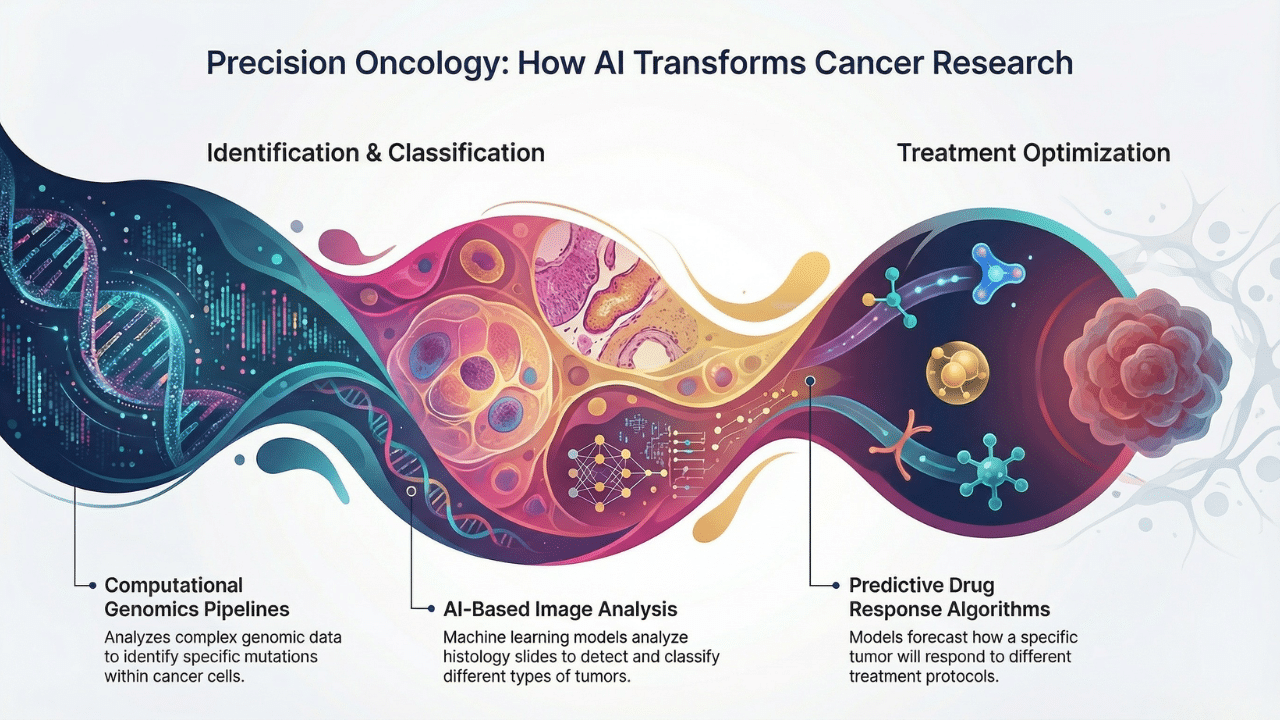
After you have seen some of the major global cancer research projects, let’s understand how modern cancer research tools are helping. These tools help scientists across the world in studying tumors. Some of the most important tools are:
- Computational genomics pipelines: These tools analyze genomic data and identify mutations in cancer cells.
- AI-based image analysis: With the help of machine learning, we can analyse histology slides that will detect and classify tumors.
- Predictive algorithms for drug response: These models will forecast how a tumor will respond to different treatment protocols.
Another important tool is genome editing in cancer. With CRISPR- Cas9, the researchers can modify genes in cancer cells. AI helps in identifying the best target for editing. We can now design treatment plans faster and more precisely.
Here are some widely used platforms in cancer genomics research:
Popular Cancer Research Tools
| Tool | Purpose | Key Feature |
| DeepVariant | DNA variant detection | Accurate genomic analysis |
| OncoKB | Cancer gene database | Clinical interpretation of mutations |
| cBioPortal | Cancer data integration | Combine genomic and clinical data |
| CRISPR Design Tools | Genome editing | Identify targets for therapy |
If you have knowledge and hands-on experience with these tools, then you have an edge over others. By learning them, you can have a wide range of opportunities in research and a career in computational cancer genomics.
Career Opportunities in Cancer Genomics with AI and ML
The field of AI and machine learning in cancer genomics is fast-growing. It offers many new and promising career paths for life science students like you. Let’s have a look at some of these paths.
- Bioinformaticians: As a bioinformatician, you will be analyzing genomic data and developing algorithms. To build a successful career, you need skills in Python, R, and statistics.
- Data scientists in oncology: If you are someone who loves computers and data, then you can build your career as a data scientist. You will be working on building models to predict tumor growth and drug response.
- Research scientists in pharma or biotech: As a research scientist, you can use AI and machine learning to accelerate drug discovery.
To gain the right skills and build a strong career, you can take up the online courses and certifications from reputed organizations. Biotecnika offers you a course on AI and ML in cancer genomics. This course provides you with real hands-on experience along with projects and placement assistance.
Challenges and Future Directions
When we talk about advanced technology, we always concentrate on the brighter side. But these advanced technologies come with their own set of challenges. Some of them are:
- Data Privacy: The primary concern for patients and their families is how these advanced technologies will protect their data. Data protection is a must.
- Multi-omics integration: to get accurate results, researchers use DNA, RNA, protein, and clinical data. This can make the process complex and heavy.
- Clinical validation: We can completely depend on the technologies. After the predictions from the computational models, we must test them on real patients.
Even with these challenges, the future of cancer genomic research is bright. AI and machine learning are expected to improve early detection, personalized therapies, and survival rates. With the open-access datasets and international collaborations, we can continue to advance research.
How can Life Science students get started?
As a life science student, if you are interested in artificial intelligence in cancer research, then you can have a most promising career. To build this career, you need a strong foundation in biology, genetics, and computer science.
Along with your educational foundation, you can follow these practical steps too.
- Start your journey by learning programming languages like Python, R, and more.
- To gain real-world experience, you can work with genomic datasets on platforms such as cBioPortal and TCGA.
- To boost your knowledge and resume, take up online courses in machine learning, bioinformatics, and computational genomics.
- Along with all these, you can do internships and research projects. This will help you in getting hands on experience.
By combining these computational skills with biology knowledge, you can be a part of global research. You can contribute to computational cancer genomics and make a real impact in cancer research.
Real-World Impact
AI-driven cancer genomics is already improving patient care. It helps detect rare mutations, predict treatment outcomes, and support safer genome editing in cancer. By combining cancer research tools with computational models, researchers are making treatments more precise and personalized.
Conclusion
The journey of AI and Machine Learning in Cancer Genomics is just beginning. What we see today is only the start of a bigger change in how we study and treat cancer. With better data, smarter tools, and global teamwork, cancer research is becoming more precise and hopeful.
For students and early researchers, this is a great time to get involved. Learning machine learning in cancer research, using cancer research tools, and understanding genome editing in cancer can help you grow in this field. You do not need to know everything now. Stay curious and keep learning.
The next big breakthrough could come from someone like you.