



Biotechnology Degrees, Syllabus, Skills & Career Outcomes Abroad: The Complete Guide
I know that the world of biotechnology is filled with excitement and confusion. Do you find yourself wondering about your future in biotechnology? Is your biotechnology degree truly opening the door to a promising career?
You are alone. Thousands of biotech graduates across the globe have the same questions. With the advancing technologies, the biotech world is moving faster than ever. Understanding biotechnology degrees, careers, skills, and opportunities can be a bit difficult.
So, here we are today, to give you honest and straightforward answers to help you excel in this complex world of innovation and discovery. We all know that Biotechnology is not just another course you study in college. It’s a field that can change millions of lives with just one innovation. And if you want to be part of it. Then let me tell you that there are some really incredible and inspiring opportunities waiting for you.
So, let’s dive deeper and explore the biotech journey. In this biotechnology guide, we will talk about biotechnology degrees, syllabus, skillsets, and more. This guide will provide you with precisely the things you need to build a promising career in biotechnology. So, let’s start our journey.
1. Biotechnology: An Excellent Career Choice
First, let us understand why you should consider biotechnology as your career choice. We know biotech is part of our everyday life. From healthcare to industrial processes, biotech is everywhere. It’s a field where science and technology solve real-world problems.
Do you know what the best part is? There is always a demand for biotech professionals. And if you are planning to build a career overseas, like in the USA, Germany, UK, Singapore, and the Middle East, then you will have endless opportunities in this field.
These countries are investing heavily in biotechnology. They need skilled people, and that’s where you come into the picture. But to make it there, you need a plan. So, let’s build one for you.
2. Choosing the Right Biotechnology Degree
The first thing you need is a degree. The level of degree varies by career path. Your career path depends on where you are in your education. To make things easy for you, here is a breakdown of them.
2.1 Bachelor’s Degree (BSc in Biotechnology)
This is the most common starting point. During your BS, you will learn about:
- Molecular Biology
- Microbiology
- Genetics
- Biochemistry
- Cell Biology
- Bioinformatics Basics
The bachelor’s degree is the foundation of your biotechnology career. Many universities also include lab work and internships to help you learn better and be future-ready.
2.2 Master’s Degree (MSc in Biotechnology)
After the bachelor’s comes your Biotechnology master’s. If you want to specialize, a master’s degree is the way to go. You will dive deeper into:
- Advanced molecular biology
- Bioprocess technology
- Genetic engineering
- Immunology
- Advanced bioinformatics
By the end of your master’s, you will be able to work on research projects independently. This will help you in developing technical skills. If you are considering working abroad, many international companies prefer candidates with a master’s degree or higher.
2.3 PhD / Doctoral Programs
After your master’s, you can do your PhD. This is not just another degree but a gateway to your research biotechnology career.
With a PhD degree, you can apply for a teaching job at the university or top positions in the biotech industry abroad. The PhD degree program will help you to be dedicated, develop research skills, and gain connections.
3. Syllabus Overview for Biotechnology Degrees
I know the syllabus can look scary, but let’s break it down simply. At both your undergraduate and graduate levels, the subjects will be:
| Core | Subjects |
| Core Biological Sciences | Cell Biology, Molecular Biology, Genetics, Microbiology |
| Lab Skills | PCR, Gel Electrophoresis, Cell Culture, Microscopy |
| Bioinformatics & Data Analysis | Handling Big Data, Basic Coding, Computational Biology |
| Specialized Electives | Immunology, Plant Biotechnology, Animal Biotechnology, Environmental Biotechnology |
| Research & Projects | Major project or thesis (especially for MSc and PhD) |
Remember, it’s not about memorizing everything. It’s about understanding concepts and learning to apply them. That’s what employers abroad value.
4. Skills You Must Develop
Alright, this is where I give you the inside scoop. If you want to stand out internationally, focus on these skills:
4.1 Technical Skills
| Skills | Explanations |
| PCR (Polymerase Chain Reaction) | A technique to amplify DNA sequences is essential for molecular biology experiments. It’s widely used in research and diagnostics. |
| DNA Sequencing | Understanding how to read and analyze DNA sequences is crucial for genetics, genomics, and bioinformatics. |
| Cloning & Gene Editing (e.g., CRISPR) | Techniques for modifying or replicating genes are widely used in research, agriculture, and medical biotechnology. |
| Cell Culture | Growing and maintaining cells in the lab is fundamental for drug testing, stem cell research, and tissue engineering. |
| Bioinformatics & Data Analysis | Using computational tools to analyze biological data, including genome data, protein structures, and large datasets. |
| Bioprocessing Techniques | Knowledge of fermentation, protein purification, and lab-scale production is essential for industrial biotech roles. |
| Microscopy & Imaging | Using microscopes and imaging tools to analyze cells and tissues, key in diagnostics and research labs. |
4.2 Soft Skills
| Skill | Explanation |
| Communication | Ability to write clear reports, give presentations, and explain complex scientific ideas to colleagues or non-scientists. |
| Teamwork | Most biotech projects are collaborative; working effectively in diverse teams is essential. |
| Problem-Solving | Labs don’t always go as planned; you need to troubleshoot experiments and find innovative solutions. |
| Adaptability | Working abroad or in new labs requires flexibility and openness to new methods, cultures, and challenges. |
| Time Management | Managing multiple projects, experiments, and deadlines is critical, especially during research or internships. |
| Critical Thinking | Analyzing data carefully, questioning assumptions, and making informed decisions is key to scientific success. |
| Networking & Professionalism | Building connections with mentors, professors, and peers can open doors to global opportunities. |
If you plan to do a PhD abroad, learning how to email professors properly is crucial. There’s a whole guide on BioTecNika that gives templates for contacting supervisors. And trust me, it’s a game-changer.
5. Career Outcomes Abroad
Here’s the part you have been waiting for, the payoff. Biotechnology offers a wide range of opportunities overseas. Let me break it down:
5.1 Industry Jobs
Biotech companies around the world hire fresh graduates and experienced professionals. Some examples:
| Region | Roles / Opportunities |
| Europe (Germany, Switzerland, UK) | Research Scientist, QC/QA Analyst, Bioprocess Engineer, Bioinformatics Analyst |
| Middle East (UAE, Saudi Arabia) | Clinical Research Associate, Lab Scientist, Biotech Project Manager |
| Asia-Pacific (India, Singapore, Japan) | Research Scientist, Bioprocess Engineer, Regulatory Affairs, Bioinformatics Analyst |
5.2 Educational & Research Careers
If you do a PhD, teaching or research positions in universities or research institutes abroad are great options. You might join a lab in Europe or the US working on cutting-edge genetics or environmental biotech research.
5.3 Internships & Training Programs
Before applying for a full-time job, you can explore international internships. This will give you an edge in the job market. For example:
| Internship / Training | Details |
| Bioinformatics Internship at AbCellera | For PhD students, global research exposure |
| Molecular Biology Internship at SGS (Portugal) | Hands-on lab experience, international exposure |
| Labcorp Global Internship | Real-world lab training, exposure to industry standards |
6. How Can You Prepare Yourself for a Career Abroad
I know biotechnology can be overwhelming. To win this race, you need the right strategy. Here is your roadmap for a successful biotechnology career:
6.1 Educational Preparation
- You must aim for strong grades and lab experience
- Take your internships and research projects seriously
- Broaden your skillset by learning bioinformatics tools and coding basics
6.2 Professional Preparation
- Build your LinkedIn profile highlighting biotech skills
- Connect with your alumni who went abroad
- You can practice writing professional emails and CVs
6.3 Application Strategy for PhDs
- Identify professors whose research matches your interests
- Write concise, polite emails, mention your skills, and why you are interested in their lab
- Attach your CV and transcripts
BioTecNika even has a guide on writing emails to professors for PhD positions; use it.
6.4 Regional Strategy
Now, depending on where you want to go, here is a snapshot of the countries and their opportunities and focus to help you make a better decision.
| Region | Opportunities / Focus |
| Europe | Research labs, internships, postdocs |
| USA/Canada | Industry + academia, H1B visas for graduates |
| Middle East | Emerging biotech hubs, skilled professionals needed |
| Asia-Pacific | Growing biotech sector, research + industry roles |
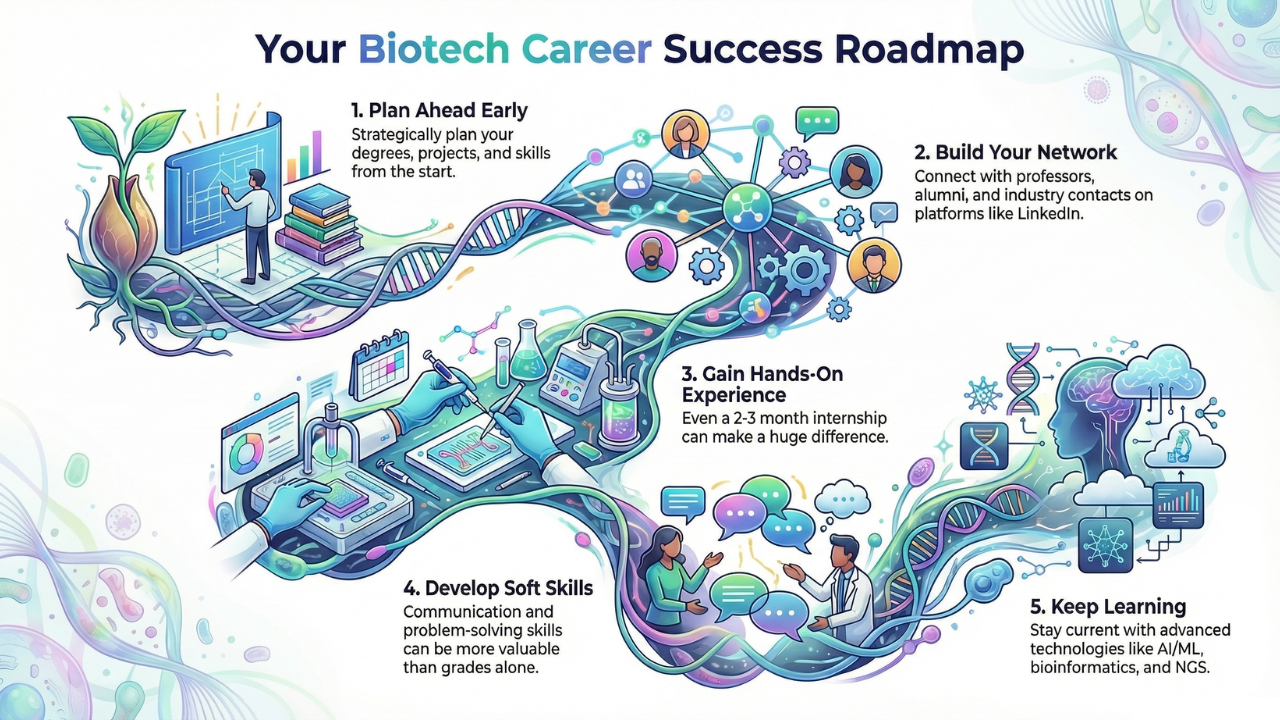
7. Tips from Your Senior (Trust Me on These)
The human mind often tends to memorize facts. But my dear buddy, I don’t want you just to memorize facts. Think strategically:
- Start Early: Plan your biotechnology degrees, projects, and skills now
- Network: Build strong connections with your professors and alumni. Don’t forget that in this digital world, LinkedIn connections matter.
- Internships Matter: Don’t just think of it as extra work or an escape from your college work. Even 2–3 months of hands-on experience can make a huge difference.
- Soft Skills Count: Only the technical skills will not help you. Remember, with Communication and problem-solving skills, you can often beat grades.
- Keep Learning: We have seen the rapidly evolving biotech world. You have to keep up with the latest and most advanced technologies, such as AI/ML, bioinformatics, and NGS, to stand out from the rest.
So, my dear buddy, always remember that biotechnology is more than just a degree. It’s your passport to a global biotechnology career. And to build a successful career abroad, you need:
- The right degree (BSc, MSc, or PhD)
- Hands-on lab and research experience
- Technical and soft skills
- A strategy for applying abroad, including internships and networking
With the right strategy, you will be able to explore the endless opportunities. From top biotech companies in Europe, the USA, Asia-Pacific, and the Middle East to research labs, you can explore a new world of biotechnology.
The world is waiting for talented and skilled biotech minds like you. So start building your career now, with the right skills and mentorship. Apply for the opportunities across the world and don’t be afraid to step out of your comfort zone.
My friend, you have got this. The journey may be challenging. But the rewards, knowledge, experience, and a global career are absolutely worth it.