


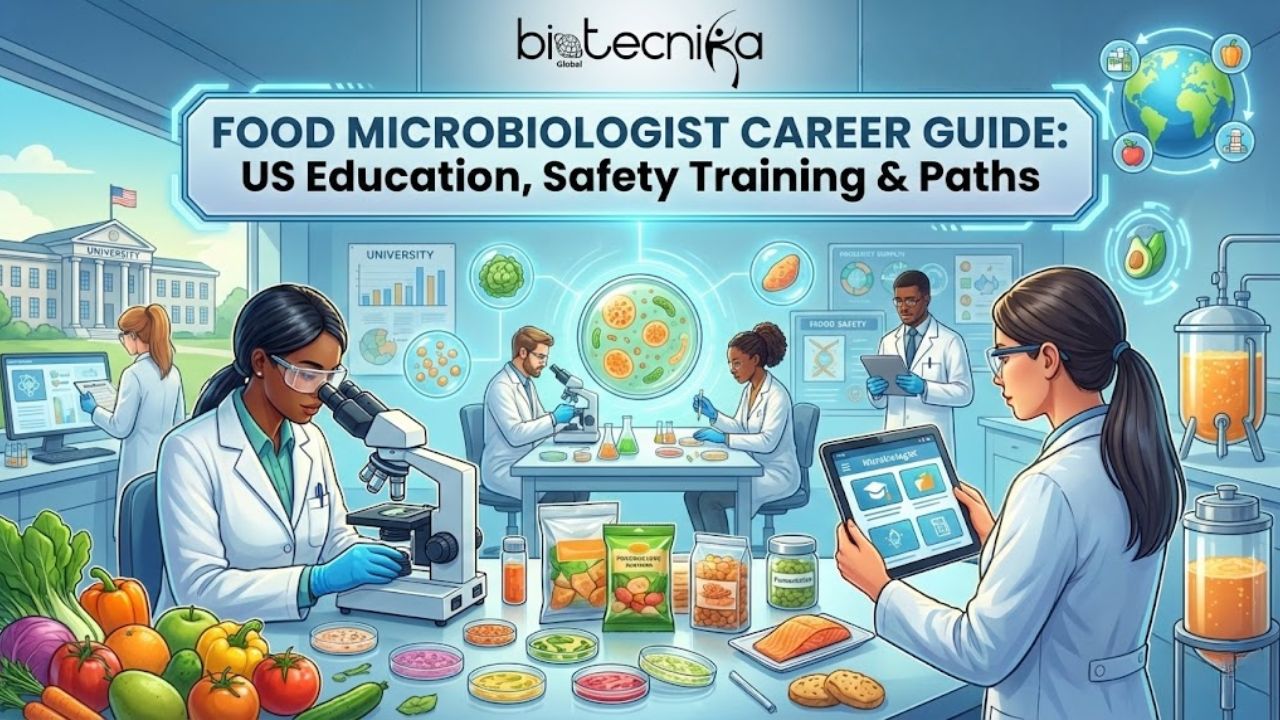
Food Microbiologist in the US
Imagine that you are living in 1995. A sudden and mysterious disease spreads all over the state. Children are falling sick after eating fast-foods, and burgers. Panic arises. Who do you call? Not the police, but a dedicated team of researchers in white coats, armed with Petri dishes. They tracked down the culprit responsible for the outbreak. A specific strain of Escherichia coli that changed food safety laws forever. It is not just about staring at microscopes; it is about being detectives as Food Microbiologists.
Food Microbiologists are the silent guardians who ensure that the milk in a cereal bowl, a lettuce in a salad, doesn’t turn into a health hazard.
“We don’t just study bacteria; we outsmart them to keep the world fed and safe.” – Dr. Sarah J., Senior Food Safety Specialist.
What Does a Food Microbiologist Do?
Simply put, a microbiologist in the food sector studies the “good,” the “bad,” and the “ugly” of tiny organisms.
- The Good: Bacteria that turn cabbage to kimchi or milk into yogurt.
- The Bad: Microbes that are responsible for food contamination and spoilage, making it smell or taste awful.
- The Ugly: Pathogens like Salmonella or Listeria species that make people sick.
The ultimate job of a Food Microbiologist is to stop the bad and ugly while helping the good ones to survive.
Steps to Becoming a Food Microbiologist in the USA
Step 1: Education – Building the Foundation
You cannot become a Food Microbiologist without proper education. The path is straightforward but requires a lot of dedication toward science in the US.
- The Bachelor’s Degree (4 Years): At first, you need a Bachelor of Science (BS) Degree. You should do a major in Microbiology, Food Science, Biology, or Chemistry as a specific Food Microbiology degree is rare at the undergraduate level.
- Essential Courses: You will be in laboratories during your college time more than in four-walled lecture halls. Key courses you must take include:
- General Microbiology: Basics of bacteria, viruses, and fungi.
- Food Microbiology: Studying specifically about the microbes that live in, on, or around food.
- Organic Chemistry: Understanding the chemical reactions in life forms.
- Biochemistry: The study of chemical processes within and relating to living organisms.
- Advanced Degrees (Optional but Recommended): You will eventually need a Master’s or a PhD if you want to lead research or teach at a university about Food Microbiology. This is where you will specialize. You will study in detail about the methods to keep vegan meat safe and extend the shelf life of milk without preservatives.
Step 2: Food Safety Training and Certifications
A Degree in Food Microbiology can get you in the door, but certifications can only get you the job. You need specific Food Safety Training to prove that you know all the rules and regulations, as the food industry is heavily regulated.
- HACCP (Hazard Analysis and Critical Control Points): This is one of the gold safety standards. This management system addresses food safety by analyzing and controlling biological, chemical, and physical hazards. It is a must for every Food microbiologist to have this certification.
- PCQI (Preventive Controls Qualified Individual): It is essential for complying with the US FDA regulations.
- Certified Food Scientist (CFS): This is a prestigious credential for all experienced Food microbiologists. This is offered by the Institute of Food Technologists (IFT).
Step 3: The Career Path and Salary
The journey actually starts in the laboratory and can end in the boardroom. Below is a career progression for a Food Microbiologist in the USA.
| Career Stage | Job Title | Typical Responsibilities | Estimated Salary (USD) |
| Entry-Level (0-3 Years) | Lab Technician / QA Associate | Testing samples, preparing media, entering data, and cleaning equipment. | $45,000 – $60,000 |
| Mid-Level (4-8 Years) | Food Microbiologist / Safety Specialist | Designing tests, analyzing trends, managing safety protocols, and providing Food Safety Training for staff. | $65,000 – $85,000 |
| Senior-Level (8+ Years) | Lab Manager / R&D Director / Principal Scientist | Leading teams, strategy, regulatory compliance, and new product safety. | $90,000 – $130,000+ |
A Day in the Life of a Food Scientist
- 8:00 AM: Arrive at the laboratory and check the incubators to determine whether the organism grows overnight.
- 10:00 AM: Perform tests, such as PCR, on a new batch of food product to ensure there are no harmful pathogens.
- 1:00 PM: Attend meeting with the production team. Advise the team to carefully check processing, packaging, and storage to avoid mold contamination.
- 3:00 PM: Accuracy is crucial in this field. Write a report on the day’s findings.
- 4:30 PM: Review new FDA guidelines on food microbiology to ensure the company stays away from complaints.
Why a Career in Food Microbiology Matters?
Becoming a Food Microbiologist is a stable and rewarding career choice. Because people always need to eat, they need the food they consume to be safe. As a Food Microbiologist, you are protecting public health. Your work will save lives whether you are working for a government agency like the FDA, a giant like Kraft Heinz, or a small organic startup.
This path of a Food Microbiologist might be perfect for your career if you love science and have a detective mind.