


What Happens If You Don’t Learn Lab Techniques in the US
In the life sciences or biotech field, students who want to pursue a life science or biotech career in the US, and fresh graduates, tend to hear this frequently: you need strong lab skills. Graduates are expected to have good grades with hands-on lab experience. What will happen if you enter the US job market without laboratory skills?
To answer this question, fresh graduates shared their experiences on how they learned this lesson the hard way. Their experiences and the challenges they faced explain the important impact of practical laboratory training.
Why Lab Techniques are considered important in the United States
Companies and research teams in the US often do not have the time to thoroughly train freshers from scratch. They want you to know at least the basics, such as: already
- Pipetting
- PCR and qPCR
- Gel electrophoresis
- Cell culture
- Proper aseptic handling
- How to read and follow a protocol
- Basic data analysis and documentation
Students are expected to have some level of lab experience to attend internships nowadays. Students who fail to learn these skills during college or through hands-on laboratory training programs find themselves struggling to build a career.
Job Applications and Interviews
Many of the graduates said that the toughest part was the interview stage.
“Tell me how you would troubleshoot a failed PCR.”
Questions raised about the real-life issues people face in labs exposed those who had real experience and those who didn’t. Graduates without hands-on practice said that:
- They gave textbook answers.
- They couldn’t describe real troubleshooting steps.
- They struggled to explain how they handled equipment.
- Interviewers can instantly reject them, telling them they weren’t lab-ready.
As a result, students apply for jobs, and they either never hear back from the recruiters or receive rejection after all.
Self-Doubt, Stress and Feeling Left Behind
Not learning the laboratory skills can possibly affect job opportunities, which can eventually affect confidence. Many graduates said that they felt:
- Not prepared
They knew the theory perfectly, but panicked at the thought of doing the actual experiment.
- Behind their peers
Watching their friends who had research experience get interviews and offers sooner.
- Nervous about labs
Some even have the fear of doing basic tasks wrong, like contaminating cells or misusing equipment.
- Stuck in a loop
They didn’t have skills → they didn’t get interviews → they couldn’t gain experience → they stayed stuck.
For international students, the pressure was even higher because their visa status often depended on getting a STEM-related job quickly.
4. After Getting Hired, The Learning Curve Is high
Even those who got a job realised that working in a lab without prior experience can be overwhelming.
Fresh graduates shared their experiences, like:
“I didn’t know how to pipette properly at first.”
“I contaminated my cell culture within two days.”
“I didn’t know how to balance a centrifuge.”
These might sound like small mistakes, but inside a busy lab, mistakes like these can cost time, money, and trust.
New hires often had to deal with:
- Relearning extremely basic lab techniques
- Asking for help constantly
- Extra supervision
- Fear of making mistakes
- Feeling like they were slowing the team down
And because they lacked confidence, they didn’t get advanced projects at first. Many were assigned beginner-level tasks for months.
Missed Opportunities, Slower Career Growth without Lab Techniques
Lower starting positions
Without strong laboratory skills, many graduates had to start in assistant or support roles and not full research positions.
Lower salaries
Technical roles pay more. Without knowing the lab techniques, graduates miss out on higher-paying opportunities.
Slower promotions
When fresh graduates take months to learn the basics, their promotions are delayed.
Limited access to cutting-edge fields
Areas like gene editing, immunology, drug discovery, and synthetic biology require solid lab techniques. Graduates without hands-on lab skills are not allowed to explore these fields before they acquire experience.
Real Experiences From Fresh Graduates
Here are a few real stories summarised in simple words:
Story 1: “I knew everything in theory, but nothing in practice.”
A biology graduate said she froze during a live pipetting test in an interview. She realised she had never even touched a real pipette during college practicals.
Story 2: “I wasted six months applying for jobs.”
An international student said every job expected PCR, gel runs, or cell culture. But he didn’t have the expected experience. He eventually joined a short lab techniques training program to catch up.
Story 3: “My first three months at work were stressful.”
A research assistant admitted he made silly mistakes and felt embarrassed asking for help constantly. It took him months to feel confident.
Story 4: “I couldn’t enter the field I wanted.”
A biochemistry graduate wanted to work in genomics, but they had not learned the basic molecular biology skills. She ended up in a non-lab role for one year.
How to Avoid These Problems
You can avoid this situation by following these recommendations from the graduates.
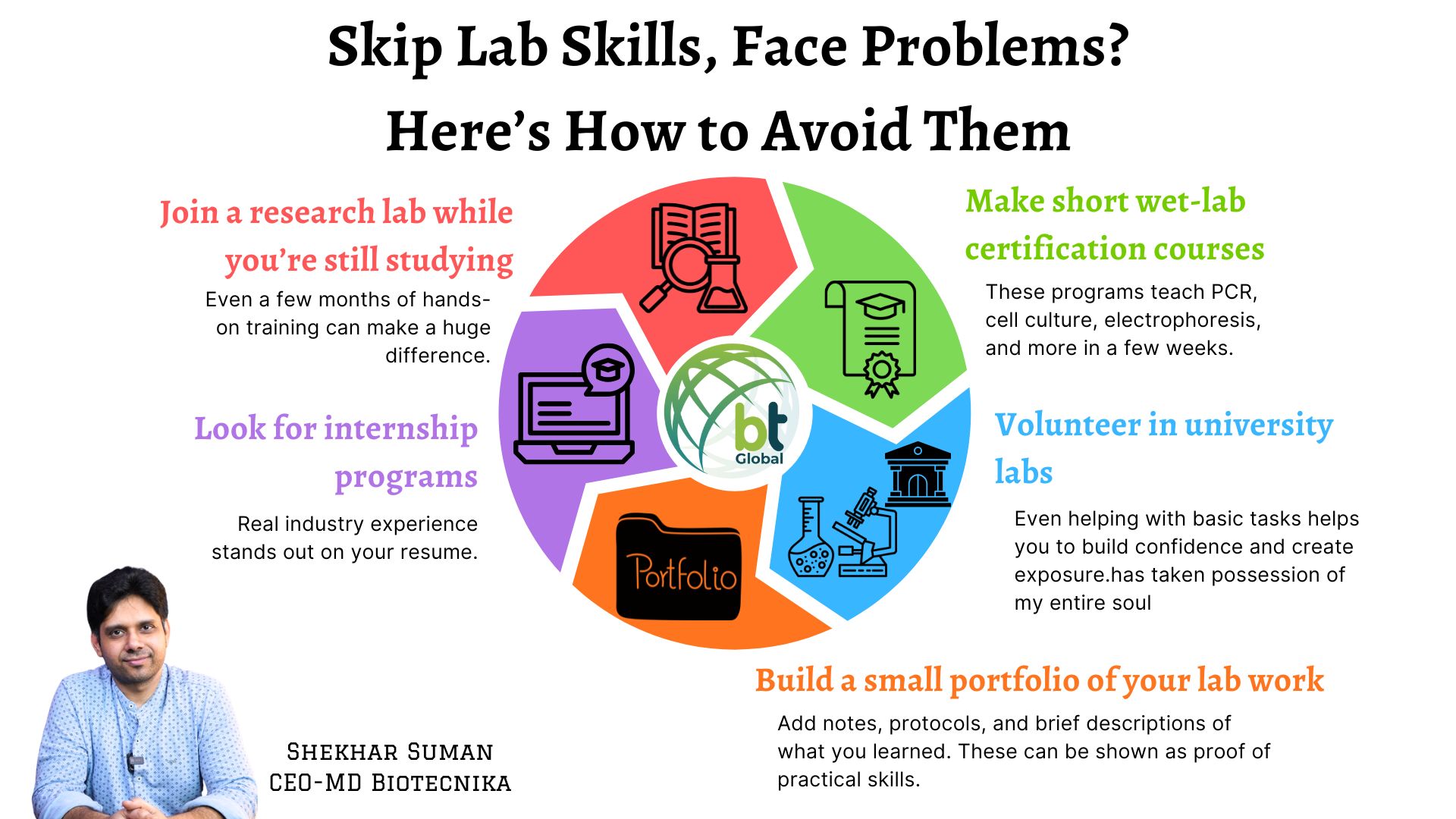
- Join a research lab while you’re still studying
Even a few months of hands-on laboratory training can make a huge difference, and help gain confidence with handling lab techniques.
- Look for internship programs
Real industry experience stands out on your resume.
- Take short wet-lab certification courses.
These programs teach PCR, cell culture, electrophoresis, and more in a few weeks and will provide Lab Certification as proof of completion.
- Volunteer in university labs
Even helping with basic tasks helps you to build confidence and create exposure.
- Build a small portfolio of your lab work.
Add notes, protocols, and brief descriptions of what you learned. These can be shown as proof of practical skills.
Conclusion
If there’s one thing all the graduates agreed on, it’s that Lab techniques are not optional in the US; they are essential.
Learning lab techniques can help decide:
- How confidently you interview
- How quickly can you get a job
- How fast do you grow once hired
- How advanced can your projects be
- How competitive your career becomes
When you spend some time learning real, hands-on lab techniques, everything becomes easier. You can approach the interviews with confidence. You can adapt to a lab environment quickly. Your mistakes are reduced. And you will be able to explore exciting fields like biotech, genetics, pharmaceuticals, and diagnostics.
But when the Lab Techniques step is skipped, the career journey becomes slower and can have unwanted tough situations.
The message from fresh graduates is simple:
Get into a lab early, practice as much as you can, and build laboratory skills and learn the lab techniques that make you confident, capable, and career-ready.