
AI in Drug Discovery: Cutting Timelines While Clinical Trials Lag
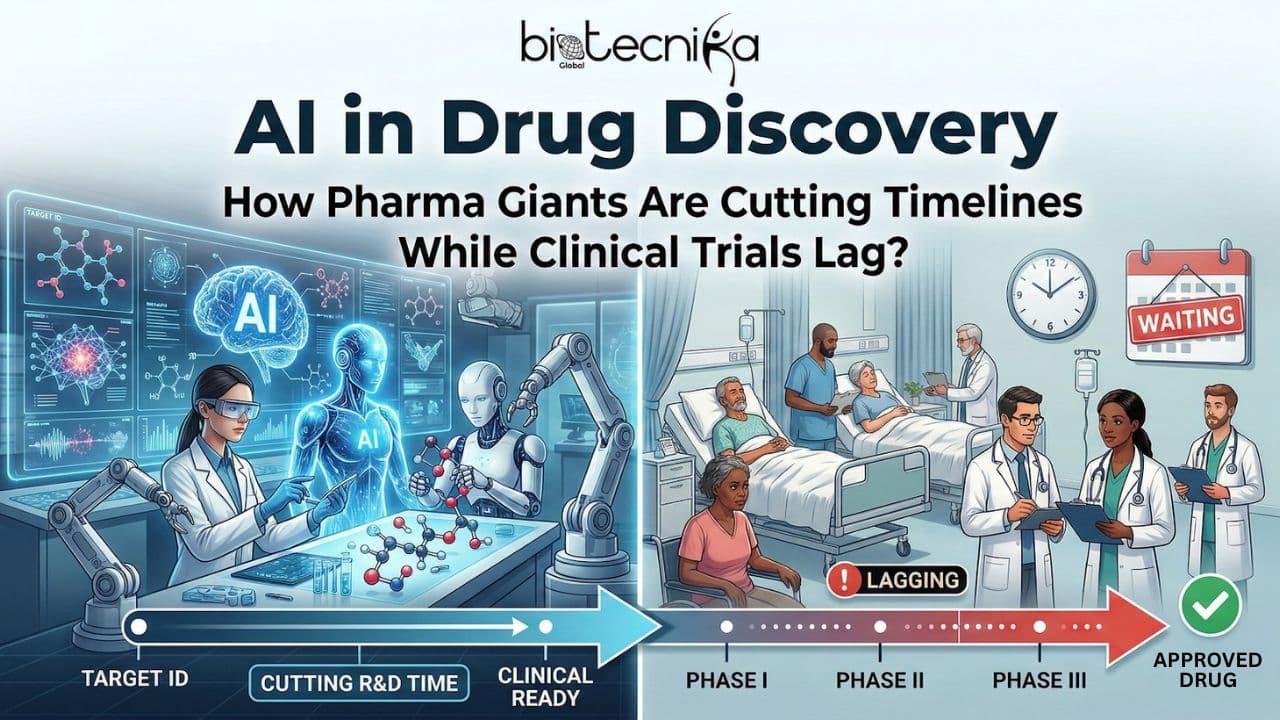
AI in Drug Discovery is no longer a future idea. It is happening right now in many Pharma Giants. AI is being used at the very beginning of every drug research project. At the BioAsia Summit in Hyderabad, industry leaders revealed that AI is helping companies accelerate drug discovery in many ways. It helps discover medicines faster, expand their drug pipelines, and even prepare launch documents on time. It helps to analyze a large set of biological data in minutes. Some companies say that their pipelines have doubled in just a few years due to AI. But there comes a big question. Why are the Clinical Trials still taking a long time if AI is moving so fast?
AI is now being used by various researchers to find potential drug targets more quickly. AI predicts the issues at the earlier stages. It helps analyze large amounts of biological data more quickly. Many companies say that AI allows them to increase innovation without spending much.
Merck Sharp & Dohme (MSD) is one major example of this transformation. In a Pharma or a Biotech company, advanced technologies are now deeply integrated into both research and downstream processes. According to Anton Groom, the Chief AI Officer of MSD, these AI tools have helped the global drug development pipeline over the past few years. This means the company now has twice as many potential drugs in development as before.
The technology is not only used inside MSD laboratories. Generative tools are also helping with regulatory paperwork, medical documents, and patient-related content. Approval documents that once took weeks can now be prepared much faster. This makes it possible for multiple medicines to move toward approval simultaneously while still adhering to strict regulatory requirements. The company plans to launch more than 20 new drugs globally in the coming years. This shows strong confidence in tech-driven growth.
Takeda Pharmaceuticals is another Pharma Giant taking a powerful approach. Instead of simply adding digital tools as support, Takeda is redesigning its research system from the ground up. The company is building “AI-native laboratories” in which intelligent systems are part of everyday workflows rather than separate add-ons.
India is playing a major role in this shift. Takeda’s Innovation Capability Center in Bengaluru is developing large-scale digital and data systems that support global research, manufacturing, supply chains, and patient services. The company sees India as a strategic capability hub due to its strong digital talent and a growing innovation ecosystem. This setup helps the organization operate more quickly and efficiently across the world.
However, not every company is seeing immediate reductions in costs and timelines. During the discussions, Miltenyi Biotec offered a more cautious view. Its founder, Stefan Miltenyi, explained that while advanced systems are widely used in molecular design, imaging, and data analysis, their impact on products currently entering Clinical Trials is still limited.
Many development processes continue to rely on traditional and paper-based systems. Even if a promising drug is discovered quickly, later stages may move slowly because the overall system has not fully adapted. Clinical Trials involve strict regulations, patient safety checks, and detailed documentation, which cannot be changed overnight.
Experts believe the biggest benefits will appear over time. These technologies could significantly improve clinical trial design, statistical planning, data management, and regulatory reporting in the future. They are already better than humans at analyzing large imaging datasets and identifying complex biological patterns. However, the full transformation will depend on how quickly regulators in Europe, the United States, and India update their frameworks to support tech-driven development models.
AI in Drug Discovery is powerful and helps Pharma Giants expand their pipelines and improve efficiency. But the Clinical Trials remain one of the most complex and time-consuming parts of drug development. The industry is in the middle of a change!
AI is not a magic shortcut. It is a strong tool that works best when combined with human expertise. This partnership between AI and humans could decide how fast the next life-saving drug reaches patients around the world!