


Medical Ethics
Imagine that a doctor sits in front of a screen late at night and observes an AI-generated treatment plan for a cancer patient. The results are fast, confident, and backed by millions of data points supporting the treatment plan. But there arises one question. Is this treatment plan truly in the best interest of the patient? Bioethics lives today in that moment of pause between innovation and responsibility.
Modern Healthcare is moving faster. The rise of new tools and technologies is transforming diagnosis, treatment, and life. As a result, Medical Ethics is no longer about right and wrong. Bioethics has expanded from the research labs and data centers to policy rooms. This is the major reason why Bioethics plays an important role in Medical Research and Healthcare Innovation.
What is Bioethics?
Bioethics is the study of ethical issues arising from advances in biology, medicine, and technology. It helps to make decisions when science challenges the values. It creates a balance between fiction and reality. It has traditionally focused on patient consent, clinical trials, and end-of-life care.
The scope of Bioethics is becoming much broader. It addresses problems related to artificial intelligence, big data, gene editing, and access to care.
From the Doctor’s Approach to Global Governance
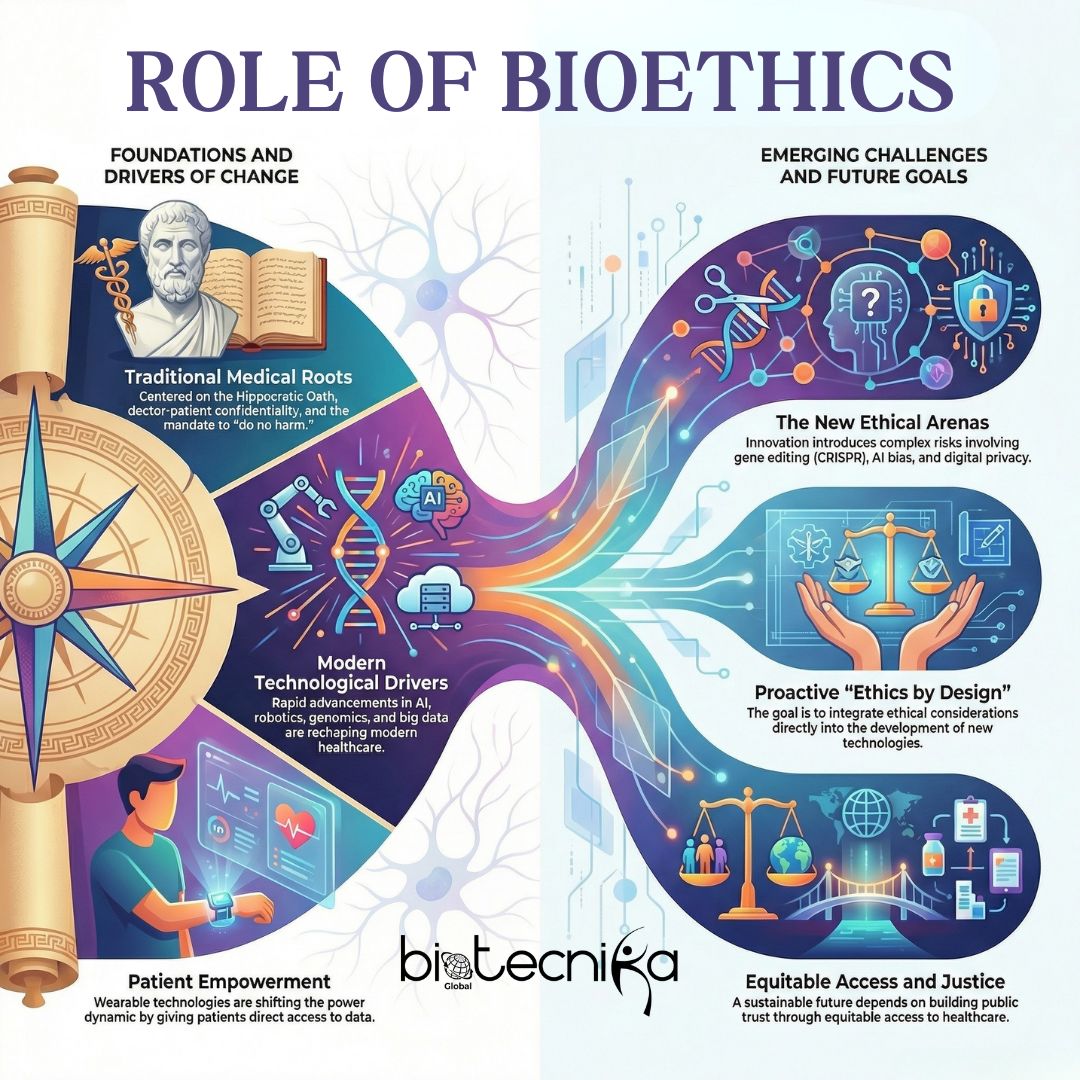
Medical ethics were on point for many years. It was guided by the Hippocratic Oath, “Do no harm.” It was all about honesty, confidentiality, and the patient’s best interest.
Everything had changed by the mid 20th century. There were many advancements in the medical field. There were a number of organ transplantations, the use of ventilators that could save lives, and the boom in genetics.
But also, the world was horrified by revelations of unethical medical research. One of those was the Tuskegee Syphilis Study. In the study, human subjects were treated as data points rather than people.
It was clear that the old rules and regulations were not enough. There is a need for a broader framework to address society, technology, and the very definitions of life and death beyond doctors and patients. Bioethics emerged from this need. It stepped in to do something.
New Frontiers in Bioethics
Healthcare innovation is expanding today. Science fiction is becoming reality nowadays. The innovations introduce complex moral dilemmas that conventional medical ethics struggles to address on its own.
- Artificial Intelligence (AI) in Diagnostics: Bioethics ensures that modern healthcare tools don’t automate discrimination and that algorithms don’t exhibit bias.
- CRISPR and Gene Editing: Genetic diseases like cystic fibrosis could be eliminated using gene editing tools. But what if we can fix those diseases by enhancing the traits? Are parents allowed to design “better’ babies? Bioethics serves as the stop sign. It is forcing scientists to pause and consider the long-term impacts of altering the human genome.
- Big Data and Privacy: Medical research relies heavily on large datasets. A smartwatch can calculate the heart rate, sleep patterns, and activity levels. This data is gold for researchers seeking to identify patterns in disease. Bioethics is working hard to define digital rights and consent for our health data that lives in the cloud.
Change from Clinical Ethics to Bioethics Challenges
| Traditional Medical Ethics Focus | Modern Bioethics Challenges |
| Patient Confidentiality (doctor keeping secrets) | Big Data Privacy & Genetic Information Security |
| Informed Consent for Surgery | Broad Consent for Future Uses of Biological Samples |
| End-of-Life Care (DNR orders) | Defining Death in an era of artificial life support |
| Fair Access to Doctors | Algorithmic Bias in AI Healthcare Tools |
| Doctor-Patient Trust | Trust in Pharmaceutical Companies & Tech Giants |
Bioethics as an Innovation
Bioethics ensures sustainability. Treating ethics as a post-research checkbox is no longer viable. Some giant organizations use “ethics by design.” For example, Engineers and ethicists must collaborate when designing neural implants. This ensures they can address risks, such as personality changes or software obsolescence, at earlier stages. Incorporating ethics into the research process improves the quality of the end product and fosters public trust.
Pillars of Bioethics in Action
| Principle | Simple Definition | Modern Healthcare Example |
| Autonomy | The right to make your own decisions about your body. | A patient choosing to decline a life-saving experimental AI treatment because they don’t trust “black box” algorithms. |
| Beneficence | Acting in the best interest of the patient/society (doing good). | Researchers are developing mRNA vaccines rapidly to halt a global pandemic. |
| Non-maleficence | “First, do no harm.” Avoiding unnecessary risk. | Ensuring a gene-editing trial has ironclad safeguards to prevent off-target genetic damage. |
| Justice | Fairness in distributing benefits and burdens. | Ensuring that expensive new gene therapies are not available only to the ultra-wealthy. |
The Empowered Patient
Bioethics has empowered patients through technology. Bioethics provides the framework as healthcare innovation continues to accelerate. But we have to be careful not to leave people behind. Bioethics acts as a reminder that progress shouldn’t come at the expense of equality.
Conclusion
Bioethics has expanded beyond clinical care into the high-stakes world of tech development. As innovation accelerates, a strong moral framework is no longer optional; it is essential. Rather than hindering research, bioethics directs it. It is ensuring that our technical progress remains aligned with the people it is meant to serve.