


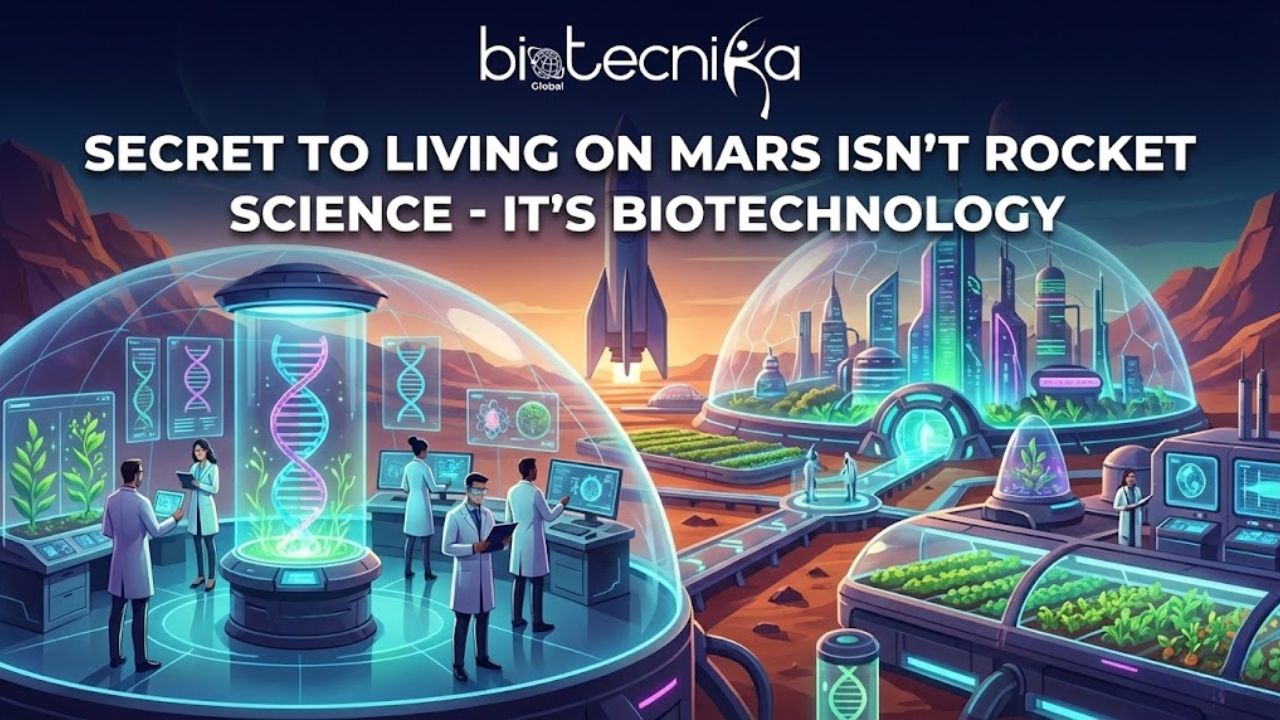
Secret to Live on Mars
We all have seen many science fiction movies. A sleek ship touches down on a red planet, the doors open, and humans step out to start a new life. But there is a massive plot hole in those movies. We rarely talk about all these. The conversation about space travel was dominated by rocket fuel, thrust, and landing gears for years. But a team of researchers from Northeastern University reported that the engine that will drive human civilization in space is actually Biotechnology.
A report titled “A Policy Framework for International Cooperation in Space Biotechnology” states that the reusable rockets have not solved the problem of staying in space. However, they have a chance to get into the space.
Mai’a Cross, a professor of international affairs, spearheaded the study. The study brought together a unique team of researchers ranging from philosophers and AI specialists to marine biologists. This study was designed to figure out how humans can survive in space. Their conclusion was Biotechnology.
Mai’a Cross states that the next big frontier will be biotechnology. Biotechnology holds the answers to how human beings can not only survive but thrive in hostile environments like space.
Space is trying to kill humans. Spending more time in orbit or on Mars exposes DNA to radiation, causing it to be shredded. Muscles, bones, and the immune system weaken due to a lack of gravity.
The Researchers emphasized that we need closed-loop systems. The body needs a system in which the oxygen we breathe is instantly recycled, and the food we eat is grown right next to our bed.
But it goes deeper than just growing lettuce in a greenhouse. The researchers discuss the usage of engineered microorganisms. Just imagine bacteria designed to repair radiation-damaged cells, or fungi designed to grow walls using local dust to build a place to live.
Cross states that the latest technology enables them to program microbes to create on-site habitats for humans. They are taking life that can build tools to Mars, and not just the tools.
The most interesting part of this report is not the science, but the philosophy. The report was supported by the Carnegie Council for Ethics in International Affairs, which raises a big question: How do we want to behave when we get there?
Brian Helmuth, a marine and environmental science professor on the team, points out that while robots are great, they don’t have a conscience. “When humans get to Mars before 2030, we bring our values with us.”
Helmuth asks how conquerors should behave, noting that those who go to Mars to exploit resources must be mindful of avoiding past mistakes. This is why international cooperation is essential. It will become a disaster if different nations go to Mars with different biological experiments and no rules. We must require a rulebook before the rocket launches.
The timeline for this is significantly tighter. The report also notes that an unmanned spacecraft could head to Mars by 2027, with humans following around 2030.
This research matters to you even if you have no plans to head out of the Earth. The same closed-loop technology that can recycle water on a spacecraft could revolutionize water management during a drought on Earth. The microorganisms that heal astronauts could lead to several medical breakthroughs in hospitals.
As the researchers put it, what we choose to do in space has tangible consequences for our own planet.
So, the next time you look up at the stars and dream of the future, don’t just picture a rocket. Picture a small, engineered microbe working hard to keep the dream alive!