


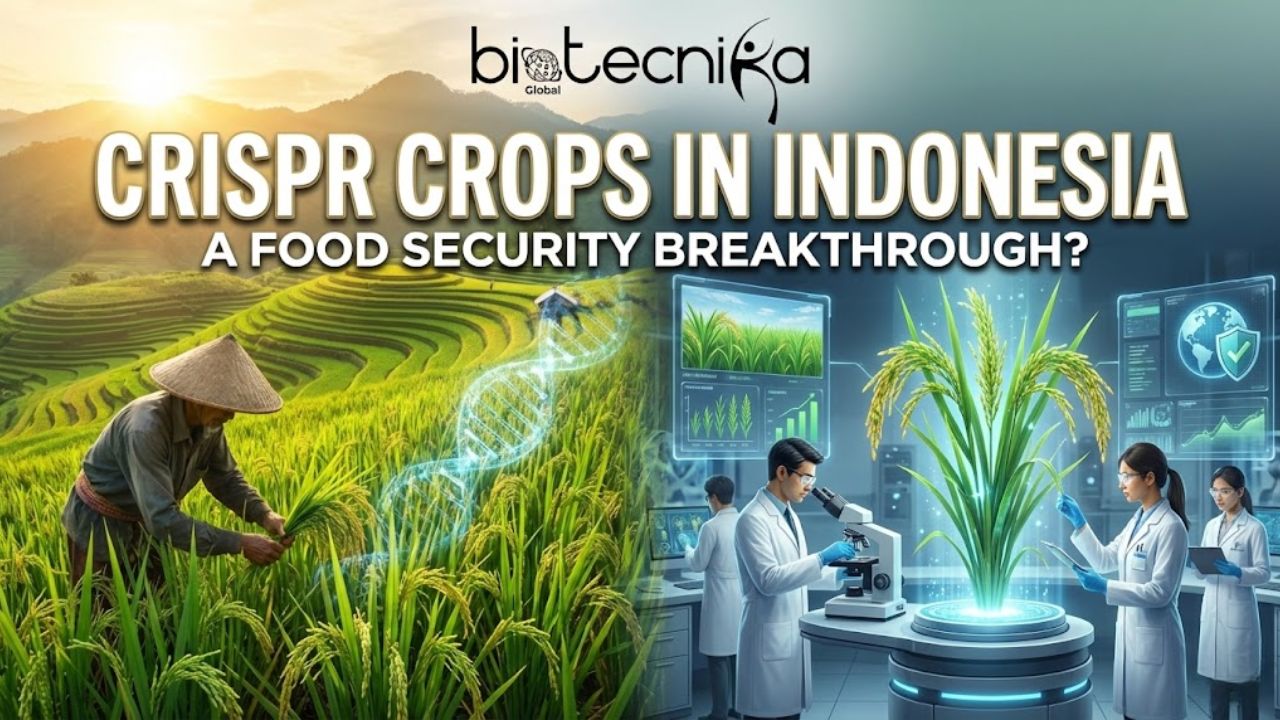
CRISPR Crops in Indonesia
All farmers depend on the local seeds, experience, and willpower to feed their families and their nation. Like other developing countries, Indonesia is also facing challenges in feeding its growing population while preserving its rich biodiversity. Food Security in Indonesia could be provided by CRISPR-based gene-editing technology. But can technology alone fix the problems that lasted for many years?
There are two urgent needs in Indonesia. One is Food security for the growing population. The other is the responsibility of protecting its biodiversity. This supports millions of small farmers who are the backbone of agriculture. Unpredictable weather, climate changes, and pests are making this balance harder.
CRISPR is one of the most promising biotechnological tools for gene editing. The researchers believe that this technology can improve the conditions of staple crops such as rice, cassava, and corn. This technology can make them more resistant to disease, drought, and poor soil conditions.
CRISPR works by making small and minor changes within the DNA of any organism. No foreign genes are added, unlike other gene editing techniques. CRISPR gene editing makes crops healthier, develops faster, and is more acceptable to consumers. Indonesia imports large amounts of corn and soybeans for food and animal feed. This CRISPR technology could reduce the dependence on global markets and improve National Food Security in Indonesia.
Past experience with genetically modified crops still influences public opinion in Indonesia. Bt Cotton was introduced but later withdrawn after the regulatory challenges and limited land access in the early 2000s.
Genetically modified crops vanished from commercial farming for nearly two decades, apart from small government organizations. The regulatory bodies have approved several genetically modified crops, including corn, potatoes, and sugarcane, since 2021. CRISPR-edited sorghum and rice are now being researched in institutions. The progress looks promising on paper. But in reality, many farmers and consumers are still not sure what this technology means for them.
A 2024 study involving farmers, researchers, NGOs, and consumer groups revealed an important truth in Indonesia. Food Security cannot be solved alone by technology. CRISPR can only improve crop yields. This does not address issues such as land ownership, limited access to funding, or unstable markets.
Many farmers lack clear information about gene editing. This lack of understanding and knowledge creates fear and mistrust among farmers and consumers. Some farmers worry that powerful and huge companies could control seeds. This turns the farmers into dependent buyers.
Seed Patents also have some concerns. There is a fear among the farmer unions that local seeds could be developed in laboratories, patented, and sold back to communities.
The innovations and ideas that often stay in laboratories are among the strongest messages we could take away from the study. The researchers develop solutions, while social and ethical questions are discussed later.
Food is deeply personal and is shaped by culture, economics, and social factors. Women farmers play an important role in the agriculture and food systems. They can grow crops, cook food, and make household decisions. It is very important to consider their voices for the development of technologies.
CRISPR has significant potential to support Food Security in Indonesia, but only when it is introduced carefully. Past mistakes can be repeated if the “technology first, consultation later” approach remains the same.
Awareness and community engagement are as important as investing in research laboratories. Farmers need better knowledge and understanding of CRISPR. Consumers deserve to know what ends up on their plates at the end of the day. CRISPR becomes a powerful tool when combined with social inclusion, clear regulation, and respect for local knowledge.
The path forward depends on aligning the scientific innovation with the real lives of farmers and communities in Indonesia. Gene editing can shape the future of a sustainable and cultural food system only when CRISPR and FOOD SECURITY grow together.