


Environmental DNA in the air is revealing hidden biodiversity and reshaping ecosystem monitoring
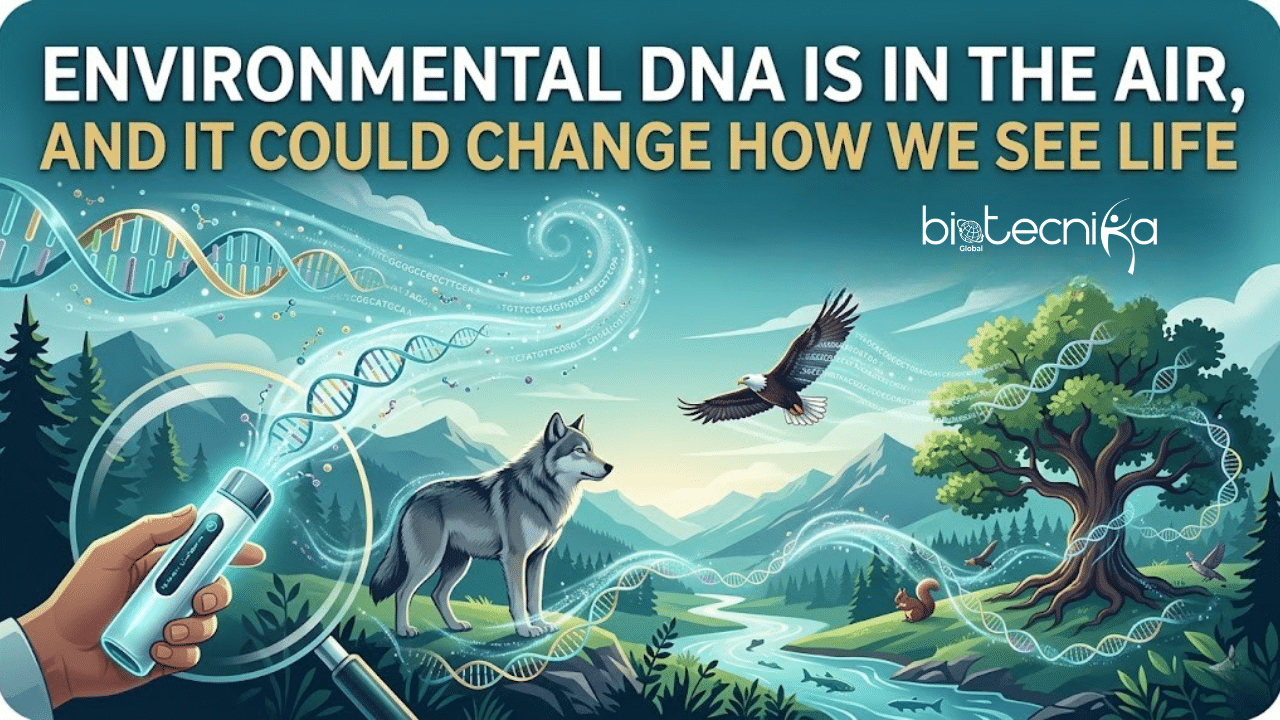
Environmental DNA is all around us, even in the air we breathe. Step outside, take a breath, brush your hair, and you release a faint Biological signature into the atmosphere. But it doesn’t disappear; it persists, floats, and becomes mingled with those of things all around you: plants giving off their pollen, animals losing skin and fur, invisible microbes traveling through the air. These DNA fragments can remain suspended for several days, often attaching to dust particles, and may travel from just a few meters to several kilometers depending on wind patterns. Scientists are looking at this phenomenon with new eyes, recognizing it as the active presence of a Biological history.
“It’s completely mind-blowing,” says Ryan Kelly, an eDNA specialist at the University of Washington. “We’re always surrounded by information in terms of DNA and RNA.”
From Empty Space to a Biological Signal
Scientists have been studying ecosystems using DNA in soil, water, and even snow for a while now. But air always seemed like an impossible target because of its complexity and chaos.
This is beginning to change now with Airborne or Environmental DNA.
All of our activities, including breathing, walking, and sloughing off dead skin cells, can leave us depositing DNA into the air around us. The DNA in the air is derived from viruses, fungi, plants, bacteria, as well as many other sources. Sometimes, the DNA gets caught up with dust and ends up traveling distances that range anywhere from a couple of meters to hundreds and even thousands of kilometers.
In some cases, these fragments include long stretches of genetic material, sometimes tens of thousands of base pairs, making them rich sources of Biological information.
In early studies of Airborne DNA, Scientists who had expected meager results were surprised by the abundance of organisms found in these air samples.
But then came a discovery that brought the full potential of air sampling into the light.
Air samples taken at a Zoo in the UK (United Kingdom) showed DNA from tigers more than 200 meters away from where the samples were taken, along with DNA from many different animal species, their food, and local animals such as squirrels and hedgehogs.
In total, researchers identified DNA from more than 25 species, including both captive animals and surrounding wildlife. The conclusion was very clear: air not only carries DNA but also Ecological information.
A Wider, Less Biased View of Life
Since those early studies, researchers have begun scaling up.
In the UK, Scientists used an existing network of air-monitoring stations to carry out what they describe as the first nationwide Biodiversity survey using Airborne DNA. The results revealed more than 1,000 different taxa, ranging from mammals and birds to fungi, plants, and even single-celled protists.
What stood out was not just the number, but the difference in perspective.
When compared with large citizen Science databases such as iNaturalist, the contrast became clear. Traditional observations tend to capture visible, charismatic species, birds, mammals, and larger plants, often near human activity. Airborne DNA, on the other hand, picked up what is usually missed: fungi, invertebrates, lichens, and other small or nocturnal organisms.
Interestingly, comparisons showed that citizen science databases missed nearly half of the species detected through Airborne DNA, while airborne methods failed to capture around 40% of visually observed species, highlighting how the two approaches complement each other.
These less visible groups are often the backbone of ecosystem function.
In that sense, Airborne DNA doesn’t replace existing methods; it complements them, filling in critical gaps.
Turning Environmental DNA or Airborne DNA Into an Ecological Archive
In Sweden, Scientists have taken the idea further , not just sampling the present, but looking into the past.
Air filters collected over decades as part of a radionuclide monitoring program, originally designed to detect nuclear activity, have been reanalyzed using modern sequencing approaches. Instead of focusing only on short DNA markers (a method known as metabarcoding), some researchers have used shotgun sequencing, which captures a broader and more detailed Genetic picture.
The results were striking.
DNA from plants, animals, microbes, and even parasites was found preserved in these filters, creating a timeline of Ecological change. Researchers have been able to track shifts in plant populations linked to forestry practices, as well as broader changes tied to climate and environmental pressures.
What was once routine monitoring has quietly become a long-term Biodiversity record.
Real-World Applications Are Taking Shape
The practical potential of Airborne DNA is now drawing attention across multiple fields.
Conservationists see it as a way to monitor species, including rare or elusive ones, without direct observation. Governments could use it to detect invasive species early, when intervention is still possible.
In Agriculture, researchers are developing systems to identify crop pathogens before visible symptoms appear, potentially allowing for more targeted and reduced pesticide use.
There is also growing interest in public health and Biosecurity. New Technologies are being designed to continuously sample air and analyze it for pathogens or even unknown Biological threats, offering a broad, real-time snapshot rather than searching for a single known target.
The appeal lies in that breadth. One system, many insights. Some emerging systems aim to process this data in near real time, combining field sampling with cloud-based analysis.
Interpreting The Environmental DNA as a Moving Target
Still, Airborne DNA is not easy to interpret.
One of the biggest challenges is understanding where the DNA actually comes from. Air currents can carry genetic material over long distances, making it difficult to link a signal to a specific location.
In one case, researchers detected marine fish DNA in a forest sample more than 100 kilometers from the sea, likely transported by strong winds.
There are other open questions, too. How long does DNA remain detectable in the air? In what condition does it persist? How many samples are needed to accurately represent an ecosystem?
These uncertainties don’t limit the potential, but they do demand caution. Scientists are now focusing on four key questions: how DNA enters the air, what physical state it exists in, how long it persists, and how it is transported across environments.
The Ethics of What We Breathe Out
Alongside technical challenges, Air or Environmental DNA is raising deeper ethical questions, especially regarding human Genetic material.
People constantly release DNA into the environment. As a result, air samples often contain human Genetic traces. In some studies, even limited analysis has revealed information about ancestry or genetic traits.
That raises an uncomfortable question: if our DNA is freely circulating in the air, what does that mean for privacy?
“If breathing is putting your DNA out into the air, how does that bump up against how we think of privacy?” Kelly has asked.
Some researchers are now calling for clear global guidelines, and even temporary restrictions, on the analysis of human DNA from environmental samples until Ethical frameworks are properly established. Some researchers have even called for a temporary global moratorium on studying human DNA from environmental samples until clear guidelines are in place.
The concern is not just misuse, but trust. Without it, even the most promising tools can face resistance.
At the same time, Forensic Scientists are exploring whether Airborne DNA could help identify individuals in enclosed spaces, offering a new tool for investigations, although with clear limitations and Ethical concerns.
A New Way of Seeing the Living World
The study of Airborne DNA remains a relatively new Science. There are issues that need further Environmental DNA investigation, and many questions to be answered. However, its promise cannot be ignored.
It provides an opportunity to study life on a scale that was simply unimaginable before; both the macroscopic and the microscopic, the visible and the invisible, the current and even the historical.
Our atmosphere has never been empty. We are just scratching the surface in discovering what lies there and what it has to reveal to us.