


Choosing between microbiology and biotechnology careers can be confusing for many students and freshers in life sciences. Both fields offer exciting opportunities, but they differ in scope, job roles, and global demand.
Microbiology majorly is about studying microorganisms such as viruses, fungi and bacteria. On the other hand, biotechnology applies biological knowledge to develop products and technologies that improve human life. With the rapid growth of the global biotech industry, students often wonder which field offers better career opportunities abroad.
In this article, we will compare microbiology vs biotechnology careers in terms of scope, salary, job roles, and global demand to help you make the right choice.
What is Microbiology?
Microbiology is a very interesting subject when it comes to studying microbiology. It is a scientific study of microorganisms that include bacteria, fungi, archaea, viruses, and protozoa. This field investigates their structure, function, ecology, genetics etc.
Microbiology is the study of microscopic organisms that affect humans, animals, plants, and the environment. It plays a crucial role in healthcare, food safety, and environmental sustainability.
The important aspects of microbiology are mentioned below:
- Study of microbes: these include unicellular and multicellular microorganisms like fungi, bacteria, viruses, algae and protozoa.
- Significance: the microbes are very essential for life. They aid in decomposition, nutrient cycling. Biotechnology, food production like cheese, yogurt etc.
- Applications: Microbiology helps in developing vaccines, diagnostic tools, antibiotics, and as well as advancements in environmental cleanup or bioremediation.
There are some main branches of microbiology that include:
- Medical microbiology: This branch includes studying about disease-causing microorganisms
- Environmental microbiology: Studies the importance of microbes in ecosystems.
- Industrial microbiology: This uses microbes for producing goods like fuel, food and pharmaceuticals.
- Microbial Genetics & Physiology: This area involves studying the molecular levels of microbial cells.
This field is very essential for understanding the oldest forms of life that dates back to around 3 billion years ago, and this field continues to be important for understanding and solving modern health challenges.
What is Biotechnology?
Biotechnology is a broader field when compared with microbiology as it uses biological systems and organisms to develop new advanced technologies and products that improve human lives and environmental health.
It combines natural sciences(biology, chemistry) with engineering to modify organisms for practical applications, like medicine, agriculture, and industry.
Key areas in biotechnology include:
- Genetic engineering: The field is related to gene editing using CRISPR-Cas9 and much more.
- Bioinformatics: a field that uses computer technology, mathematics, and statistics to collect, store, analyze and interpret data like DNA, RNA, and protein sequences.
- Pharmaceutical biotechnology: this field combines biological techniques with pharmaceutical science to develop and formulate drugs using living organisms.
- Agricultural biotechnology: This field helps in creating pest-resistant crops, enhancing food quality, and improving yields.
Key Differences: Microbiology vs Biotechnology
Understanding the difference between microbiology and biotechnology is important before choosing a career path.
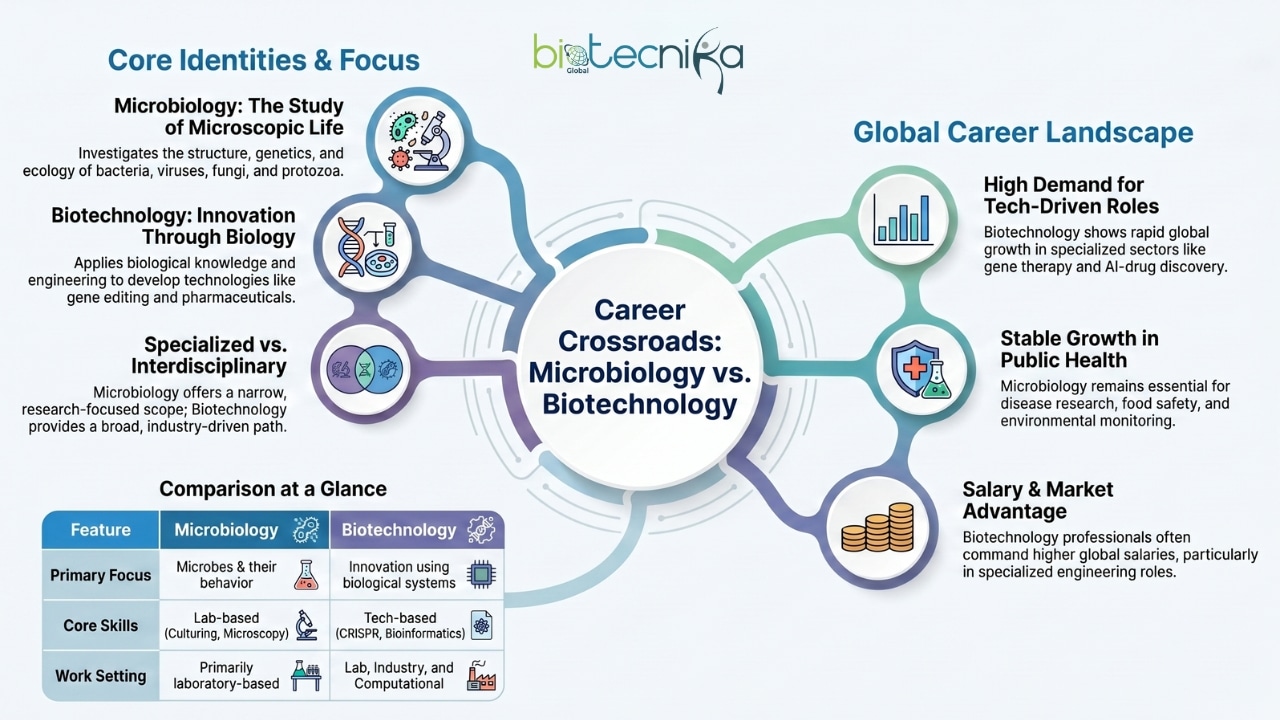
- Focus: Microbiology studies microorganisms, while biotechnology applies biology for innovation.
- Scope: Biotechnology has a broader scope with multiple industries involved.
- Skills: Microbiology focuses on lab-based skills, whereas biotechnology requires both lab and computational skills.
- Career Orientation: Microbiology is more research-focused, while biotechnology is both research and industry-driven.
In short, microbiology is more specialized, while biotechnology is more interdisciplinary.
Microbiology vs Biotechnology Careers: Quick Comparison
Here is a quick comparison of microbiology vs biotechnology careers to help you decide:
| Parameter | Microbiology Careers | Biotechnology Careers |
| Definition | Study of microorganisms like bacteria, viruses, fungi | Application of biology to develop technologies and products |
| Scope | Narrow and specialized | Broad and interdisciplinary |
| Focus Area | Microorganisms and their behavior | Innovation using biological systems |
| Core Skills | Microbial culturing, microscopy, lab techniques | Molecular biology, gene editing, bioinformatics |
| Technology Use | Limited to lab-based tools | High use of advanced technologies like CRISPR-Cas9 and AI |
| Career Options | Microbiologist, Clinical Microbiologist, QC Analyst | Biotechnologist, Genetic Engineer, Bioinformatics Scientist |
| Industries | Healthcare, food industry, environmental labs | Pharma, biotech companies, research labs, agriculture |
| Salary (Global) | Moderate to good | High, especially in specialized roles |
| Global Demand | Stable demand in healthcare and research | Rapidly growing demand worldwide |
| Work Environment | Mostly laboratory-based | Lab + industry + computational environments |
| Future Scope | Strong in disease research and public health | Very high due to innovation in gene therapy and personalized medicine |
| Best For | Students interested in research and microbiology labs | Students interested in innovation, technology, and high-growth careers |
Career Opportunities in Microbiology
Microbiology offers stable career options, especially in healthcare and research.
Top Job Roles
- Microbiologist
- Clinical microbiologist
- Quality control analyst
- Research scientist
These roles are essential for disease diagnosis, food safety, and environmental monitoring.
Industry Opportunities Abroad
| Sector | Top Global Organizations | Key Opportunities |
| Pharmaceuticals / Biotech | Pfizer, Novartis, Roche, Moderna | Research & Development (R&D), drug discovery, clinical trials, regulatory affairs |
| Food & Beverage Industry | Nestlé, Unilever, PepsiCo | Food safety, quality assurance, product innovation, regulatory compliance |
| Healthcare Sector | Mayo Clinic, Cleveland Clinic, National Health Service | Clinical diagnostics, microbiology labs, infection control, translational research |
| Public Sector / Research | National Institutes of Health, Max Planck Society, European Molecular Biology Laboratory | Government-funded research, postdoctoral roles, fellowships, international collaborations |
| Emerging Sectors | Startups in AI-driven biotech, gene editing, personalized medicine, and sustainable biotech | Innovation roles, startup careers, interdisciplinary research, product development |
Career Opportunities in Biotechnology
Biotechnology offers diverse and high-growth career opportunities, especially in global markets like, agriculture, healthcare, pharmaceuticals, and environmental sectors, that have significant demand for roles like Research Scientists, Clinical Research Associates, and Bioinformatics Specialists etc.
Top Job Roles
- Biotechnologist
- Bioinformatics scientist
- Genetic engineer
- Clinical research associate
Industries Hiring Biotech Professionals
- Pharmaceutical companies
- Biotech startups
- Research and development labs
- Healthcare and diagnostics
Leading Employers and Opportunities Abroad
| Category | Top Global Organizations / Sectors | Key Opportunities |
| Top Companies | Pfizer, Novartis, Roche, Thermo Fisher Scientific, Nestlé, GSK | Research & Development (R&D), clinical trials, quality control, regulatory affairs, manufacturing |
| Government / Research Labs | National Institutes of Health, Max Planck Society, European Molecular Biology Laboratory, UK Research and Innovation | Government-funded research, scientist roles, postdoctoral positions, international collaborations |
| Emerging Sectors | Startups focusing on AI-driven biotech, gene editing, personalized medicine, and sustainable biotech | Innovation roles, startup careers, product development, interdisciplinary research |
Salary Comparison: Microbiology vs Biotechnology
Microbiology Salaries
- Entry-level: Approximately ₹2.5 – ₹6.5 LPA
- Experienced roles: Good growth in clinical and research sectors
Biotechnology Salaries
- Entry-level: Competitive
- Experienced roles: High-paying, especially in specialized fields
Biotechnology professionals often earn higher salaries globally, especially in areas like genetic engineering and bioinformatics.
Global Scope & Demand
When comparing microbiology vs biotechnology careers, global scope is a key factor.
Biotechnology has a stronger global presence due to its role in innovation. Countries like the USA, UK, Germany, and Canada are investing heavily in biotech research.
Reports from OECD and World Economic Forum show that biotechnology is one of the fastest-growing sectors worldwide.
Microbiology also has global demand, especially in healthcare and disease control. However, its growth is more stable compared to biotechnology.
Skills Required in Both Fields
To succeed in either field, you need strong scientific and analytical skills.
Microbiology Skills
- Microbial culturing techniques
- Microscopy
- Laboratory analysis
Biotechnology Skills
- Molecular biology techniques
- Gene editing tools
- Bioinformatics and data analysis
Common Skills
- Critical thinking
- Problem-solving
- Research skills
Biotechnology often requires a broader skill set due to its interdisciplinary nature.
Which Career is Better for You?
Choosing between microbiology and biotechnology depends on your interests and career goals.
- If you enjoy working in labs and studying microorganisms – Microbiology is a better choice
- If you are interested in innovation, technology, and high-growth careers – Biotechnology is ideal
Students aiming for global careers and higher salaries often prefer biotechnology. However, microbiology remains a strong and stable career path.
Future Scope of Microbiology vs Biotechnology
Both fields have promising futures, but biotechnology is growing faster.
Microbiology is essential for tackling global challenges like antibiotic resistance and infectious diseases.
Biotechnology, on the other hand, is driving innovation in:
- Gene therapy
- Personalized medicine
- AI-driven drug discovery
Research published in Nature Medicine highlights the rapid advancements in biotechnology and healthcare.
Keynote
When comparing microbiology vs biotechnology careers, both fields offer valuable opportunities. However, biotechnology has a broader scope, higher salary potential, and stronger global demand.
Also, there is no one-size-fits-all answer. The best choice depends on your interests, skills, and long-term goals.
If you want stability and research-focused roles, microbiology is a great option.
If you aim for high-paying jobs and global opportunities, biotechnology may be the better choice.
Explore both fields, build your skills, and choose a career that aligns with your passion and future goals.