



QA & QC Careers in Biotech: Global Job Roles, Skills, and Salaries
Hey Youngminds! Did you just complete your degree and feel confused about what to do next? Don’t worry. This is a common problem every graduate faces. You are not alone. Many students, especially life science students, ask one question at this stage: “Where do I fit in this biotech industry?” Most of them think that research is the only option in biotechnology. But is it really the only path, or are there more exciting career paths waiting for you? If you are someone who likes structure, accuracy, and pays attention to details, then QA QC careers in biotech might be exactly what you are looking for.
Today, every medicine on the market has undergone strict quality checks before reaching patients. Behind this are the QA and QC professionals who make sure everything is safe, effective, and consistent. And do you know what the best part of this career is? You don’t need years of experience to get started. All you have to do is build the right skills and a strong educational background for a promising career.
You help you get a better understanding of the QA QA careers in biotech, here we are with a detailed article. We will talk about global job opportunities, the skills you need, and the salaries the industry is currently offering. So, let’s dive deep into this amazing career.
What are QA and QC in biotech?
Before you start building your career, let’s first understand what each of these career paths offers. We will also understand the difference between both of them.
Quality Assurance (QA)
Quality Assurance or QA is all about systems and processes. As a QA professional, you will have to make sure that everything is done the right way from the start.
Your tasks as a QA will be:
- To write and review SOPs (Standard Operating Procedures)
- You will have to check the batch records
- You have to handle deviations and investigations
- Also, you have to make sure the company follows the GMP rules
In simple words, as a QA professional, you will try to prevent mistakes before they happen.
Quality Control (QC)
If you want to build a career in Quality control, then your work will be mostly practical and lab-based. As a QC professional, you will test products to ensure they meet quality standards.
In a QC role, your tasks are:
- You will test raw materials and finished products
- You will be using instruments like HPLC, GC, and spectrophotometers
- Most of your work will be in labs
- After your work, you will have to prepare a test results report
As a QC professional, you will focus on finding mistakes after production.
QA vs QC Careers in Biotech
Many students get confused between QA and QC. Both are important, but the day-to-day work, skills, and career paths differ significantly. This table will help you clearly understand the differences between QA and QC careers in biotech.
| Feature | Quality Assurance (QA) | Quality Control (QC) |
| Main Focus | Focuses on processes and systems | Focuses on products and testing |
| Goal | Prevent errors before they happen | Detect errors after production |
| Nature of Work | Documentation, audits, compliance | Lab testing, sample analysis |
| Work Environment | Office, production floor, documentation rooms | Laboratory environment |
| Daily Tasks | Reviewing batch records, handling deviations, writing SOPs | Performing tests, recording results, and instrument handling |
| Involvement Stage | Involved throughout the entire process | Mostly involved after production or during testing stages |
| Key Responsibility | Ensure the company follows GMP and regulations | Ensure product meets quality standards |
| Tools Used | Documentation systems, audit tools | HPLC, GC, spectrophotometer, lab instruments |
| Skills Needed | GMP knowledge, attention to detail, and documentation skills | Analytical skills, lab techniques, and data accuracy |
| Interaction | Works with all departments (production, regulatory, QC) | Mostly works within lab teams |
| Pressure Type | Audit pressure, compliance deadlines | Test accuracy and result deadlines |
| Career Growth | QA Specialist → QA Manager → Head of Quality | QC Analyst → QC Scientist → QC Manager |
Why QA QC jobs in biotech are in high demand?
The biotech industry is growing rapidly worldwide. New vaccines, biologics, and biosimilars are being developed every year. At the same time, regulations are becoming stricter.
This creates huge demand for:
- Quality assurance jobs
- Quality control jobs
- Compliance and audit professionals
Countries like the USA, Germany, India, Singapore, and Ireland have strong biotech industries. That means there are plenty of global QA QC jobs in biotech. For students, this is good news. It means better job security and global opportunities.
Job roles in QA QC careers in biotech
Let’s break this down by experience level so you can clearly see your growth path.
Entry-level roles (Freshers)
If you are just starting out, you can apply for:
- QA Associate
- QC Analyst
- Microbiology Analyst
- Documentation Executive
These are typical biotech QA QC fresher jobs. In these roles, you will learn:
- GMP basics
- Lab testing
- Documentation
- How real biotech companies work
Mid-level roles
After 2 to 5 years of experience, you can move into:
- QA Specialist
- QC Scientist
- Validation Executive
- Compliance Officer
Here, you will start handling:
- Investigations
- Audits
- Process improvements
Senior roles
With more experience, you can become:
- QA Manager
- QC Manager
- Head of Quality
- Director of Quality
These roles involve decision-making, leadership, and regulatory interactions.
Biotech QA QC skills required
To succeed in QA QC careers in biotech, you need the right mix of technical and soft skills. Here is the list of both technical and soft skills.
Technical skills
-
Good Manufacturing Practices (GMP)
The most important skill is GMP in QA QC careers in biotech. This skill will help you ensure that biotech products are made safely and consistently. This will help you focus on quality, hygiene, proper processes, and following strict guidelines.
-
Good Laboratory Practices (GLP)
GLP is about maintaining quality and accuracy in lab testing and experiments. It ensures that results are reliable, traceable, and properly recorded.
-
Documentation and SOP writing
This involves writing clear step-by-step procedures for every task. It helps maintain consistency and ensures everyone follows the same process.
-
Lab techniques like HPLC, GC
These are tools used to test and analyze chemical and biological samples. They help check the purity, composition, and quality of products.
-
Data analysis
Data analysis means reviewing and interpreting results from tests and experiments. It helps identify errors and trends and ensures correct decision-making.
These are must-have biotech QA QC skills required for getting hired.
Soft skills
Many students ignore this part, but it is very important.
You need:
- Attention to detail
- Problem-solving ability
- Clear communication
- Teamwork
In QA and QC, even a small mistake can cause big problems. So being careful and focused is very important.
QA QC salary in biotech
Now let’s talk about something every student wants to know. Salary. The QA QC salary in biotech depends on your country, skills, and experience.
| Experience Level | USA Salary (Yearly) | India Salary (Yearly) | Europe Salary (Yearly) |
| Entry-Level | $50,000 – $70,000 | ₹2.5 – ₹5 LPA | €30,000 – €50,000 |
| Mid-Level | $70,000 – $95,000 | ₹5 – ₹12 LPA | €45,000 – €65,000 |
| Senior-Level | $100,000+ | ₹12 – ₹30 LPA | €70,000+ |
Salaries increase as you gain experience, especially if you move into audits, validation, or regulatory roles.
How to get QA QC jobs in biotech?
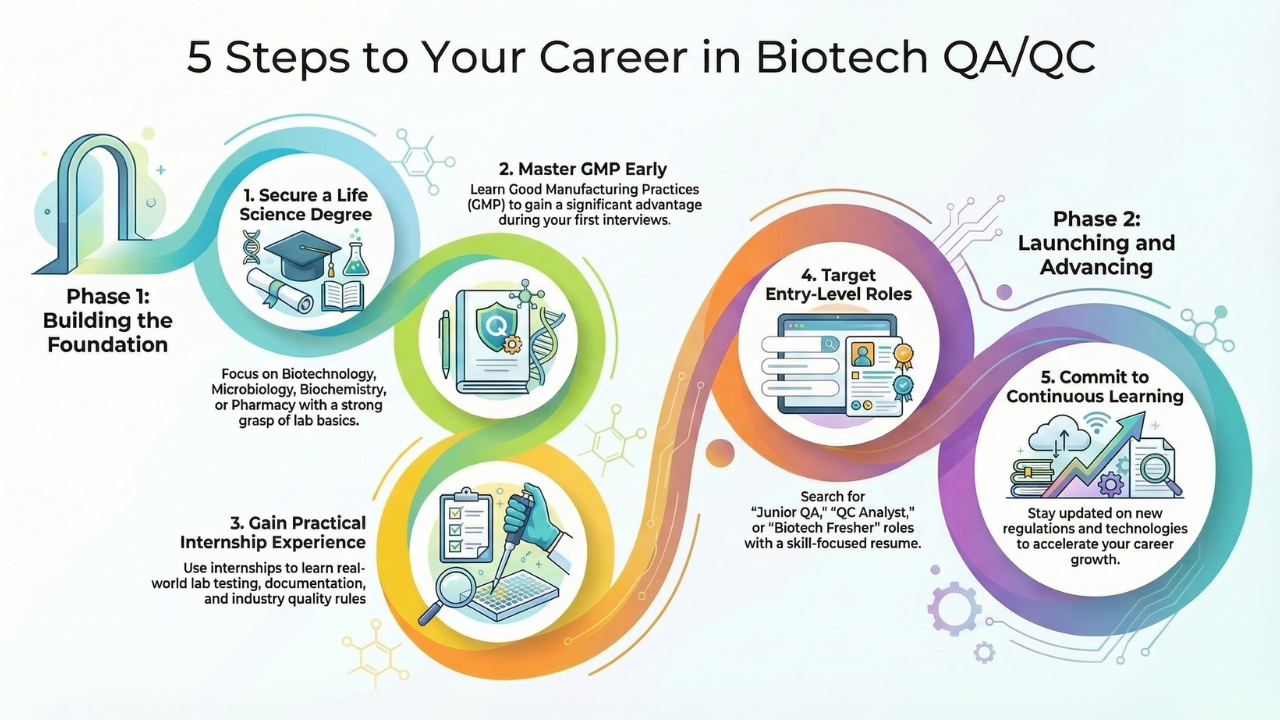
If you are serious about getting into QA QC careers in biotech, don’t worry, the path is actually quite clear. You just need to take it step by step. Let’s break it down in a simple way.
Step 1: Get the right degree
First things first, your degree matters. Most companies look for students from life science backgrounds.
The common degrees are:
- Biotechnology
- Microbiology
- Biochemistry
- Pharmacy
You don’t need to be from a top university, but you should understand the basics well. Focus on subjects like microbiology, lab techniques, and industrial processes. These will help you later in QA QC jobs in biotech.
Step 2: Learn GMP and basics
This is where many students fall behind. GMP (Good Manufacturing Practices) is very important in quality assurance and quality control jobs.
In simple words, GMP is a set of rules that companies follow to make safe and high-quality products.
Start early by:
- Watching simple GMP videos
- Reading basic notes
- Understanding how industries work
If you know GMP before your first interview, you already have an advantage over others.
Step 3: Do internships
Internships are a game-changer. You might have good marks, but companies want to see if you understand real work. Internships help you learn things that books cannot teach.
During internships, you will understand:
- How lab work actually happens
- How samples are tested
- How documentation is maintained
- How companies follow quality rules
Even a short internship can make a big difference when applying for biotech QA QC fresher jobs.
Step 4: Apply for fresher jobs
Once you have basic knowledge and some experience, start applying.
Search for:
- biotech QA QC fresher jobs
- Junior QA roles
- QC analyst roles
Don’t wait for the “perfect job.” Apply to multiple roles and keep learning from interviews. Also:
- Make a simple and clear resume
- Highlight your skills, such as GMP, lab techniques, and internships
- Be confident, even if you are a fresher
Step 5: Keep learning
This is very important. The biotech industry keeps changing. New rules, new technologies, and new methods are always coming.
So even after getting a job:
- Keep upgrading your skills
- Learn new techniques
- Understand regulations better
The more you learn, the faster you grow in QA QC careers in biotech.
Final tip
Don’t rush and don’t compare yourself with others. Everyone starts somewhere. If you stay consistent and keep improving, you will definitely find your place in this field.
Final thoughts
Starting your career can feel overwhelming, but choosing the right path makes a big difference. QA QC careers in biotech offer stability, global opportunities, and steady growth. You may begin with small tasks like documentation or testing, but over time, you build skills that are highly valued across the industry.
The journey is not about being perfect from day one. It is about learning, staying consistent, and improving step by step. Whether you aim for quality assurance jobs or quality control jobs, this field gives you a clear direction and long-term career security.
If you stay curious, keep upgrading your skills, and stay patient, there is a strong future waiting for you in biotech quality.