


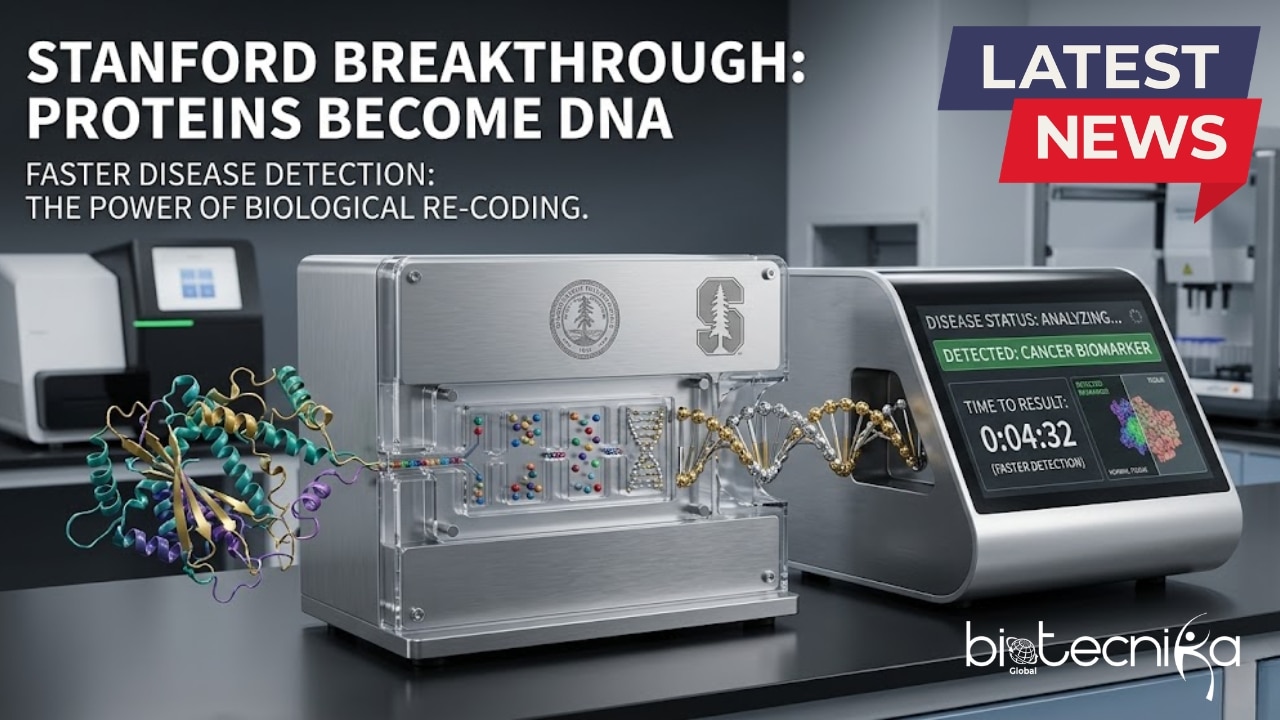
Stanford University Scientists have turned proteins into DNA to read them faster!
Stanford University scientists repurposed the DNA sequencing technology to read proteins at single-molecule resolution. They developed a new way to study proteins that could change how diseases are detected and also treated. The developed method is a “Reverse Translation” method that converts protein sequences into DNA, which allows DNA sequencers to identify individual molecules with extreme sensitivity.
Proteins are essential molecules in the human body. They control almost every biological process, from how cells function to how the immune system fights infections. But studying proteins has always been difficult. Unlike DNA, which can be copied and sequenced quickly, proteins are more complex and harder to decode.
The new method, reported by researchers and highlighted in sources like Stanford’s official report and coverage from The Analytical Scientist, solves this problem in a clever way. Scientists first convert proteins into a DNA-like format. Once in this form, they can use existing DNA sequencing tools to read them quickly and accurately.
A Professor of Bioengineering at Stanford University and a corresponding author Dr. Hyongsok Tom Soh said, “In nature, proteins are made from DNA. Over the past two decades, our society has created amazing technologies to sequence a lot of DNA really quickly and inexpensively,”. “But unfortunately, we haven’t really made similar progress for sequencing proteins.”
This approach is often described as “turning proteins into DNA to read them faster.” It allows researchers to study thousands, or even millions, of protein molecules at the same time. This is a big improvement compared to older methods, which were slower and could only handle smaller samples.
According to the Stanford University team, this breakthrough could have a major impact on healthcare. For example, it may help doctors detect diseases like cancer much earlier. Many diseases leave tiny protein signals in the body. With this new technology, those signals could be found faster and more reliably.
A Research Engineer at Stanford University and the first author of the study said in a press release “What really is different is how much from the same sample we can see”. “With mass spectrometry, you’re shooting 1 billion to 10 billion protein molecules and see, typically, a million molecules out of it. With our method, you can potentially see 1,000 times that amount.”
The method could also improve drug development. By understanding proteins better, scientists can design medicines that target diseases more precisely. This could lead to treatments that are more effective and have fewer side effects.
Another important benefit is sensitivity. The new technique can detect very small amounts of proteins, even in complex samples like blood. This makes it useful for early diagnosis, where detecting small changes can make a big difference in patient outcomes.
While the method is still being developed, experts believe it could soon be used in real-world applications. Hospitals and research labs may adopt this technology to improve testing and research.