



Neuroscience Research Careers have been grabbing a lot of attention, as the demand for brain research, mental health solutions, and neuroscience research careers are continuously growing.
Neuroscience is playing a critical role in modern science; be it from understanding how the brain works to developing treatments for neurological disorders.
Today, students and researchers are exploring neuroscience research careers not only in academia but also in industry, healthcare, and technology sectors. With increasing global investment, this field offers exciting job opportunities, competitive salaries, and access to cutting-edge research labs.
In this article, we will explore neuroscience research areas, careers, top global job roles, leading labs, salary trends, and how you can build a successful career in this field.
What Are Neuroscience Research Careers?
Neuroscience Research Careers focus on studying the structure and function of the brain and nervous system. This field combines biology, psychology, medicine, and technology to understand behavior, cognition, and neurological disorders.
Professionals in neuroscience research careers work in:
- Universities and academic labs
- Hospitals and clinical research centers
- Pharmaceutical and biotech companies
- Neurotechnology and AI-driven industries
These careers can be broadly divided into academic research and industry-based roles, depending on your interests and qualifications.
Top Neuroscience Research Career Options
Neuroscience Research Career roles usually focus on studying the nervous system to develop therapies, analyze brain data, or advance fundamental knowledge of brain function.
There are several exciting roles available in neuroscience research careers, which include roles like:
- Neuroscientist
Neuroscientists usually conduct experiments on the brain and nervous system to understand function or develop new treatments, often in university or biotech settings.
- Clinical Neuroscience Researcher
These professionals usually work on human patients or animal models to bridge the gap between research and clinical treatments, focusing on neurological diseases such as Alzheimer’s and Parkinson’s.
- Neuroinformatics Specialist
This role combines neuroscience with data science. Professionals analyze brain data using computational tools.
- Cognitive Neuroscientist
These professionals actually study the biological mechanisms underlying human cognition, like memory, attention, and decision-making.
- Neuropharmacologist
They mainly focus on developing drugs for neurological and psychiatric disorders.
- Brain-Computer Interface (BCI) Researcher
These researchers work on advanced technologies that connect the brain with machines, a rapidly growing field in neurotechnology.
Top Countries for Neuroscience Research Careers
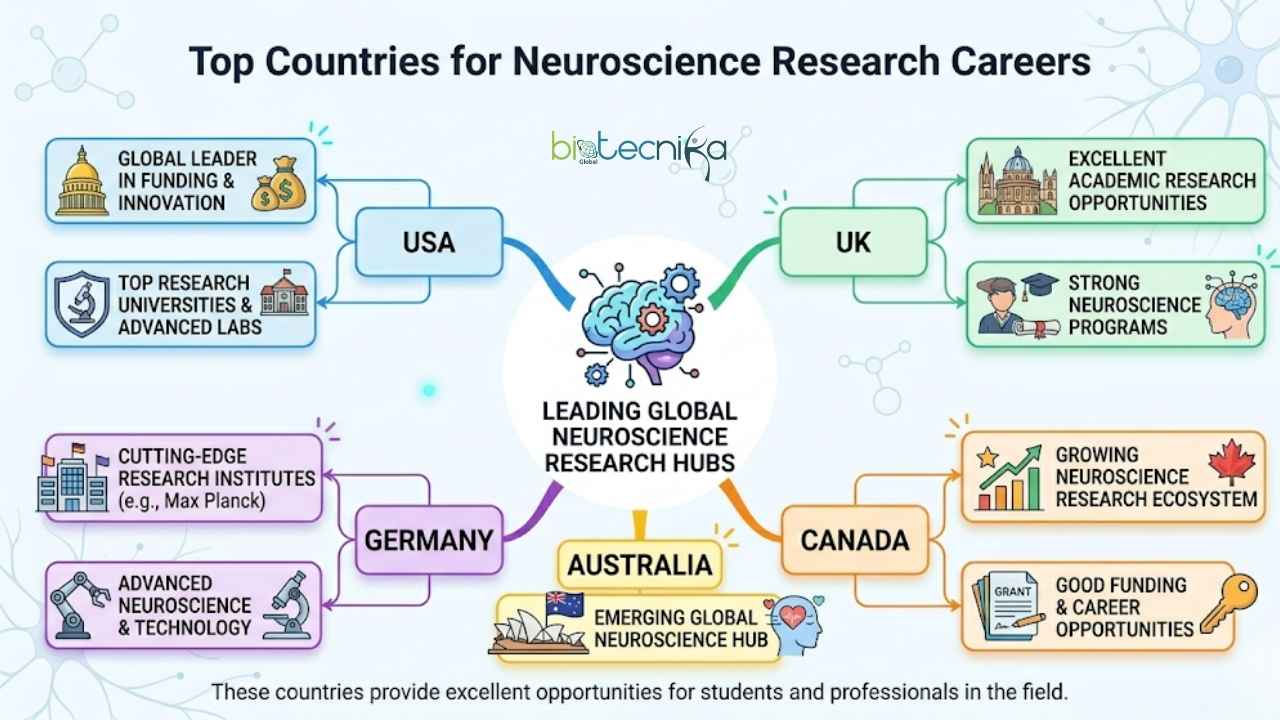
Neuroscience research job roles are highly global, with several countries leading in research and innovation.
USA
The USA is a global leader with strong funding, advanced labs, and top universities.
UK
The UK offers excellent academic research opportunities and strong neuroscience programs.
Germany
Germany is known for cutting-edge research institutes and advanced neuroscience labs.
Canada
Canada has a growing neuroscience research ecosystem with good funding and opportunities.
Australia
Australia is emerging as a hub for neuroscience and mental health research.
These countries provide excellent opportunities for students and professionals pursuing neuroscience research careers.
Leading Neuroscience Labs & Research Institutes
Working in top labs is a major advantage for those pursuing Neuroscience Research Careers.
Some globally recognized institutes include:
- National Institutes of Health – USA
- Max Planck Society – Germany
- Allen Institute for Brain Science – USA
- University College London – UK
| University | Country | Key Strengths | Why It’s Top for Neuroscience |
| Harvard University | USA | Brain research, clinical neuroscience | Strong funding, access to top hospitals and labs |
| Stanford University | USA | Neurotechnology, AI + neuroscience | Leading research in brain-computer interfaces |
| Massachusetts Institute of Technology | USA | Computational neuroscience | Cutting-edge research and innovation |
| University of Oxford | UK | Clinical and experimental neuroscience | World-renowned research output |
| University of Cambridge | UK | Cognitive neuroscience | Strong academic and research excellence |
| University College London | UK | Brain sciences and neurology | Leading neuroscience institutes |
| ETH Zurich | Switzerland | Neuroengineering, computational neuroscience | Advanced research facilities |
| Karolinska Institute | Sweden | Medical neuroscience | Known for Nobel Prize research |
| University of Toronto | Canada | Clinical neuroscience, mental health | Strong healthcare research ecosystem |
| University of Melbourne | Australia | Neuroscience and brain research | Emerging global research hub |
Salary Trends
Salary is an important factor when choosing a career.
Here is a general overview of salary trends:
- Entry-level roles: Moderate salaries
- Mid-level roles: Competitive growth
- Senior roles: High-paying, especially in industry
| Role | Average Salary (Global) | Growth Potential |
| Neuroscientist | Moderate to High | High |
| Clinical Researcher | Moderate to High | High |
| Neuroinformatics Specialist | High | Very High |
| Neuropharmacologist | High | High |
| BCI Researcher | Very High | Rapid Growth |
Skills Required for Neuroscience Research Careers
To succeed in neuroscience research, you must have a mix of technical and soft skills.
Technical Skills
- Brain imaging techniques (fMRI, EEG)
- Data analysis and statistics
- Programming (Python, MATLAB)
Soft Skills
- Critical thinking
- Problem-solving
- Communication and teamwork
How to Start a Career in Neuroscience Research
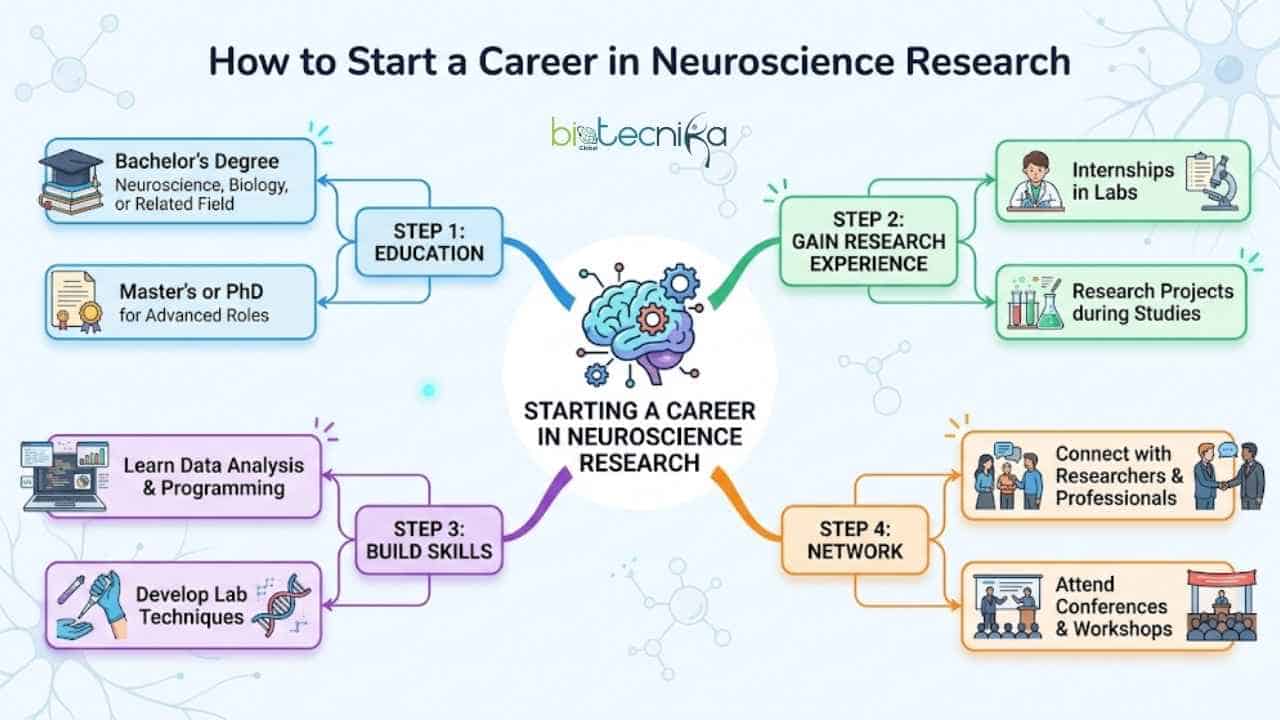
Starting a career in neuroscience research requires proper planning.
Step 1: Education
- Bachelor’s degree in neuroscience, biology, or related field
- Master’s or PhD for advanced roles
Step 2: Gain Research Experience
- Internships in labs
- Research projects during studies
Step 3: Build Skills
- Learn data analysis and programming
- Develop lab techniques
Step 4: Network
- Connect with researchers and professionals
- Attend conferences and workshops
Future Scope
The future of Neuroscience Research Careers is very promising.
Key growth areas include:
- Neurotechnology and brain-computer interfaces
- Mental health research
- AI integration in neuroscience
- Personalized medicine
As technology advances, the demand for neuroscience professionals will continue to grow globally.
Keynote
Neuroscience research careers offer exciting opportunities for students and researchers interested in understanding the human brain. With strong global demand, advanced research labs, and high-paying roles, this field is one of the most promising career options in life sciences.
Whether you are interested in research, healthcare, or technology, neuroscience has something for everyone.
Start building your skills, gain research experience, and explore global opportunities to succeed in neuroscience research careers.