


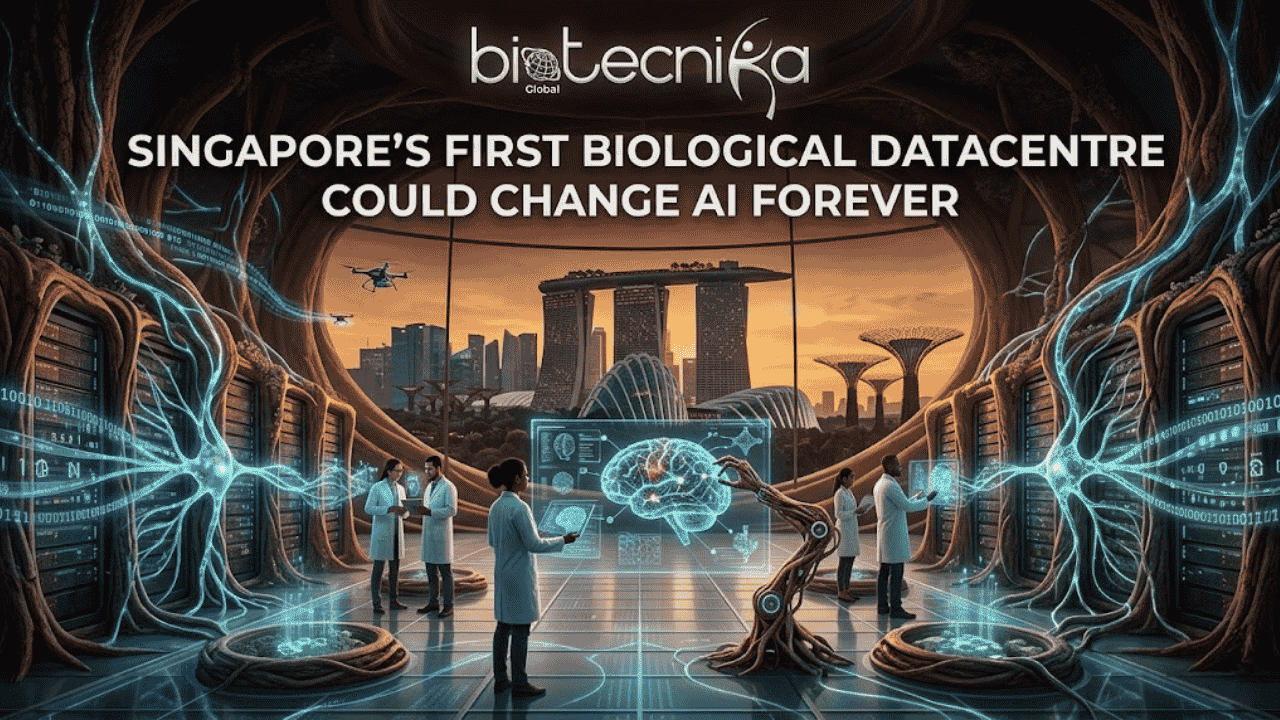
Singapore’s First Biological Data Centre Could Change AI Forever
What if the future of computing did not depend on thousands of silicon chips at all? What if it ran on the living cells? What if these machines relied on biological neurons grown from stem cells? This may look like some random thoughts or a stupid conversation. But what if I tell you they are about to become a reality? Yes, a reality that we have never imagined before. This sci-fi plot is coming to life as Singapore’s first biological data centre.
Until now, we have seen how the servers have been dependent on power-hungry silicon chips. But not anymore. Today, researchers have a much better solution to tackle this problem: “wetware”. These are biological neurons grown from the stem cells. Instead of relying on these high-power chips, we can process information and power AI workloads with just a fraction of the energy required by classical computers.
This project is made possible by DayOne, a Singapore-based global data centre provider, and Melbourne-based Cortical Labs, a biocomputing startup. These two giants are building Singapore’s first biological data centre.
The project will start off as a prototype at the Yong Loo Lin School of Medicine at the National University of Singapore (NUS Medicine). This prototype is built with the financial and strategic input from DayOne.
Another brain behind this innovative project is the Cortical Labs, which first grabbed global attention in 2022. With the DishBrain project, they successfully taught a network of 800,000 in vitro brain cells to play Pong within five minutes.
Singapore’s first biological data center became a topic of discussion in the biotech community when it caught the attention of Amazon chief technology officer Werner Vogels. Mr. Vogels highlighted how traditional computing relies on silicon chips and how biological intelligence can change the game. The biological cells can learn and adapt efficiently. They can reduce the unpredictability in their environment. And most importantly, they need very little energy and generate almost no heat.
The prototype will comprise a single rack of 20 cortical cloud units at NUS Medicine. Under Professor and Director of the neurobiology programme at the NUS Life Sciences Institute, Rickie Patani, the cells will be cultured and grown for testing. The team will test the system’s viability for the large, complex research activities.
Prof. Patani said that wetware systems can help researchers explore new approaches to learning, adapting, and building biological systems. The team of neurobiology research experts is working on understanding how to generate specific subtypes of clinically relevant human neurons and glia from stem cells. This will provide them with a strong foundation for translating the biological principles into biocomputing platforms.
He also highlights the importance of the project in drug discovery and research on neurological diseases. He adds that running experiments on the brain, such as biological networks, along with conventional computing, will help accelerate hypothesis testing. This will shorten the process from laboratory insights to real-world impact.
After validation by NUS, the live deployment will be conducted in the DayOne commercial data centre in Singapore. The wetware systems will then be tested with the real workloads. They will be tracked to understand compatibility with standard power distribution, environmental management systems, and cooling distribution. If this project is successful, then the partners will expand upto 1000 units deployed.
This initiative is even more important because global data center capacity is projected to reach 200 GW by 2030. Experts estimate that in Southeast Asia, capacity will increase from 2.6 GW in 2025 to 10.7 GW by 2035.
To address this issue, the Singapore government has implemented sustainable policies for the sector. They are planning to release atleast 200MW of new capacity with this first biological data centre roadmap.
Wetware offers an alternative computing model for sectors that wrestle with power availability and grid emissions.
CEO of DayOne, Jamie Khoo, said that Singapore is raising the bar of sustainable data center growth. The market is responding with new approaches. He also highlighted that by partnering with Cortical Labs, they can explore a new compute paradigm that complements Singapore’s and the region’s sustainability-led trajectory, supporting continued innovation while staying aligned with evolving efficiency and greener energy expectations.
Today, Singapore is writing a new chapter of digital infrastructure with sustainability at its core. As AI becomes a necessity across all sectors, there will soon be a high demand for energy. With this project, the world now has a practical solution to tackle this problem. With a sustainable pathway, the partners and policymakers aim to decouple compute growth.