

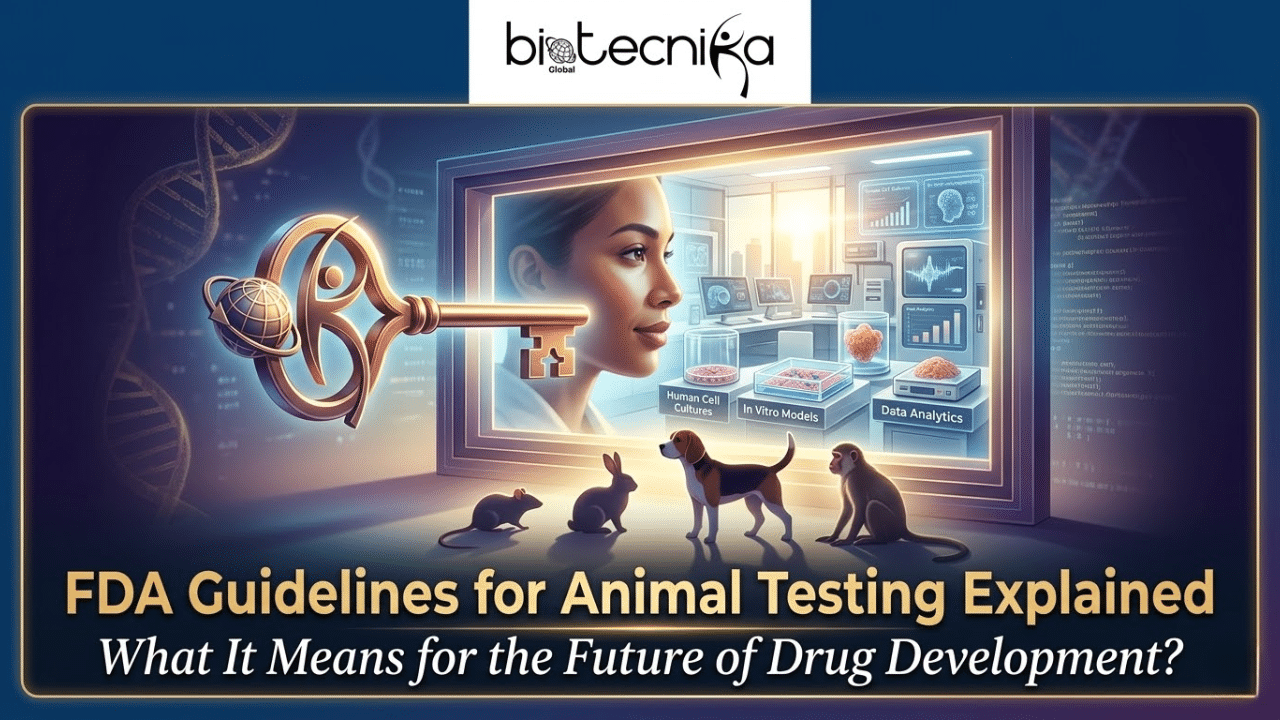
FDA Guidelines for Animal Testing Explained: What It Means for the Future of Drug Development?
For decades, scientists have been using animals as a part of their research. But now these lab rats may finally have a break. Yes, the new FDA Guidelines for Animal Testing have made heads turn in the scientific community. The life science world has now entered a new phase of research.
The US Food and Drug Administration has issued a draft guidance that will help in drug discovery. Now the drug developers have to validate new approach methodologies (NAMs) that can replace animal testing. This draft was built with the aim of bringing safer and more effective drugs to market faster using human-based data.
This is another major milestone by the FDA in reducing animal testing. This shows the agency’s commitment to a safer and modern approach. The agency is seriously planning to move away from using animals as the default way to check drug safety.
The draft guidance also explains how the Center for Drug Evaluation and Research (CDER) recommends validating new methods when companies submit non-animal data as part of a drug application or for certain over-the-counter drug approvals.
The HHS Secretary Robert F. Kennedy Jr. said that this draft guidance shows the agency’s commitment to move away from animal testing and use methods that are more relevant to human beings. He further adds that the clear rules will help these new tools gain trust and bring safer, more effective treatments to patients faster.
Under the FDA rules, the drug sponsors must provide nonclinical pharmacology and toxicology data before testing a drug on humans. In the past, this was mostly done with the help of animals. CDER also accepts data from new methods. But only if they are proven to be reliable and scientifically sound
FDA Commissioner Marty Makary said that new technologies are helping them move beyond animal testing in drug development. He also highlighted that the results of animal testing are not always accurate in predicting how a drug will work in the human body. He is confident that this guidance will make it easier to use modern alternatives in regulatory submissions.
NAMs include a range of modern testing methods. These can be lab studies using human cells, either in simple flat layers or more advanced 3D structures like mini-organs and organ-on-chip systems. They also include chemical tests, computer-based simulations, and studies using simpler organisms like zebrafish or tiny worms such as C. elegans.
In many cases, these newer methods are already showing better results than traditional animal models when it comes to predicting how drugs will work in humans. They can help spot harmful effects early, explain how a drug works, and make preclinical research more reliable. This can also improve safety before drugs move into human trials.
The draft guidance also sets out four basic rules for using these methods:
- Context of Use: Be clear about what the method is being used for
- Human Relevance: Show that the method reflects human biology
- Reliability: Prove that the results are consistent and trustworthy
- Fit for Purpose: Make sure the method is useful for regulatory decisions, like drug approval
In short, the FDA wants these new tools to be not just innovative, but also dependable and practical.
The guidance gives general advice on how to validate these new methods in drug development. However, it does not cover specific techniques or how they should be used for particular drugs. The FDA advises companies to speak with the right review team before using these methods, especially for specific diseases, organs, or treatment goals.
Acting CDER Director Tracy Beth Hoeg said that it is time for the FDA to move away from using animals to predict how drugs will work in humans. He adds that we should use human-focused models that can give more reliable, faster, and more ethical results before clinical trials.
The MAHA Commission had earlier recommended using more NAMs to reduce dependence on animal studies, which often fail to accurately reflect complex human conditions.
This announcement also builds on a draft guidance released in December 2025 that aimed to cut down testing on non-human primates for certain monoclonal antibody treatments.
Along with the NAMs draft guidance, the FDA has also updated its final guidance on pyrogen endotoxin testing to better explain its current approach.