


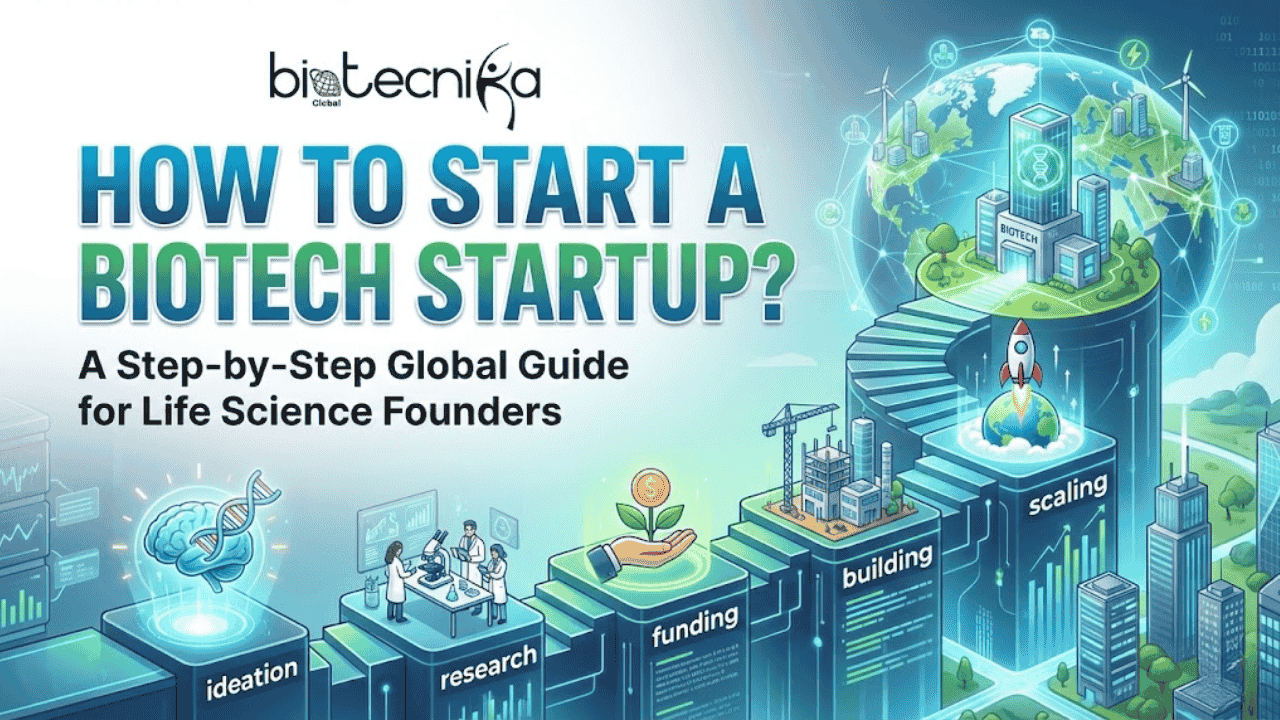
How to Start a Biotech Startup: A Step-by-Step Global Guide for Life Science Founders
As a biotech person, working in a lab, the world of startups may feel overwhelming. But what if your research could become more than just a lab experiment? What if it could help millions of people across the globe? Biotech professionals and students like you want to build a biotech startup. But they do not know where to start.
The idea of building a biotech startup can feel both exciting and scary. Well, many of us think that these startups are only for business experts or people with funds. But that’s not true. Today, some of the world’s most successful biotech companies are built by young minds like you. Can my science solve a real problem?
To help build a better future, here is a guide specifically written for you. If you are a student, researcher, or someone starting a career, this article will help you understand bioentrepreneurship. Don’t worry, it’s lecture notes or a high-end guide. Its a article that will give you a clear idea of how biotech startups are actually built, funded, and grown.
What Is a Biotech Startup and Why Is It Different?
In the simplest terms, a biotech startup is a science-based startup. These startups differ from the traditional ones that you have seen. They work on products such as drugs, diagnostics, vaccines, medical devices, industrial enzymes, and many other biological products.
With the scientific research and regulatory guidelines, these startups solve real problems. Usually, a biotech startup needs years of research and validation. Once it is completed, they seek regulatory approval from agencies such as the FDA, EMA, and other national regulators. When the founders obtain the required approvals and permissions, they raise funds to operate the business. Meanwhile, to strengthen the company’s position in the market, they filed for strong intellectual property protection.
According to Nature Biotechnology, most biotech companies take 7 to 12 years to reach the market, especially in drug development. This makes planning and execution even more important. Let’s build your startup step by step.
Step 1: Identify a Real Scientific and Market Problem
Remember that every successful startup starts with a real problem. It’s not just an interesting experiment that compels you to start a business. Many bio entrepreneurs make one common mistake. That is, they focus more on technology than on need. If you run a successful startup, you must understand the needs of your users. Because the investors, regulators, and partners care about the problems more than advancing technology.
How to Find the Right Problem?
If you are stuck on this question, here is a solution. You should ask yourself these questions:
- Who will use this product?
- What problem does it solve better than existing solutions?
- Is this problem urgent and expensive today?
Once you find the answers to these questions, your startup journey becomes easy. Good biotech startup ideas often come from everyday scientific and clinical experiences.
You might encounter challenges in a hospital where patients are not responding well to current treatments. You may encounter diagnostic tests that are slow, expensive, or not sufficiently accurate. Sometimes, the best ideas come from industry or lab work, where manufacturing processes waste time, money, or resources. Paying attention to these real-world gaps is often the first step toward building a meaningful biotech startup.
The NIH National Center for Advancing Translational Sciences (NCATS) states that there must be clear clinical or commercial relevance for an idea to transition successfully from the lab to market.
Step 2: Build the Right Founding Team and Advisors
Another startup mantra is to build the right team to make your startup successful. Because till now, no biotech startup has been built alone. And strongest biotech companies grow when they have a team where science, business, and regulatory knowledge come together.
Key Roles in Early Biotech Startups
| Role | Why It Matters |
| Scientific Founder | Drives research, credibility, and innovation |
| Business Lead | Handles strategy, fundraising, and partnerships |
| Regulatory Expert | Navigates FDA, EMA, and clinical rules |
| Advisors and KOLs | Add trust and industry insight |
You have an advisory team that includes clinicians, industry experts, patent attorneys, and former biotech founders. According to Harvard Business Review, biotech startups with experienced advisors raise funding faster than others. They also make fewer regulatory mistakes.
Step 3: Create a Strong Biotech Business Plan
Thinking about a biotech business plan can feel overwhelming. A simple way to break it down is by using the 4Ps of marketing. Product, Problem, Pathway, and Profit. This helps you explain your science in a way investors and partners understand.
1. Product: What Are You Building?
This is where you explain your science in simple terms.
- What is your technology or product?
- What data shows it works?
- Why is it better or different from what exists today?
Think of this as telling the story of your research without heavy jargon.
2. Problem: Who Needs It and Why?
Here, you describe the real-world need.
- What disease, challenge, or gap are you solving?
- Who will use this product?
- Why does this problem matter right now?
This helps show that your work is not just interesting science, but something people truly need.
3. Pathway: How Will You Get It to the Market?
This part explains the journey.
- What are your key development milestones?
- What approvals or regulations are involved?
- How will you protect your idea with patents or licenses?
Investors want to see that you understand the steps ahead, even if the path is long.
4. Profit: How Will the Startup Survive and Grow?
This section is about sustainability.
- How will the startup make money in the future?
- Will you partner with pharma, industry, or hospitals?
- How much funding is needed and when?
As a founder, you do need to perfect your numbers. You just need a clear, honest, and realistic plan. You can use frameworks from IndieBio, Y Combinator Bio, and McKinsey Life Sciences to reach a global audience.
Step 4: Protect Intellectual Property Early
To build a strong and successful business, you need to protect your business with Intellectual property. This is the backbone of every biotech startup. Without strong IP, it’s almost impossible to attract investors. You can have an IP for molecules, methods, or platforms. Apart from these, you can have IP for trade secrets, too.
The World Intellectual Property Organization (WIPO) recommends filing patents before public disclosure. If you are a student, you need to work closely with the technology transfer office to secure licensing rights early.
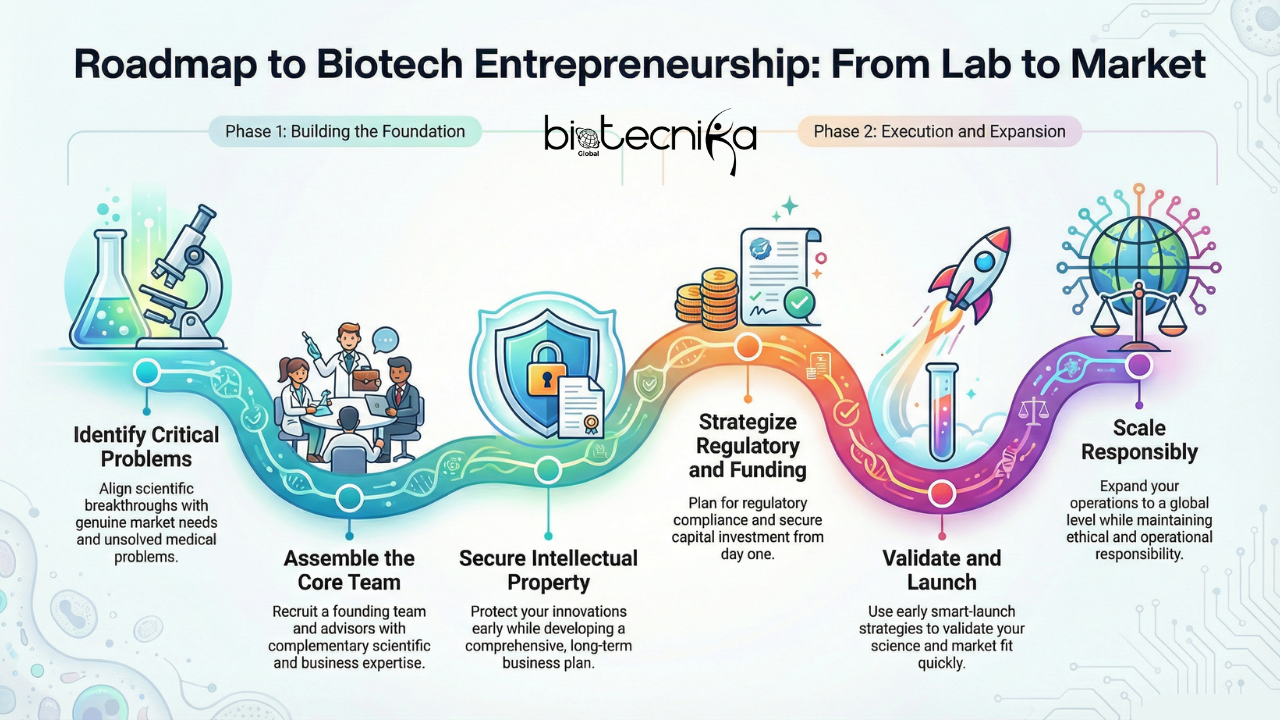
Step 5: Plan Regulatory Strategy from Day One
In the biotech industry, regulation is not just about a rulebook. It’s define future of your business. Every country has its own rules and regulations for biotech products. You should know about them from the beginning. It will save you time and money.
By planning early about these regulations, you can have a stress-free experience. With this knowledge, you can design experiments better and save yourself from expensive mistakes. It guides you towards the right clinical path from the start. Many first-time founders seek scientific advice from programs offered by the FDA and EMA.
Step 6: Understand Funding for Biotech Startups
Understanding funding for the biotech people can be difficult. But remember that funding in biotech differs from funding for software companies. Most of the biotech companies raise money through grants and investor funding.
Types of Biotech Funding Explained
| Funding Type | Examples | Best For |
| Non-dilutive | NIH, Horizon Europe, Innovate UK | Early research |
| Angels | Life science angels | Seed stage |
| Venture Capital | Biotech VCs | Clinical development |
| Corporate Partners | Pharma ventures | Scaling |
According to PitchBook and Crunchbase, global biotech investment remains strong despite market cycles, especially for platform technologies and rare disease startups.
Step 7: Launch Smart and Validate Early
When we talk about launching a biotech startup, it’s not just about putting your product on the market. It’s telling the world about your science and its impact. At the beginning, validation may seem small, but remember, it is meaningful. This may include proof-of-concept studies, early pilot studies, or work with CROs and pharma partners.
These partnerships at the start help a lot. They reduce risk, bring real-world experience, and build trust. The recent industry reports show that biotech startups with early partnerships have a much better chance of surviving and growing.
Step 8: Scale Globally and Responsibly
Most of the biotech startup is focused on scaling. You have to make sure that your startup grows carefully and not just quickly. Your product should be safer for the people. To build an international brand, you need to understand global compliance. These rules change from country to country. So, you have to align your startup with these rules.
Groups like the World Health Organization stress ethical innovation and fair access. For many startups, working with partners is the easiest and safest way to grow globally.
Common Mistakes First-Time Biotech Founders Make
In the world of startups, failure is inevitable. These failure is not because of your science. They are due to mistakes that founders make. As a first-time entrepreneur, you have to value time and money. Most founders delay in protecting their ideas, and ignore regulatory planning. These can cost your startup heavily. Along with these, many startups raise money without any clear goals. As an entrepreneur, you need to set goals and a vision for your startup. The experts says hat porr planning and execution cause more failures than bad science.
Final Thoughts: Building a Biotech Startup Is a Long Game
Always remember that building a startup is not just about being perfect or having all the answers. It’s about being curious, patient, and willing to learn. You have think beyond lab and experiments. Every successful founder has started where you are now. With millions of questions, doubts, and ideas, you may feel unfinished.
But you don’t have to rush. Take your time to understand the problems that really matter. Gain the required skills and knowledge. To gain more insight, meet people who share your vision. Learn how science connects with business, ethics, and society.
Starting a biotech startup is not about being perfect or having all the answers. It is about being curious, patient, and willing to learn beyond the lab. Every founder starts where you are now, with questions, doubts, and ideas that feel unfinished. Take every step with confidence and turn your dreams into reality.