


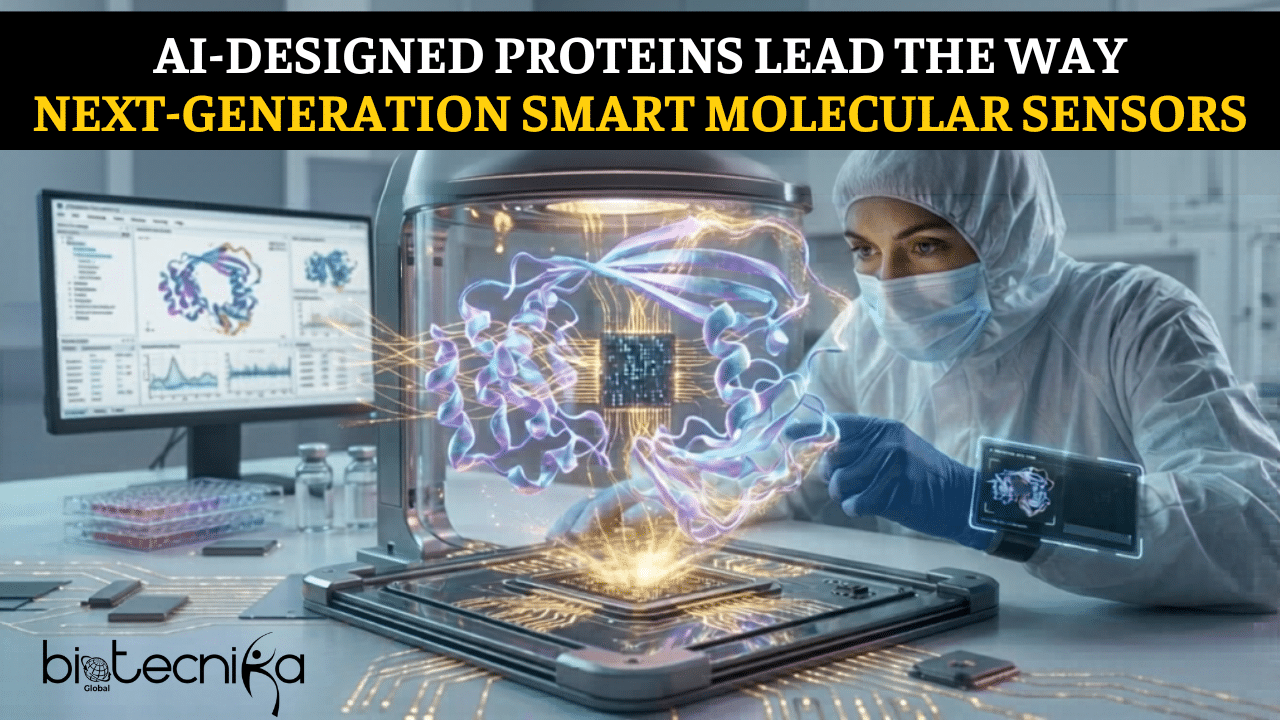
AI-Designed Proteins Lead the Way for Next-Generation Smart Molecular Sensors
A group of renowned global Scientists released a highly effective new method for creating smart sensor Technologies based on Artificial Intelligence or AI-created proteins. This represents an important and futuristic advancement in both Synthetic Biology and biosensing systems.
A novel Research study, published in the journal Nature Biotechnology, provides details on how these Scientists created “Allosteric protein switches,” engineered using machine learning for both the receptor design and the resulting switch protein design. These allosteric protein switches will respond only in the presence of their specific target, allowing for highly selective and adaptive smart sensors to be built and used.
The researchers from the Queensland University of Technology brought together several developments from the fields of Artificial Intelligence and Protein Engineering to eliminate one of the major limitations of these Technologies: the reliance on naturally occurring proteins.
From Natural Constraints to AI-Driven Smart SensorsDesign
Historically, Biological proteins that have already been developed have been modified by Scientists into sensing devices; therefore, the use of enzymes to develop sensing devices limits the diversity and flexibility of biosensors. However, recent studies have demonstrated that AI (Artificial Intelligence) can aid in the design of new Biological protein receptors that are incorporated into functional systems that act as smart sensors.
The Engineering of the mentioned proteins used nonspecific enzyme reactions to produce measurable signals (in this case, light, color, or electrical) that are associated with a number of other detection platforms (for example, Electrochemical Devices, such as glucose meters).
A New Class of Protein Switches & Smart Sensors
The foundation of the innovation in such studies is the application of allosteric regulation of the receptor protein. This allows a receptor protein to modulate its functional activity when a specific molecule binds to it at a specific binding site. Researchers demonstrated that AI-designed receptors could be immediately integrated into the design of these functional systems (such as molecular switches). This Research highlighted that in many of the designed molecular switch proteins, the receptor protein did not need to undergo gross structural rearrangements to function properly. Instead, the design of these proteins depended on relatively small dynamic changes within the receptor protein to activate the sensor systems. This has simplified and strengthened the design of smart sensors.
This insight not only improves Engineering approaches but also offers a new understanding of how natural proteins regulate activity at the molecular level.
Demonstrating Real-World Functionality Of Smart Sensors
The Research team successfully tested the advanced Technology across multiple scenarios. The AI-designed switches could successfully detect small molecules, peptides, as well as proteins, demonstrating their versatility as Smart Molecular Sensors.
In addition, the Researchers developed Electrochemical Biosensing Systems capable of detecting compounds such as steroids. These systems convert molecular detection into electrical signals, highlighting the potential for portable diagnostic tools powered by smart sensors.
Crucially, the Research also confirmed that these Engineered Protein Systems can function inside living bacterial cells. This represents an important step toward integrating smart sensors into living systems for real-time monitoring and response.
Broad Implications Across Industries
The development of AI-powered smart sensors could have far-reaching implications across multiple sectors. In Medicine, they may enable rapid and low-cost diagnostic devices capable of detecting diseases at early stages. In Environmental Science, they could be used to monitor pollutants and toxins with high precision.
Beyond detection, the Technology could support the creation of Engineered cells that respond intelligently to Chemical signals, opening new possibilities in Biotechnology and Synthetic Biology.
A Global Scientific Effort
The Research involved collaboration between multiple institutions across Australia, the United Kingdom, as well as the United States. Key contributors included the University of Washington, with involvement from renowned protein-design expert David Baker, and Australia’s National Science Agency or CSIRO (Commonwealth Scientific and Industrial Research Organization).
As AI continues to reshape Biological Research, this futuristic study highlights a significant transition, from modifying natural systems to designing them from first principles.
With the emergence of AI-Engineered protein switches, smart sensors are poised to become more accessible, precise, as well as customizable than ever before, bringing Science closer to a future where detection systems are not only responsive but truly intelligent.